

TL;DR:
- Proper eyewear fit ensures comfort, clear vision, and prevents headaches and eye strain.
- Trendy oversized frames often compromise fit, causing distortion and discomfort.
- Accurate measurements and virtual try-on tools help Australians find stylish, well-fitting glasses online.
Most Australians pick glasses the same way they pick shoes — they go straight for what looks good. But here’s the uncomfortable truth: the most striking frames on the shelf can quietly wreck your comfort and vision if they don’t fit your face correctly. Poor fit isn’t just an inconvenience. It can cause persistent headaches, blurred vision, and even accelerate lens distortion for anyone with a moderate to strong prescription. This guide walks you through the science of fit, how to spot a problem before it becomes chronic, and how to shop smart for eyewear that delivers both style and genuine comfort.
Table of Contents
- The science behind eyewear fit
- Fashion trends vs. functional fit
- Signs your eyewear doesn’t fit — and why it matters
- How Australians can find their best fit online
- Why Australians shouldn’t compromise on eyewear fit
- Discover eyewear made for you
- Frequently asked questions
Key Takeaways
| Point | Details |
|---|---|
| Fit first, style second | Choosing frames that fit properly protects your comfort and vision far more than focusing solely on trends. |
| Oversized risks | Trendy oversized frames can increase lens thickness and distortion, making fit especially important for optical clarity. |
| Watch for warning signs | Headaches, lens slippage, and red marks signal a poor fit and mean you should reassess your frames. |
| Smart shopping | Using virtual try-on tools, understanding measurements, and knowing return options help you buy eyewear that truly fits online. |
The science behind eyewear fit
Fit isn’t a vague concept in eyewear. It’s a precise relationship between your facial anatomy and the geometry of the frame. When that relationship is off, everything suffers — your comfort, your vision clarity, and even the longevity of the glasses themselves.
Frame size directly affects where the lenses sit in front of your eyes. The optical centre of each lens is ground to align with your pupil distance (PD) and the height of your pupil within the frame. When a frame is too wide or too tall, the optical centre shifts away from your pupil. The result? You’re looking through the wrong part of the lens, which introduces distortion and forces your eyes to work harder than they should.
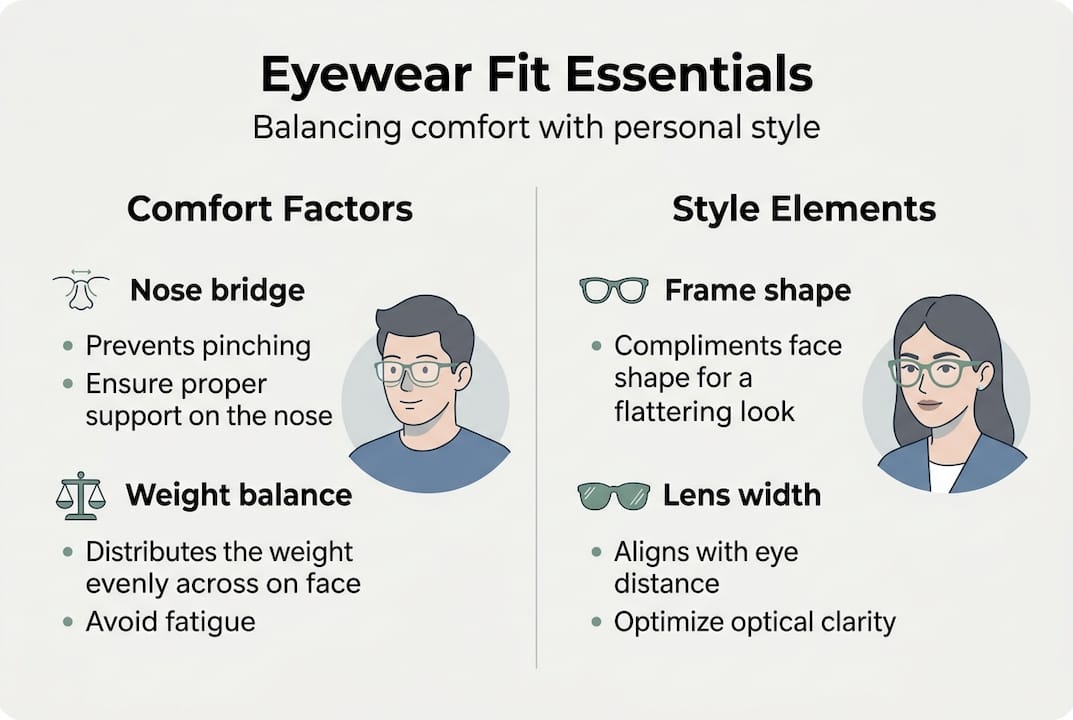
Weight is another underrated factor. Heavier frames press down on the bridge of your nose and can cause the glasses to slide forward throughout the day. Once they slide, the optical alignment breaks down completely. Oversized frames increase lens thickness, decentration, and distortion, especially for people with high prescriptions, adding unnecessary weight that contradicts optimal optics and comfort.
| Frame issue | Effect on vision | Effect on comfort |
|---|---|---|
| Too wide | Lens decentration, blurring | Slides off nose, ear pressure |
| Too narrow | Restricted field of view | Pinching at temples |
| Too heavy | Optical drift when sliding | Nose and ear fatigue |
| Incorrect bridge | Pupil misalignment | Redness, soreness |
Pro Tip: Ask your optician for your PD measurement before shopping online. This single number is the most important factor in matching a frame to your prescription accurately.
“The frame is not merely a fashion accessory — it is a precision instrument that must be matched to both the face and the prescription for optimal visual performance.” — 20/20 Magazine, optical industry publication
For those who struggle with frames that don’t stay put, flexible frames for comfort offer a practical solution, using spring hinges and lightweight materials to maintain consistent fit throughout the day.
Fashion trends vs. functional fit
Understanding the science of eyewear fit sets up an important question: how does this intersect with what’s actually fashionable?
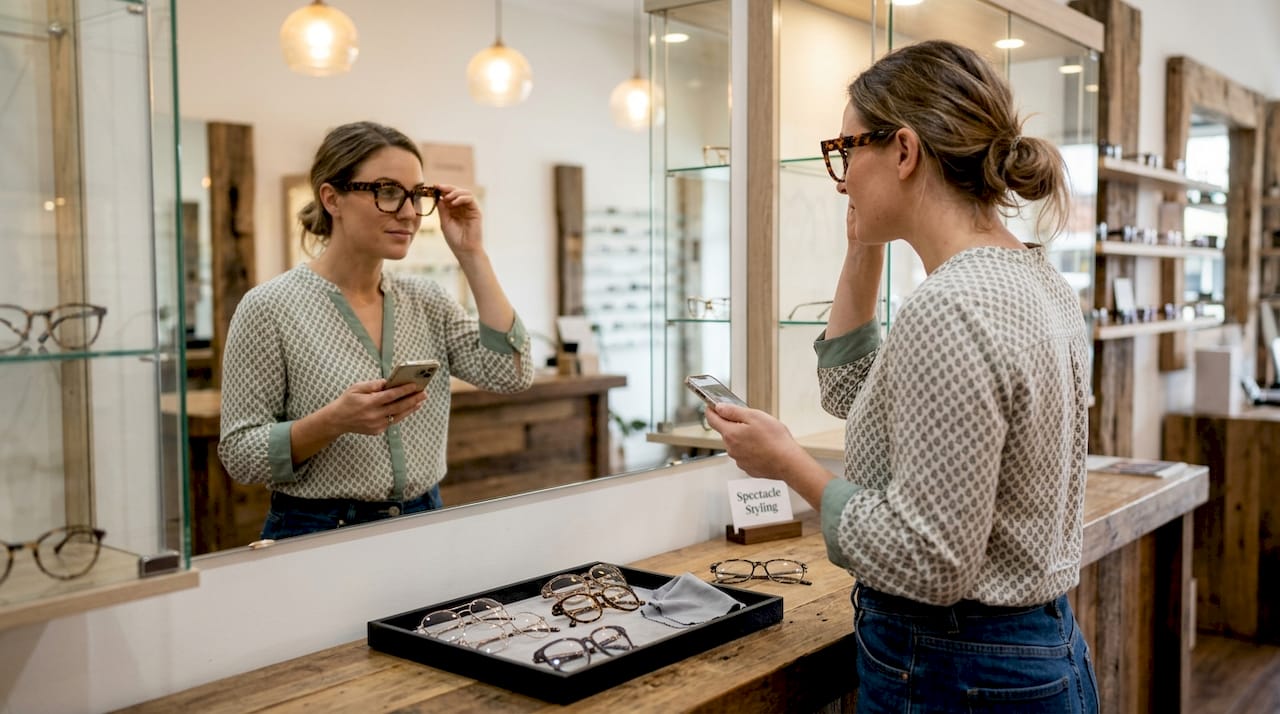
Oversized frames have dominated eyewear trends for several years. Bold, wide silhouettes photograph beautifully and project confidence. The problem is that what reads as stylish in a photo doesn’t always translate into a frame that works optically or physically for the person wearing it.
| Feature | Fashion-first frames | Functionally ideal fit |
|---|---|---|
| Lens size | Large, wide | Matched to PD and face width |
| Weight | Often heavier | Lightweight, balanced |
| Bridge fit | Decorative, variable | Snug, anatomically matched |
| Optical centre | May not align | Precisely aligned to pupil |
Fashionable oversized styles prioritise aesthetics over function, but for Australian consumers, balancing trend appeal with virtual try-on tools and professional measurement ensures you don’t have to sacrifice one for the other.
Virtual try-on technology has made this balance far more achievable. Tools like Fittingbox allow you to preview how a frame sits on your actual face shape using your phone camera, reducing the guesswork of online shopping significantly. Pair that with accurate measurements and you’ve got a reliable system.
Here are the warning signs your frames don’t fit well:
- The frame slides down your nose within minutes of putting it on
- The temples press into the sides of your head or behind your ears
- You tilt your head to see clearly through the lenses
- The frame leaves red marks on your nose after a few hours
- The lenses feel too close to your eyelashes or cheeks
If you’re exploring trendy glasses styles for 2026, it’s worth understanding how eyewear in fashion has evolved to include more fit-conscious designs. Brands are increasingly recognising that on-trend frame shapes can be engineered to flatter without compromising optical performance.
Signs your eyewear doesn’t fit — and why it matters
Knowing trends is only part of the equation. How do you spot a bad fit in everyday life?
The signs are often subtle at first, which is exactly why so many Australians persist with frames that are slowly making their daily life harder. Here’s what to watch for:
- Constant sliding — If your glasses drift down your nose repeatedly throughout the day, the bridge is too wide or the temples aren’t gripping properly.
- Headaches after extended wear — Pressure at the temples or behind the ears often causes tension headaches that people mistakenly attribute to screen time.
- Nose pad marks or soreness — Red indentations on the bridge of your nose signal that the nose pads are too tight or poorly positioned.
- Blurry or distorted vision — Particularly in your peripheral vision, this often means the optical centre is misaligned with your pupil.
- Frequent readjusting — If you’re constantly pushing your glasses back up or tilting them, the fit is working against you.
- Eye fatigue by midday — Your eyes are compensating for misaligned lenses, which is exhausting work they shouldn’t have to do.
The optical consequences are serious. Lens decentration and distortion increase significantly with oversized frames, particularly for higher prescriptions, meaning the visual quality you paid for in your lenses is being undermined by the frame holding them.
Research into precision fitting also highlights how even minor misalignments matter. Studies on contact lens fitting found that a sagittal depth difference of 120 to 280 micrometres represents the optimal fit range, illustrating just how sensitive the eye is to small deviations. The same sensitivity applies to spectacle frames.
Pro Tip: A small temple adjustment at your local optician takes less than five minutes and costs nothing. If your glasses are sliding, don’t wait. That one fix can completely change your daily experience.
Understanding fashion’s role in fit helps explain why so many people end up with frames that look great in the shop but feel uncomfortable within a week of regular use.
How Australians can find their best fit online
With fit and style issues identified, here’s how to make sure your next eyewear purchase actually feels and looks right.
Buying glasses online in Australia has never been easier, but it does require a bit more preparation than walking into a physical store. Here’s a practical checklist:
- Measure your pupillary distance (PD) — Use a ruler and mirror or ask your optician. This number is essential for prescription glasses.
- Know your frame measurements — Check the inside of your current frames for three numbers (lens width, bridge width, temple length). These are your baseline.
- Use virtual try-on tools — Professional measurement and virtual try-on together give you the best chance of a successful online purchase.
- Check the return policy — Reputable online eyewear retailers offer returns or exchanges if the fit isn’t right. Always confirm this before purchasing.
- Look for adjustment guides — Some retailers provide resources on minor at-home tweaks that can fine-tune the fit after delivery.
For Australians hunting for value, there are genuine stylish eyewear deals available online without sacrificing fit quality. Knowing your consumer rights in eyewear is also important — Australian Consumer Law gives you protections if a product doesn’t match its description or fails to meet acceptable quality standards.
For those shopping for functional reading glasses, fit is especially critical because reading glasses are worn for extended periods at close range, making even minor discomfort very noticeable very quickly.
Pro Tip: Order two or three frames in different sizes if a retailer offers a home try-on programme. Wearing them for a full day each is the only reliable way to know which one genuinely fits your lifestyle.
Why Australians shouldn’t compromise on eyewear fit
Here’s the contrarian view worth sitting with: the eyewear industry has done an exceptional job of making aesthetics the primary conversation. Walk into any optometrist or browse any online store and the first thing you encounter is style. Colour. Shape. Personality. Fit is often treated as an afterthought, something to sort out after you’ve already fallen in love with a frame.
This has caused more long-term discomfort for Australian wearers than almost any other factor. People persist with frames that hurt because they look good, and they quietly accept headaches and eye fatigue as normal. They’re not normal. They’re signals.
The good news is that most Australians can absolutely achieve both style and comfort. The frames exist. The tools to find them exist. It simply requires shifting the question from “does this look good?” to “does this work for me?” That’s not a sacrifice. That’s a smarter standard. The future of eyewear design is moving toward frames that are engineered for fit first, style second, and that’s a shift worth getting ahead of.
Discover eyewear made for you
If you’ve made it this far, you already understand something most eyewear shoppers don’t: fit is the foundation of a great pair of glasses. Style follows from there.
At Ministry of Sight, we make it easy to find frames that work for your face, your prescription, and your lifestyle. Explore our range of reading glasses accessories to keep your eyewear comfortable and in top condition. Want to know more about who we are and what drives our approach to eyewear? Visit our about Ministry of Sight page. With free shipping across Australia and a satisfaction guarantee, finding your best fit has never been more straightforward.
Frequently asked questions
How do I know if my glasses fit properly?
Properly fitting glasses rest comfortably on your nose and ears without sliding, pinching, or leaving marks. Your pupils should be centred in the lenses, as lens decentration causes distortion that undermines both comfort and vision quality.
Can I adjust my frames if they don’t fit perfectly?
Minor adjustments can often be made at home, but for best results, see an optical professional. Virtual try-on tools and professional fitting together offer the most reliable path to a frame that genuinely works.
What risks come with wearing badly fitted eyewear?
Ill-fitting glasses may cause headaches, blurred vision, and eye strain. Oversized frames increase decentration and distortion, which can worsen visual fatigue and compound prescription-related discomfort over time.
Are virtual try-on tools accurate for finding the right fit?
Virtual try-on tools are genuinely useful for assessing style and proportion, but professional measurement and physical comfort checks remain essential for confirming a precise, comfortable fit.
Recommended
- Enhance your style with the role of eyewear in fashion – MINISTRY OF SIGHT
- 7 essential eyewear accessories for style and function – MINISTRY OF SIGHT
- Stylish reading glasses checklist for perfect fit – MINISTRY OF SIGHT
- Role of Fashion in Eyewear: Complete Guide – MINISTRY OF SIGHT
Our Best Reading Glasses Australia guide covers frame quality, lenses, fit and the features worth considering before you buy.


