

Struggling to read the fine print on your favourite novels or labels at the shops is a familiar frustration once presbyopia sets in after 40. This shift in vision is common, but the right pair of reading glasses can restore clarity and comfort for all your close-up tasks. With countless stylish options and online deals available across Australia, you can choose frames that suit your personality while enjoying effortless shopping and promotions that make life easier.
Table of Contents
- Reading Glasses: Purpose And Core Benefits
- Types Of Reading Glasses Explained
- How Reading Glasses Correct Presbyopia
- Choosing The Right Pair For Your Needs
- Mistakes To Avoid When Buying Reading Glasses
Key Takeaways
| Point | Details |
|---|---|
| Understanding Presbyopia | Presbyopia is a natural age-related condition, typically affecting those over 40, which necessitates the use of reading glasses to aid close-up vision. |
| Core Benefits | Reading glasses alleviate eye strain and enhance reading comfort, allowing individuals to engage in hobbies and work without discomfort. |
| Types of Glasses | Different types of reading glasses, including single vision, bifocals, and progressives, cater to various lifestyle needs and tasks. |
| Practical Selection | When choosing reading glasses, consider factors like diopter strength, frame comfort, and lens coatings to ensure optimal usability and comfort. |
Reading Glasses: Purpose And Core Benefits
Presbyopia is the culprit behind why reading glasses matter once you hit 40. Your eye’s lens naturally stiffens with age, losing its ability to focus sharply on close objects. Reading glasses work by magnifying near objects, giving your eyes the optical boost they need to see small print clearly again. This isn’t about your eyesight failing, it’s simply how our eyes change over time. The research data shows that reading glasses address this age-related condition directly, restoring your ability to read books, menus, screens and detailed work without straining. Think of them as a bridge between where your eyes were in your 30s and where they are now.
The core benefits go well beyond just making text readable. When you use proper reading glasses, you’re actually reducing eye strain that occurs when your eyes work overtime trying to focus on close objects. That familiar tired feeling at the end of a day spent reading or working on detailed tasks? That’s your eyes exhausting themselves. Reading glasses eliminate this fatigue, which means you can read longer, work more comfortably and actually enjoy your hobbies without discomfort. You’ll also experience improved productivity since you’re not constantly squinting or moving text further away to see it properly. Many Australian adults report boosted confidence too, when they can read price tags, prescriptions and fine print without fumbling for their glasses or asking someone else to read for them.
Preserving your eye health is another significant advantage. When your eyes strain to focus on near objects repeatedly, you’re putting unnecessary stress on the muscles around your lens. Over time, this overexertion can contribute to eye fatigue and discomfort. By using reading glasses that match your prescription needs, you allow your eye muscles to relax during close work. This preventative approach means you’re not just solving today’s vision problem, you’re protecting your eyes for the years ahead. The beauty of modern reading glasses is their accessibility too. Unlike bifocals or progressive lenses that require a full eye examination and prescription, many reading glasses are available in standardised strengths (called diopters) that let you find what works for your vision without extensive testing.
Here’s what makes reading glasses practical for daily Australian life. You can keep a pair at your bedside for morning reading, another at your desk for work, and a stylish pair in your handbag for when you’re out. Unlike contact lenses or other vision solutions, you can instantly switch between tasks without any transition period. Whether you’re catching up on emails, enjoying a novel, or checking labels at the shops, having properly fitted reading glasses means you’ll always have clear, comfortable vision exactly when you need it. The role of reading glasses for adults explores how they integrate seamlessly into various life stages and activities.
Pro tip: Start with a moderate strength (usually +1.50 to +2.00 diopters) if you’re new to reading glasses, then adjust up or down based on comfort, since different tasks may actually need different strengths for optimal clarity.
Types Of Reading Glasses Explained
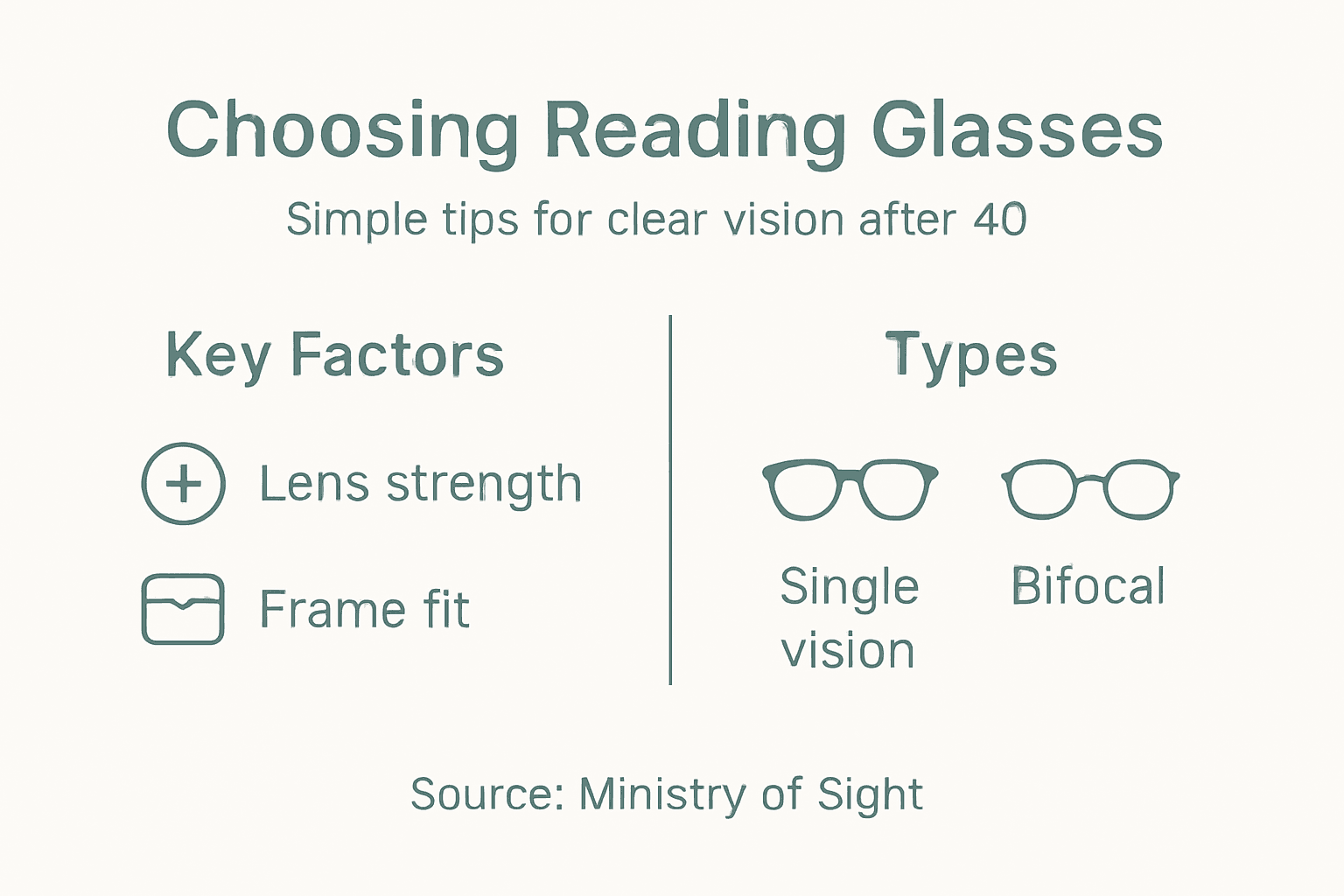
Not all reading glasses are created equal. The type you choose depends on your lifestyle, work demands and how you want to move through your day. Single vision reading glasses are the most straightforward option, magnifying the entire lens area for close-up work. These are ideal if you only need help with near vision and don’t mind removing them when you look at distances. They’re affordable, uncomplicated and come in countless frame styles from practical to fashionable. However, if you frequently switch between looking at your screen, then across the room to speak with colleagues, you’ll find yourself constantly removing and replacing them. That’s where other options become more attractive.
Bifocal glasses solve the switching problem by dividing the lens into two distinct areas. The top portion is set for distance vision, while the lower segment magnifies for reading and close work. You simply tilt your eyes downward to access the reading area without removing your glasses. Many Australian professionals love bifocals because they work brilliantly in office environments where you’re alternating between computer screens and paper documents. The trade-off is aesthetic, as the visible line dividing the two lens areas can be noticeable. Progressive lenses offer a more elegant solution with variable magnification that gradually changes from distance vision at the top to near vision at the bottom, with no visible line. They’re the premium choice if you want seamless transitions and a more refined appearance, though they require a brief adjustment period as you learn where to look through the lens for each distance.
Half-frame reading glasses deserve special mention for their practicality. These sit lower on your nose and expose the upper part of your visual field, allowing you to look over the frames for distance vision without removing them. They’re exceptionally convenient for quick switching between tasks and suit people who want a less “obviously wearing glasses” aesthetic. There are also specialty options worth considering. Glasses with blue light blocking technology filter the blue light emitted by screens, potentially reducing eye fatigue during extended computer work or evening device use. Some brands now integrate anti-glare coatings that minimise reflections from screens and overhead lighting, which is particularly useful in Australian workplaces with strong natural light.
Choosing the right type really comes down to your daily habits. If you’re mostly reading books or documents at your desk, single vision reading glasses are perfectly adequate and budget-friendly. If you’re juggling multiple focal distances throughout the day, bifocals or progressive lenses become worthwhile investments. Different types of reading glasses also come in various frame materials and styles, so you can match your selection to your personal taste and lifestyle needs. The different types of reading glasses explained provides comprehensive detail on each category to help you make an informed decision based on your specific vision requirements.
Here’s a quick comparison of different types of reading glasses and who they’re best suited for:
| Type of Glasses | Ideal For | Main Benefit | Typical Drawback |
|---|---|---|---|
| Single Vision | Reading books/documents | Simple, budget-friendly choice | Need to remove for distance |
| Bifocal | Office or mixed-distance work | Dual-focus without swapping glasses | Noticeable lens line |
| Progressive | Seamless transition tasks | Refined look, gradual vision change | Short adjustment period needed |
| Half-frame | Frequent switching between tasks | Look over easily for distance | Style is less conventional |
| Specialty (blue light, anti-glare) | Heavy screen use, bright workplaces | Reduces fatigue and glare | Can increase price |
Pro tip: If you’re new to non-single vision reading glasses, start with bifocals rather than progressives, since bifocals have a clearer demarcation zone and require less adjustment time before they feel natural to wear.
How Reading Glasses Correct Presbyopia
To understand how reading glasses fix your vision, you need to know what’s actually happening inside your eye. Presbyopia occurs because your eye’s lens gradually hardens with age, and the tiny muscles that control lens focusing weaken. Think of it like a camera lens that can’t adjust its focus anymore. When you’re young, those muscles can reshape your lens to focus light precisely on the retina at the back of your eye. But around 40, this focusing ability starts declining. Light from close objects no longer focuses directly on your retina. Instead, it focuses behind the retina, creating that frustrating blur when you try to read small print. This isn’t a sign of weakness, it’s simply the inevitable result of how our eyes age biologically.

Convex lenses in reading glasses are the optical solution to this problem. These curved lenses are thicker in the middle than at the edges, and they work by bending light rays inward before they enter your eye. When light refracts through a convex lens, it converges or comes together, effectively shortening the focal length. This means the light focuses closer to your eye, exactly where your retina now expects it to be. The result is sharp, clear vision for close-up tasks. The strength of reading glasses is measured in diopters, which indicates how much the lens curves and how much it bends light. A higher diopter strength means more magnification, designed for people whose presbyopia is more advanced. When you put on the correct strength for your eyes, light focusing happens exactly where it needs to, and suddenly that blurry menu or prescription bottle becomes perfectly readable.
The correction is purely optical, not medicinal. Reading glasses don’t change your eye’s anatomy or reverse the hardening of your lens. Instead, they compensate for what your eye can no longer do by itself. Your eye’s focusing muscles still weaken over time, but the glasses do the work those muscles used to do. This is why you might need a stronger prescription in your 50s than you did at 40, and stronger still at 60. As presbyopia progresses naturally, you’ll likely find that the diopter strength that worked perfectly five years ago no longer provides quite the same clarity. How reading glasses improve your ability to engage with close-up tasks depends entirely on having the right strength for your current vision needs.
What makes this correction so elegant is its simplicity and reversibility. Unlike surgery or other interventions, you can easily adjust your approach by trying different strengths, switching between pairs for different tasks, or upgrading to progressive lenses as your needs change. Many Australians over 40 keep multiple pairs at hand, one strength for reading and another for computer work, since different tasks sometimes benefit from slightly different magnifications. Your eyes haven’t failed you. They’ve simply changed in a predictable, manageable way that’s been solved optically for generations. The complete guide to how reading glasses work explains the optical principles in greater depth if you want to understand the physics behind the correction.
Pro tip: Test your reading glasses at the distance you’ll actually use them most often, whether that’s 30 centimetres for reading or 60 centimetres for computer screens, since the ideal strength varies depending on your typical working distance.
Choosing The Right Pair For Your Needs
Selecting reading glasses that actually work for you isn’t complicated, but it does require thinking about your daily routine honestly. Start by identifying where you’ll use them most. Are you spending your day reading physical documents at a desk, scrolling through emails and spreadsheets on a screen, or juggling between both? Your primary activity matters because different tasks sometimes benefit from slightly different magnification strengths. Someone who reads novels all day might be perfectly happy with +1.50 diopters, while a person alternating between computer work and paperwork might find that strength frustrating. Think about the distances involved too. Reading a physical book typically happens around 30 to 35 centimetres from your eyes, whereas a computer screen sits further away at 50 to 60 centimetres. This distance variation affects which strength feels most comfortable. If you’re choosing glasses for general purpose use, you’ll want something that works reasonably well across multiple distances, which is where bifocals or progressive lenses become valuable investments.
Your lifestyle and personality also influence which frame style will actually stay on your face and get used. Frame considerations are more practical than purely aesthetic. If you’re constantly moving between tasks, half-frame or open-frame styles let you look over them without removing them completely. If you work in professional settings where image matters, you might prefer a full-frame style that looks more like regular glasses. Consider how often you’ll want to switch between frames too. Many people over 40 find that keeping two or three pairs strategically positioned saves frustration. One pair by your reading chair, one at your desk, and one in your handbag means you’re never hunting for glasses when you need them. Lightweight frames matter more than you might think, particularly if you’re wearing them for hours at a stretch. A frame that feels barely-there after five minutes will feel like you’re wearing nothing; one that’s too heavy will give you a headache by midday.
Diopter strength requires honest assessment of your current vision. If you’re completely new to reading glasses, starting with a moderate strength around +1.50 or +2.00 is sensible. Wear them for a few days in your typical environment before deciding if you need more or less magnification. Too strong and text appears magnified to the point of distortion, making your eyes work harder not less. Too weak and you’re still straining, defeating the purpose. Pay attention to eye comfort rather than what feels “right” theoretically. Some people find they prefer different strengths for different tasks. A strength that’s perfect for reading fine print in dim lighting might feel slightly too strong when reading at your desk under bright office lights. This is completely normal and is why optometrists suggest having multiple pairs. You might also consider specialty features based on your lifestyle. If you spend significant time on screens, blue light blocking coating can reduce eye strain and help your sleep patterns. Anti-glare coatings are worth considering if you work near windows or under fluorescent lighting.
Practical assessment steps to guide your selection:
- Spend 10 minutes reading your preferred material with a candidate pair of glasses
- Move between different lighting conditions if possible
- Check whether you can read text at your typical working distance without tilting your head
- Note any eye discomfort, headaches or visual distortion that develops
- Compare comfort and clarity across two or three different diopter strengths if you’re uncertain
One often-overlooked factor is trying glasses on while wearing them in realistic situations. Reading glasses that feel fine in a shop might behave completely differently when you’re actually settled at your breakfast table with a newspaper. Online shopping offers flexibility and good value, but make sure the retailer has a reasonable return policy so you can try different strengths risk-free. Your eyes deserve attention and proper fit matters for both comfort and visual clarity. Getting this right means the difference between glasses you love wearing and ones that end up in a drawer.
The following table summarises key practical factors for choosing reading glasses:
| Factor | Why It Matters | What To Consider |
|---|---|---|
| Diopter Strength | Impacts clarity and comfort | Choose based on task and distance |
| Frame Weight | Affects long-term comfort | Lighter frames suit longer wear |
| Lens Coatings | Protects eyes, reduces strain | Anti-glare, blue light useful for screens |
| Fit and Style | Determines daily usability | Bridge fit and personal taste both matter |
| Number of Pairs | Convenience for varied tasks | Place multiple pairs in key locations |
Pro tip: Order reading glasses in two different diopter strengths when shopping online, wear each pair for three days in your typical environment, then return the strength that doesn’t feel as comfortable rather than settling for “good enough”.
Mistakes To Avoid When Buying Reading Glasses
People make predictable mistakes when buying reading glasses, and most of them stem from rushing the decision or relying on guesswork instead of proper testing. The biggest mistake is buying based purely on price or convenience without actually trying them on or testing the strength in realistic conditions. A bargain pair that sits unworn in a drawer costs far more than a properly fitted pair you actually use daily. Online shopping is genuinely convenient and often offers better value than physical shops, but the advantage only works if you commit to the testing process. Order multiple strengths, wear each pair for several days in your actual environment, then return the ones that don’t work. Treating it as a quick transaction instead of a trial period is where people go wrong. You wouldn’t buy shoes online and never try them on before committing to wearing them forever, yet many Australians do exactly this with reading glasses.
Another common error is choosing frame style based purely on how they look in photos rather than how they’ll function in your daily life. That trendy style might look fabulous online but feel uncomfortable after 20 minutes, or the frames might be too loose and slip down your nose constantly. Physical comfort matters more than aesthetics when you’re going to wear glasses multiple hours daily. Testing how reading glasses fit and style actually affect your wearing experience helps you avoid this pitfall. Another mistake is assuming one pair of reading glasses will work for every situation. Your eyes don’t need the same magnification strength for reading a novel as they do for using a computer screen. Many people buy one pair and then find they’re either straining at the computer or the text is too magnified for reading books. Having two or three pairs strategically positioned for different tasks solves this completely. It sounds excessive but it’s actually more economical than constantly adjusting or suffering with inadequate vision.
Ignoring frame weight and material is a surprisingly common oversight. A frame that feels fine when you first put it on might give you a headache after two hours. Lightweight materials matter, particularly for longer wearing periods. Similarly, don’t overlook the importance of proper bridge fit. If the bridge is too wide or too narrow for your face, the glasses will either slip constantly or sit uncomfortably. Many people buy reading glasses that don’t fit properly simply because they haven’t sat down and genuinely tested them in realistic conditions. Buying without considering your actual working distance is another hidden mistake. If you’re primarily reading documents on your desk, you need glasses optimised for that specific distance. If you’re mostly using screens, the focal distance is different. Getting this wrong means your glasses feel slightly off no matter what, creating eye strain rather than relieving it.
People also frequently make the mistake of buying reading glasses without considering their lifestyle needs. If you spend significant time on screens and struggle with sleep, failing to choose blue light blocking lenses is a missed opportunity. If you work in bright natural light, anti-glare coatings genuinely improve clarity and comfort. These aren’t premium extras, they’re practical features that address real problems. One final mistake worth highlighting is not giving yourself adequate time to adjust to new glasses, particularly if you’re upgrading to bifocals or progressives. Your brain needs time to learn where to look through the lens for different distances. Judging them on first wear and returning them immediately means you’re missing out on what they could actually do for you.
Here’s the practical sequence most people skip but absolutely should follow. Purchase from a retailer with a generous return policy. Order in your intended strength plus one step stronger and one step weaker. Wear each pair in your actual working environment for three full days before deciding. Move between different lighting conditions and distances. Test them during the times of day you’ll wear them most. Only then decide which strength works best. This process takes effort, but it eliminates the guesswork that leads to drawer full of unworn glasses. Understanding how to shop for reading glasses online in detail provides additional strategies for making informed choices.
Pro tip: Buy reading glasses from retailers offering free returns or exchanges, and intentionally order in two different strengths on your first purchase to compare how each feels across an entire week of realistic daily use before committing to either.
Experience Clear Vision Beyond 40 with the Perfect Reading Glasses
Presbyopia changes how your eyes focus on close objects but you do not have to struggle through blurry text or eye strain any longer. Whether you need help with reading documents or switching quickly between screen and distance vision choosing the right reading glasses tailored to your lifestyle can bring clarity and comfort back to your daily routine. Explore our wide selection of stylish and effective options including Round Reading Glasses and classic Retro Reading Glasses designed to meet your unique needs.
Don’t wait for eye fatigue or frustration to slow you down. Visit Ministry of Sight today and discover reading glasses that combine style, function and comfort all with free shipping across Australia. Shop now to find your perfect pair and enjoy clearer reading and reduced strain every day.
Frequently Asked Questions
What are reading glasses used for?
Reading glasses are designed to help individuals with presbyopia, a condition that usually develops after age 40, which makes it difficult to focus on close objects. They magnify near objects, allowing for clearer vision when reading books, menus, screens, and other detailed work.
How do I choose the right strength for my reading glasses?
It’s recommended to start with a moderate strength, typically between +1.50 to +2.00 diopters, and adjust based on comfort. Testing different strengths in your usual reading environment can help determine which works best for your vision needs.
What types of reading glasses are available?
There are several types of reading glasses, including single vision, bifocal, progressive, and half-frame glasses. Single vision glasses are for close work, bifocals have two focal areas for distance and near vision, progressives offer a seamless transition between different distances, and half-frame glasses allow for easy switching between tasks.
How do reading glasses correct presbyopia?
Reading glasses use convex lenses that are thicker in the middle to bend light rays inward, allowing the light to focus correctly on the retina. This compensates for the natural hardening of the eye’s lens and the weakening of the muscles that help focus on close objects.
Recommended
- Understanding Your Reading Glasses Checklist for Better Vision – ministry of sight
- Understanding What are Reading Glasses and Their Importance – ministry of sight
- How Reading Glasses Improve Reading: Complete Guide – ministry of sight
- Reading Glasses: Complete Guide to Reading Comfort – ministry of sight
Our Best Reading Glasses Australia guide covers frame quality, lenses, fit and the features worth considering before you buy.


