

TL;DR:
- Understanding eyewear terminology is crucial for making safe, compliant, and style-appropriate choices tailored to your Australian consumer rights.
- Knowing the differences between frame types and safety labels helps you select durable, regulation-compliant glasses suited to your prescription and lifestyle needs.
Walking into an eyewear store or browsing online, you’ll encounter a wall of terminology that can feel more confusing than helpful. “Rimless sunshields,” “fashion spectacles,” “semi-rimless visors” — these aren’t just marketing words. In Australia, these labels carry real meaning, affecting everything from your comfort and style to your legal rights as a consumer. Choosing frames without understanding what these terms mean is like buying a car without knowing the difference between a sedan and an SUV. This guide cuts through the jargon so you can shop with genuine confidence.
Table of Contents
- Why terminology matters when buying frames
- Common optical frame terms decoded
- How frame labelling and safety standards affect your purchase
- Choosing frames: Functionality, fashion, and pitfalls to avoid
- Why frame terminology is your secret to stress-free eyewear shopping
- Discover Ministry of Sight’s frame expertise and range
- Frequently asked questions
Key Takeaways
| Point | Details |
|---|---|
| Terminology shapes choices | Knowing the right frame term helps you pick eyewear that fits your lifestyle and Australian regulations. |
| Compliance is crucial | Check for AS 1067.1 standards to ensure your frames are safe and legal in Australia. |
| Apply knowledge when shopping | Use terminology when browsing or asking questions so you get exactly what you want and need. |
| Fashion meets function | Combining style with the correct terminology gives you confidence in both your look and your consumer rights. |
Why terminology matters when buying frames
It’s tempting to treat frame terminology as background noise, something the sales assistant handles while you focus on what looks good in the mirror. But terminology shapes every aspect of your eyewear experience, from how the frame sits on your face to whether the product you’re buying actually meets Australian safety requirements.
Consider the difference between a “full-rim” and a “rimless” frame. These aren’t just design preferences. They describe fundamentally different construction methods, which affect lens thickness, durability, and how well the eyewear holds its prescription over time. A rimless frame drills directly into the lens, meaning even a minor knock can chip or crack it. A full-rim frame protects the lens edge on all sides. Knowing this upfront saves you from a frustrating discovery weeks after purchase.
The terminology also has legal implications. Your consumer eyewear rights in Australia depend partly on how a product is labelled. If a product is sold as “fashion spectacles” it may be subject to mandatory safety labelling rules, regardless of whether it looks like a regular pair of glasses. According to the Consumer Goods Safety Standard 2017, “fashion spectacles” and non-prescription sunglasses can be covered by safety labelling rules derived from AS 1067.1:2016. That’s the Australian and New Zealand standard governing optical radiation protection.
Here are the core reasons why terminology should matter to you at purchase time:
- Frame construction: Terms describe how the lens is held, directly affecting durability and repair options
- Safety compliance: Labels signal whether a product has met Australian optical safety standards
- Consumer protection: Correctly labelled products give you clearer grounds for returns or complaints
- Fit and comfort: Different frame types rest on your face differently, affecting long-term wearability
- Prescription suitability: Not all frame types accept all lens types; terminology helps you avoid mismatches
“The language used on an eyewear product isn’t just descriptive. It’s a compliance signal, and savvy shoppers read it that way.”
Pro Tip: Before you fall in love with a frame’s look, check what type it is. A beautiful rimless style may not be suitable for a strong prescription, saving you from an expensive disappointment.
Common optical frame terms decoded
With an understanding of why terms matter, it’s time to break down what each one actually means and how they differ in a real-world Australian context.
The most important terms you’ll encounter fall into two categories: frame construction types and product classification types. Frame construction describes the physical structure. Product classification describes how the item is categorised for regulatory and retail purposes.
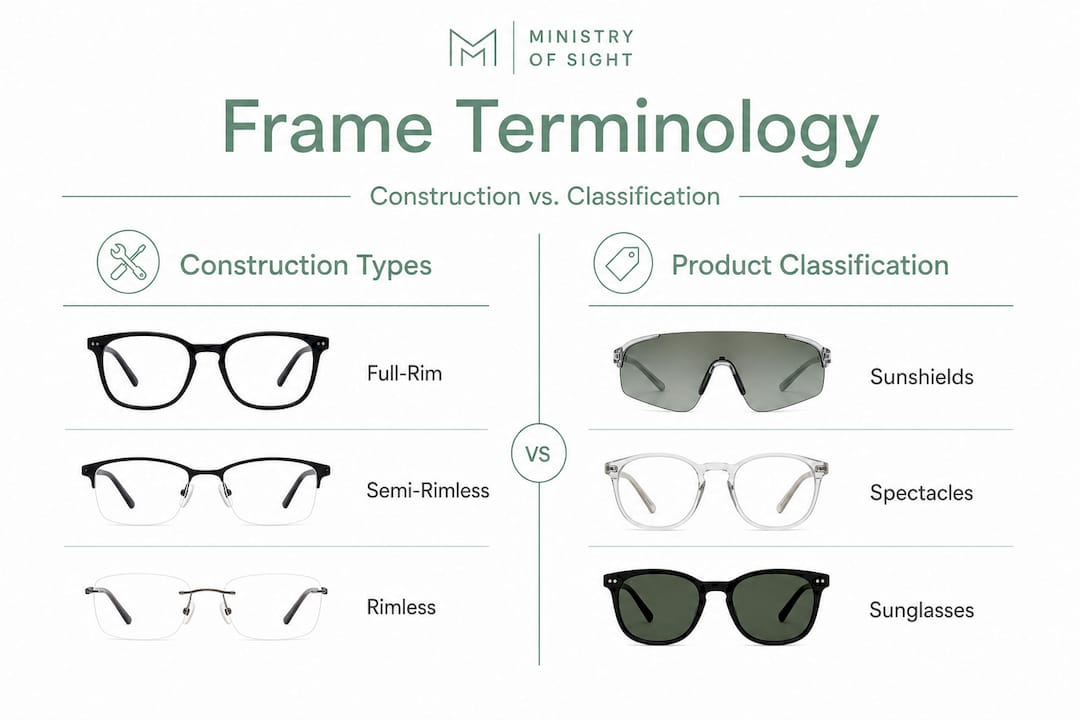
Frames labelled as “rimless sunshields” or “fashion spectacles” fall under the mandatory safety labelling requirements for non-prescription sunglasses in Australia. This means even if they look like an artistic accessory, they carry legal obligations for the seller and protections for you.
| Term | Definition | What it means at purchase |
|---|---|---|
| Full rim | Frame material completely encircles the lens | Durable, suits most prescriptions, widest style range |
| Semi-rimless | Rim covers the top or bottom of the lens only | Lighter feel, less durable, limited lens thickness |
| Rimless | Lens is drilled and attached directly to bridge and temples | Minimal look, fragile, suits mild prescriptions best |
| Sunshields | Large lenses often worn over prescription frames | Must comply with AS 1067.1 labelling if non-prescription |
| Visors | Wide, single-lens designs with minimal frame | Often used for sport or outdoor activities |
| Fashion spectacles | Non-prescription eyewear sold for style purposes | Subject to mandatory safety labelling under Australian law |
| Prescription frames | Frames designed to hold corrective lenses | Should be fitted and dispensed by a registered optical professional |
Understanding these distinctions changes how you approach a purchase. Here’s how each frame type fits into real life:
- Full-rim frames are your best bet for high prescriptions, active lifestyles, and anyone who is a bit rough on their glasses. The lens is fully protected and easy to replace.
- Semi-rimless frames suit those wanting a lighter, less noticeable look. They work well for moderate prescriptions and office or social settings where aesthetics matter.
- Rimless frames are ideal for a barely-there aesthetic but require careful handling. Anyone with a strong prescription or a physically active routine should think twice before choosing rimless.
- Sunshields and visors are popular with outdoor enthusiasts, but they must meet Australian compliance standards if sold as non-prescription eyewear. Always check the label.
- Fashion spectacles sound simple, but they carry legal weight. If you’re buying non-prescription glasses for style, the product still needs to meet safety standards.
Our frame style guide breaks down how construction types interact with different face shapes and style goals, which is worth a read before committing to a style. And if you’re thinking about lenses as well as frames, understanding your eyeglass lens choices is equally important for getting the full picture.
How frame labelling and safety standards affect your purchase
After decoding the key terms, let’s look at how these terms affect the way products are labelled and regulated under Australian law. This is where terminology moves from being an academic exercise to having genuine financial and safety consequences.
The Consumer Goods (Sunglasses and Fashion Spectacles) Safety Standard 2017 is the key piece of regulation here. It brings most of AS 1067.1:2016 into law for labelling and product claims regarding non-prescription sunglasses and fashion spectacles. In plain terms, if a product is sold as either of these, certain labelling requirements are mandatory, not optional.
What does this mean practically? If you pick up a pair of non-prescription frames and the label doesn’t reference the relevant standard or comply with the required markings, the seller may be in breach of the safety standard. That’s useful to know if you ever need to dispute a purchase or report a substandard product.
| Labelling term | What it signals | Compliance relevance |
|---|---|---|
| AS 1067.1 reference | Meets Australian optical standards | Strong signal of compliance |
| “Fashion spectacles” | Non-prescription, style-focused eyewear | Must meet mandatory safety labelling |
| “Rimless sunshields” | Specific construction type for sun protection | Covered by Safety Standard 2017 |
| Lens category (e.g. Cat 2, Cat 3) | Indicates level of tint and UV protection | Required for sunglasses sold in Australia |
| No labelling at all | Absence of compliance markings | Red flag, may be non-compliant or grey-market |
The lens category system is particularly useful. Category 1 lenses offer minimal protection and are best for low-glare environments. Category 2 provides moderate protection for variable light. Category 3, the most popular, suits general Australian outdoor use. Category 4 is for extreme conditions, such as skiing or desert environments, and should not be worn while driving.
For detailed advice on how frame construction interacts with safety requirements, our article on frame safety and fit is a helpful companion read.
Pro Tip: Always check for the AS 1067.1 marking when buying non-prescription sunglasses or fashion spectacles. Its absence is a warning sign that the product may not meet your legal protections as an Australian consumer.
Choosing frames: Functionality, fashion, and pitfalls to avoid
Now you know how labels signal safety and legality, here’s how to use this knowledge in real-world shopping. The gap between knowing what terms mean and using them confidently at the point of purchase is smaller than most people think.
Follow these steps to use terminology as your shopping advantage:
-
Identify your primary use. Are these frames for everyday prescription wear, sun protection, or fashion? Each category has different compliance and construction requirements. Don’t buy fashion spectacles when you need sun protection, even if they look similar.
-
Match construction type to your prescription. If you need corrective lenses, check that your chosen frame type is suitable. Rimless and semi-rimless styles have thickness limits that can restrict strong prescriptions.
-
Check the label before you buy. Look for AS 1067.1 compliance markings and the lens category rating. If either is missing from a non-prescription product, treat it as a warning sign.
-
Assess your lifestyle needs. Active Australians often benefit from full-rim frames with impact-resistant lenses. Flexible frames are another option worth exploring. Our guide on flexible frame advice covers how these work and who they suit best.
-
Verify the retailer’s credentials. When shopping for eyewear online, take a few minutes to confirm the retailer stocks products that meet Australian standards. A reputable seller will make compliance information easy to find.
-
Don’t ignore the frame size markings. Frames include measurements stamped inside the arm, typically in millimetres, showing lens width, bridge width, and arm length. These numbers matter as much as terms like “rimless” when it comes to comfortable fit.
The pitfalls are real and relatively common. Here are three to watch for:
- Missing labels: If a product sold as sunglasses or fashion spectacles carries no compliance reference, safety standards may not be met. This strips away your consumer protections under Australian law.
- Misleading descriptions: Some sellers use terms like “rimless” loosely to mean a minimalist aesthetic rather than the specific construction type. Always match the description against the actual product images and specs.
- Prescription-frame confusion: Buying frames labelled as “fashion spectacles” for prescription use is a mismatch. These are not designed or tested for corrective lenses, and your optometrist cannot guarantee the result.
Pro Tip: When you’re comparing frames online, use the terminology table from this article as a quick checklist. If a product description doesn’t match the construction shown in the photo, contact the retailer before purchasing.
Why frame terminology is your secret to stress-free eyewear shopping
Most people think the hard part of buying glasses is finding a style that suits them. In reality, the stressful moments happen after purchase: when frames break because the construction didn’t suit the prescription, or when a returned product falls outside consumer protections because the label was ambiguous, or when an online purchase arrives and looks nothing like what was described.
The shoppers who avoid these headaches are not necessarily more stylish or better-funded. They’re frame-literate. They’ve taken the time to understand that “rimless” isn’t just an aesthetic, that “fashion spectacles” is a legal category, and that a lens category marking is a meaningful consumer tool, not decoration.
Here’s the insight that most eyewear articles miss: terminology isn’t just about making informed choices in the moment. It’s about building a vocabulary that protects you across every purchase, for years. Once you know what AS 1067.1 means and why it matters, you’ll instinctively check for it every time. Once you understand that rimless frames carry structural limits, you’ll stop being swayed purely by aesthetics.
There’s also a broader consumer rights angle that rarely gets mentioned. Knowing your terminology means you understand your rights as an eyewear consumer more precisely. If a product is labelled as compliant but clearly isn’t, you can name the specific standard that’s been breached. That’s a very different conversation to having with a retailer than simply saying “I don’t think this is right.”
Grey-market frames are a genuine issue in the Australian market. These are frames imported without proper local compliance testing, often lacking the required labelling, and sometimes with inflated claims about UV protection. The consumer who knows the terminology spots these products quickly. The consumer who doesn’t may only discover the problem after their eyes have been exposed to unfiltered UV radiation, or when they try to return the product and find they have little legal ground to stand on.
Being frame-literate costs you nothing. It just requires an hour of reading, and the payoff is genuine confidence every time you shop for eyewear.
Discover Ministry of Sight’s frame expertise and range
With a firmer grasp of frame terminology, here’s how Ministry of Sight helps you turn knowledge into confidence at the checkout.
Ministry of Sight sources and sells eyewear with compliance and quality front of mind. Whether you’re after elegant daily frames or sun-ready options that genuinely meet Australian standards, the range is built to match informed shoppers. The Lumière Sun Readers are a standout example, blending style with the protective credentials you now know to look for. You’ll also find a well-curated selection of eyewear accessories and storage to keep your frames in top condition. And if you want to understand the philosophy behind the range before browsing, the about our reading glasses page gives you the full picture.
Frequently asked questions
What’s the difference between full-rim, semi-rimless, and rimless frames?
Full-rim frames encircle the entire lens, semi-rimless support only part of the lens edge, while rimless frames attach lenses directly to the bridge and arms without any surrounding material.
Are ‘fashion spectacles’ and sunglasses the same under Australian labelling laws?
No, but both may fall under mandatory safety labelling if they are non-prescription and sold as eyewear in Australia. As the Safety Standard 2017 confirms, fashion spectacles and non-prescription sunglasses can both be covered by the labelling rules derived from AS 1067.1:2016.
How can I confirm if a pair of frames is legally compliant in Australia?
Look for references to AS 1067.1 and the regulatory labelling required for fashion spectacles and sunglasses. The Consumer Goods Safety Standard 2017 brings these requirements into law, so any compliant product should carry the appropriate markings.
Is it worth learning frame terminology if I just want a stylish look?
Absolutely. Understanding frame terms means you’ll choose styles that genuinely suit your face and lifestyle, and you’ll avoid accidentally purchasing non-compliant or structurally unsuitable frames that look great in the shop but disappoint in daily use.


