

TL;DR:
- “Scratch resistant” lenses are not completely scratch-proof but resist minor abrasions during normal use.
- Coating quality, application method, and handling habits influence the durability of scratch resistant lenses.
- Proper cleaning, storage, and lifestyle choices can significantly extend the lifespan of lens coatings.
You buy a new pair of glasses, wear them for a few weeks, and then notice it: a faint scratch right in the centre of your vision. Frustrating, right? Many Australians assume that “scratch resistant” means their lenses are virtually indestructible, only to discover that’s not quite the case. The truth is, scratch resistance is a real and measurable quality, but it varies enormously between products. This guide breaks down exactly what scratch resistant lenses are, how they’re made, what you can realistically expect from them, and how to keep yours in top shape for as long as possible.
Table of Contents
- What does scratch resistant really mean?
- How scratch resistant lenses are made
- Do scratch resistant lenses really work?
- Tips to get the most from scratch resistant lenses
- The hidden truth about scratch resistant claims
- Discover eyewear solutions and accessories
- Frequently asked questions
Key Takeaways
| Point | Details |
|---|---|
| Not scratch-proof | Scratch resistant means tougher but not impervious to scratches. |
| Quality varies | Some coatings outlast others, so buy from reputable providers. |
| Proper care matters | Improper cleaning or storage can quickly wear down the best coatings. |
| Check before you buy | Ask about coating quality and test standards to ensure lasting protection. |
What does scratch resistant really mean?
Let’s clear something up straight away. “Scratch resistant” does not mean “scratch-proof.” These two terms are not interchangeable, and confusing them leads to a lot of disappointment. A scratch resistant lens has a special coating applied to its surface that makes it significantly harder to scratch under normal conditions, but it can still be damaged by sharp objects, rough surfaces, or poor handling.
The quality of a scratch resistant coating comes down to two main factors: how well it bonds to the lens material, and how well it maintains optical clarity after everyday wear and tear. A coating that peels, hazes, or cracks under normal use is not doing its job properly. According to industry standards, haze resistance post-abrasion is one of the key measures used to determine whether a coating is genuinely effective or just a marketing label.
“A scratch resistant coating is designed to protect the lens surface from minor abrasions while maintaining optical clarity over time. It is not a guarantee against all damage.”
Here are the most common types of lens coatings you’ll encounter:
- Hard coat: The most basic scratch resistant layer, typically applied to plastic lenses. It adds a thin, durable film to the surface.
- Multi-layer coat: A more advanced option that combines scratch resistance with anti-reflective or UV properties.
- Diamond-like carbon (DLC) coat: A premium option used on high-end lenses, offering superior hardness and durability.
- Hydrophobic coat: Repels water and oil, which indirectly protects against scratching by reducing the need to wipe lenses frequently.
Understanding the benefits of scratch-resistant lenses goes beyond just durability. Clearer, undamaged lenses reduce eye strain and improve visual comfort over time. The difference between a coated and uncoated lens becomes obvious within the first few months of regular wear.
One common misconception is that more expensive lenses are always more scratch resistant. Price can reflect brand reputation or frame design as much as lens quality, so it pays to ask specifically about the coating type and testing standards before you buy.
How scratch resistant lenses are made
Not all lenses start from the same base material, and that matters a great deal when it comes to scratch resistance. The three main lens materials are:
- Plastic (CR-39): Lightweight and affordable, but naturally prone to scratching without a coating.
- Polycarbonate: Impact-resistant and popular for safety and sports eyewear, but also soft and easily scratched without treatment.
- Glass: Naturally harder and more scratch resistant than plastic, but heavier and less commonly used today.
Because plastic and polycarbonate lenses are so widely used, scratch resistant coatings add durability and haze resistance that these materials simply can’t provide on their own.
| Lens type | Natural scratch resistance | Coating required? |
|---|---|---|
| Plastic (CR-39) | Low | Yes, strongly recommended |
| Polycarbonate | Very low | Yes, essential |
| Glass | High | Optional, but beneficial |
| High-index plastic | Low to medium | Yes, strongly recommended |
The coating itself is applied using one of three main methods. Dip coating involves submerging the lens in a liquid hardening solution. Spin coating uses centrifugal force to spread the coating evenly. UV curing exposes the coated lens to ultraviolet light to harden the material quickly and thoroughly. Each method has its advantages, but UV curing tends to produce the most consistent results in high-volume manufacturing.
Factors that affect the final quality include the thickness of the coating, how evenly it is applied, and the quality control processes used during production. A thin or uneven coating will wear through faster, especially around the edges where handling is most frequent.
Pro Tip: When buying new glasses, ask your optician or retailer whether the scratch resistant coating is factory-applied or added after manufacture. Factory-applied coatings tend to bond more securely and last longer.
Exploring the different types of lens coatings available can help you make a more informed choice when selecting your next pair of glasses. Knowing what you’re paying for is half the battle.
Do scratch resistant lenses really work?
The short answer is yes, but with realistic expectations. Scratch resistant coatings genuinely reduce the frequency and severity of surface damage under everyday conditions. Tossing your glasses into a bag without a case, wiping them on a rough shirt, or resting them face-down on a table are the kinds of habits that scratch resistant coatings are designed to handle better than uncoated lenses.
However, no coating eliminates risk entirely. Sharp objects, abrasive surfaces, and harsh chemicals can still damage even the best-coated lenses. Coating performance is linked directly to how well it withstands repeated abrasion while keeping optical clarity intact. A lens that scratches easily but remains clear is less of a problem than one that develops a hazy film, because haze directly impairs your vision.
“The real test of a scratch resistant coating is not whether it prevents every scratch, but whether it keeps the lens optically clear after months of everyday use.”
| Lens type | Typical lifespan with care | Scratch resistance level |
|---|---|---|
| Uncoated plastic | 6 to 12 months | Very low |
| Coated plastic (CR-39) | 2 to 4 years | Medium |
| Coated polycarbonate | 2 to 3 years | Medium |
| High-index with premium coat | 3 to 5 years | High |
| Glass lenses | 5 or more years | High |
Real-world performance also depends on your lifestyle. If you work outdoors, play sport, or frequently handle your glasses with one hand, your lenses will face more stress than someone who works at a desk and stores their glasses carefully. Identifying durable glasses for your specific lifestyle is a smart starting point before you invest in a new pair.

The haze resistance test is particularly important here. A lens that looks fine but has developed micro-abrasions will scatter light and reduce contrast, making your vision feel less sharp even if you can’t see obvious scratches. That’s why optical clarity after abrasion is the real benchmark of quality.
Tips to get the most from scratch resistant lenses
Even the best coating in the world won’t last if you don’t look after your lenses properly. Here are the most effective steps for extending the life of your scratch resistant lenses:
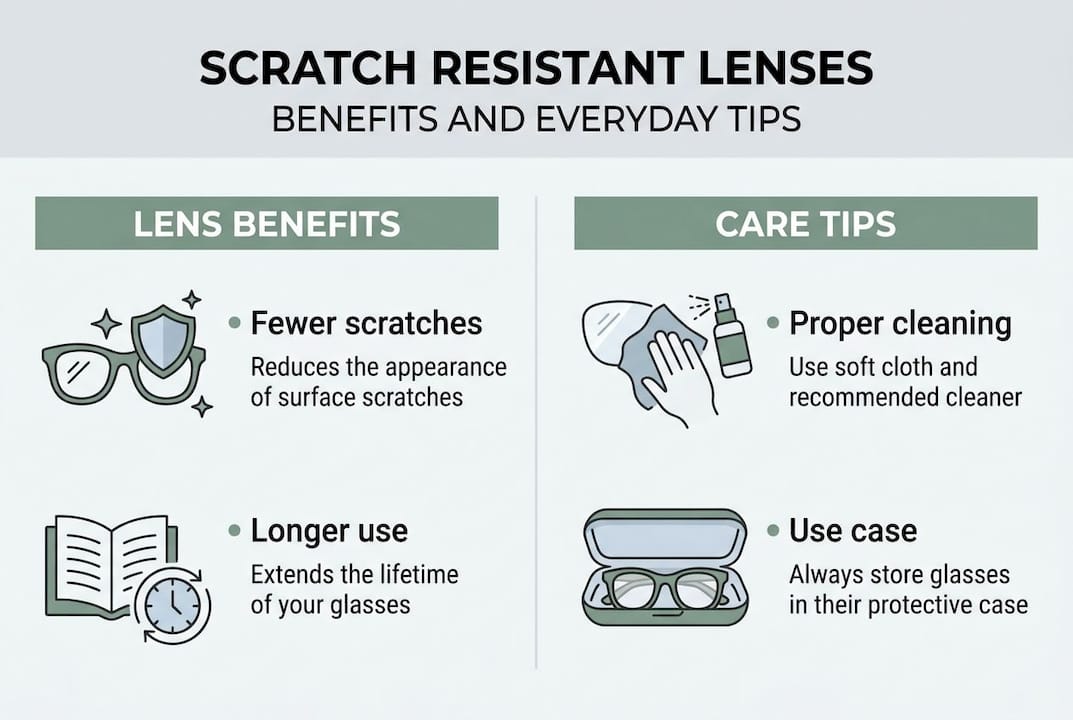
- Clean with the right tools. Always use a microfibre cloth and a lens-approved cleaning solution. Paper towels, tissues, and clothing fibres are surprisingly abrasive and will wear through your coating faster than you’d expect.
- Store glasses in a hard case. Every time you leave your glasses on a table, in a bag, or face-down on a surface, you’re risking damage. A hard case takes five seconds to use and can add years to your lenses.
- Use both hands. Removing and putting on your glasses with one hand twists the frame and puts uneven pressure on the lenses. This can cause micro-cracks in the coating over time.
- Rinse before wiping. If your lenses have dust or grit on them, wiping immediately will grind that debris across the coating. A quick rinse under water first removes the abrasive particles.
- Check the coating regularly. Hold your lenses up to a light source and look for haziness, peeling, or uneven patches. Catching coating damage early means you can adjust your habits before the problem gets worse.
Proper cleaning and storage are the single most effective ways to prevent delamination and extend the working life of any lens coating.
Pro Tip: Avoid leaving your glasses in a hot car. Extreme heat causes the lens material and coating to expand at different rates, which weakens the bond between them. This is one of the most overlooked causes of early coating failure in Australia’s climate.
For a deeper look at daily care habits, the guides on keeping glasses scratch-free and following an essential maintenance checklist are worth bookmarking. You can also follow a step-by-step lens care routine to make good habits automatic.
The hidden truth about scratch resistant claims
Here’s something most articles won’t tell you: the label “scratch resistant” is not standardised across the eyewear industry. Two pairs of glasses can both carry that label and perform very differently in real-world conditions. The difference lies in the testing standards used, the quality of raw materials, and whether the manufacturer prioritises coating adhesion or just surface hardness.
The haze test is the most revealing measure of coating quality. A lens that scores well on hardness but poorly on haze resistance after abrasion will look scratched and foggy within months. Adhesion and maintenance are the real keys to lasting scratch resistance, not just the initial hardness of the coating.
Our honest take: don’t buy glasses expecting the coating to do all the work. A premium coating combined with poor daily habits will fail faster than a mid-range coating that’s properly cared for. The best approach is to buy from a reputable source that can tell you exactly what coating is used, and then commit to the care routine. Expert care advice is freely available, and following it consistently makes a measurable difference. Scratch resistance is a feature, not a promise.
Discover eyewear solutions and accessories
Now that you understand what scratch resistant lenses can and can’t do, the next step is making sure you have the right tools to protect your investment. At Ministry of Sight, we stock a range of products designed to complement quality eyewear and extend the life of your lenses.

From protective eyewear accessories and storage solutions to stylish eyewear leashes and chains that keep your glasses safe and accessible, we’ve thought about what everyday wearers actually need. If you’re in the market for a new pair, browse our reading glasses collection to find options that combine quality lenses with practical, everyday durability. Good eyewear is an investment, and we’re here to help you protect it.
Frequently asked questions
Are scratch resistant lenses completely scratch-proof?
No, scratch resistant is not scratch-proof. The coating makes lenses significantly harder to scratch under normal conditions, but sharp objects and abrasive surfaces can still cause damage.
How can I tell if my lenses are really scratch resistant?
Ask your eyewear provider for the specific coating type and whether it has passed abrasion and haze resistance testing. Genuine scratch resistant lenses use standardised coatings that are verified through industry testing.
How long do scratch resistant coatings usually last?
With proper care, most coatings last two to five years, but coating quality and maintenance habits are the biggest factors in how long yours will perform well.
What is the best way to clean scratch resistant lenses?
Use a microfibre cloth and a lens-approved cleaner every time. Proper cleaning technique prevents micro-abrasions and stops the coating from peeling or hazing prematurely.


