

Searching for reading glasses can surprise even the savviest Australian shopper when you realise just how many lens styles exist. The right pair is about more than magnification—it’s about matching your glasses to daily habits, whether that means reading the menu at your favourite Melbourne café or switching between crafts at home and work calls. With choices like bifocal, progressive, and blue light filter lenses, finding the perfect fit means tailoring your frames to both style and real-life needs. Bold choices start with understanding the specialised options available.
Table of Contents
- What Are Reading Glasses Lens Types?
- Popular Lens Types And Key Differences
- Specialist Features Like Blue Light Blocking
- Choosing The Right Lens For Your Lifestyle
- Common Mistakes When Selecting Lenses
Key Takeaways
| Point | Details |
|---|---|
| Lens Type Matters | Different lens types cater to specific vision needs, with options like single-vision, bifocal, and progressive lenses designed for various activities and preferences. |
| Personal Assessment Required | Your unique daily routine and activities are crucial in determining the appropriate lens type, rather than relying solely on age or generic prescriptions. |
| Try Before You Buy | Always test reading glasses with materials you regularly use to ensure comfort and effectiveness; what works in a shop may differ in real-world scenarios. |
| Professional Guidance is Key | Consult an optometrist for an accurate assessment of your vision needs to avoid common mistakes and ensure the best lens choice for your lifestyle. |
What Are Reading Glasses Lens Types?
Reading glasses come in several distinct lens types, each designed to address different vision needs and lifestyle situations. Understanding these options helps you select frames that match how you actually use them—whether you’re reading a menu at a restaurant, working at your desk, or crafting hobbies at home.
Lens types vary based on the magnification method and how the optical correction is distributed across the lens. Rather than a one-size-fits-all approach, the variety available means you can find something that suits your specific daily activities and visual demands.
Main Reading Glasses Lens Types
Single-vision lenses provide uniform magnification across the entire lens surface. These work well if you only need help with close-up vision and don’t require distance correction.
Bifocal lenses feature two distinct magnification zones. The upper section contains your regular lens power (or no correction if you don’t need distance vision), whilst the lower section provides stronger magnification for reading. You’ll notice a visible line separating these zones.
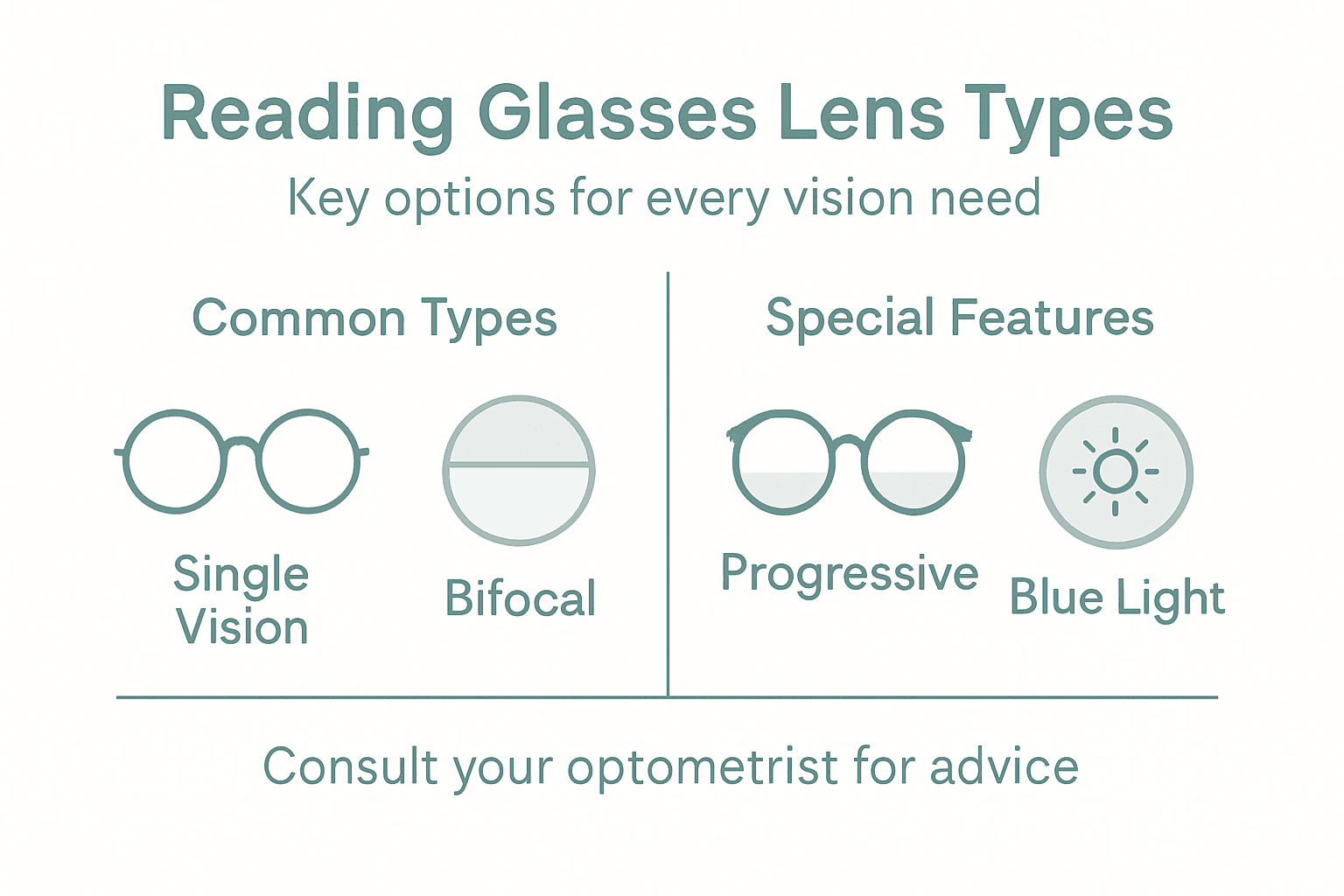
Progressive lenses offer seamless magnification that gradually changes from top to bottom. There’s no visible line, and you get smooth vision at all distances—distance, intermediate, and near. They’re ideal if you move between activities frequently.
Half-frame reading glasses sit lower on your nose, positioning the magnified portion directly where you need it. This design works brilliantly for multitasking, as you can glance over the frames for distance vision, then down through them for reading.
Blue light filter lenses reduce glare from screens and digital devices. If you spend hours on computers or tablets, these lenses can reduce eye strain and support better sleep patterns by filtering blue wavelengths.
Key differences to consider:
- Single-vision: Simple, affordable, best for reading only
- Bifocals: Two zones, visible line, good value for multiple distances
- Progressives: Seamless transitions, no visible line, premium option
- Half-frame: Practical for switching between tasks frequently
- Blue light filters: Screen-focused relief, increasingly popular for office workers
The right lens type depends on your routine, not just your prescription strength. Consider where you’ll wear them and what activities matter most.
When exploring different types of reading glasses explained in detail, you’ll notice that Australian optometrists often recommend progressives for people over 50 who want one pair handling multiple situations. Bifocals remain popular for those who prefer clarity at defined distances without the learning curve.
Pro tip: Try on different styles in natural lighting and test them with materials you actually use—bring your phone or a book to the shop so you can see real-world performance before deciding.
Popular Lens Types And Key Differences
Each reading glasses lens type serves a distinct purpose, and the best choice depends on your lifestyle and vision requirements. Understanding the differences helps you avoid buying a pair that looks great but doesn’t suit how you actually live.
Single-vision lenses remain the most straightforward option. They provide consistent magnification across the entire lens, making them ideal if you only need help with reading or close-up work and have good distance vision.
Bifocal lenses split the lens into two power zones. The top portion handles distance or intermediate vision, whilst the bottom section provides reading magnification. Many Australians aged 50-65 prefer bifocals because the distinct zones make transitions predictable.
Progressive lenses offer the opposite approach—no visible line, but continuous power changes from top to bottom. You’ll have distance, intermediate, and reading vision in one pair, though they require a short adjustment period to learn where to look.

Blue light blocking lenses combine reading magnification with screen protection. They filter blue wavelengths emitted by phones, tablets, and computers, reducing eye fatigue during extended use.
Reading sunglasses provide magnification plus UV protection. Perfect for outdoor hobbies or reading on the beach, they eliminate the need to switch between two pairs.
Key differences between types:
Here’s a concise comparison of common reading glasses lens types and their best suited users:
| Lens Type | Ideal User | Main Benefit |
|---|---|---|
| Single-vision | Dedicated readers, minimal task switching | Simple, affordable clarity |
| Bifocal | Desk workers, defined focus needs | Sharp transitions, dual purpose |
| Progressive | Multitaskers, frequent activity changes | Seamless vision, flexible use |
| Blue light filter | Office staff, heavy device users | Screen strain reduction |
| Reading sunglasses | Outdoor enthusiasts | UV protection, outdoor comfort |
- Single-vision: One power throughout, simple, budget-friendly
- Bifocal: Two zones, visible line, quick distance transitions
- Progressive: Three zones, invisible line, smooth transitions, premium cost
- Blue light: Screen-focused, modern offices, reduces strain
- Reading sunglasses: UV protection, outdoor activities, sun exposure
The most expensive lens isn’t always the best—pick the type matching your daily routine, not what sounds fancier.
Lens materials also matter alongside type. Understanding lens strength for reading glasses involves knowing that CR-39 plastic offers good clarity and affordability, whilst polycarbonate is more impact-resistant and lighter. High-index plastics work well for stronger prescriptions, reducing lens thickness.
For quick selection, here’s a summary of how lens material impacts your reading glasses performance:
| Material | Best For | Key Advantage |
|---|---|---|
| CR-39 plastic | General reading | Clear vision, affordable |
| Polycarbonate | Active, risk of impacts | Lightweight, durable |
| High-index | Strong prescriptions | Thinner, lighter feel |
When you’re comparing options, consider how often you switch between tasks. Someone reading for two hours daily needs different lenses than someone constantly shifting between screens, books, and distance work.
Pro tip: Try progressive lenses for two weeks before deciding they’re not for you—your eyes and brain need time to adjust to looking in different lens areas for different distances.
Specialist Features Like Blue Light Blocking
Specialist lens features have become increasingly popular, particularly blue light blocking coatings. However, understanding what these features actually deliver—versus marketing hype—helps you make an informed purchase decision.
Blue light filtering lenses have coatings designed to reduce blue wavelengths emitted by screens, phones, and tablets. The theory sounds appealing: less blue light means less eye strain and better sleep quality. The reality is more complicated.
Recent research from rigorous clinical trials shows that blue light glasses for computer use produce minimal measurable benefits compared to standard lenses. Current evidence indicates blue light filtering spectacles do not significantly reduce eye strain or improve sleep quality in most users.
Why? Sunlight contains far more blue light than your screen ever will. Natural daylight exposure far exceeds what any device emits, making screen filtering a minor factor in overall blue light exposure.
That said, some people report feeling better when using them—which may reflect placebo effect, improved screen habits, or simply the benefit of wearing reading glasses (any kind) during computer work.
What Actually Reduces Screen Eye Strain
Better solutions exist than blue light lenses alone:
- Take regular breaks from screens (20-20-20 rule: every 20 minutes, look at something 20 metres away for 20 seconds)
- Adjust screen brightness and position to match your working distance
- Blink deliberately and frequently when concentrating
- Wear reading glasses with proper magnification for your screen distance
- Use a reading posture that keeps your neck neutral
Blue light blocking is marketed heavily, but break frequency and proper lens magnification matter far more for screen comfort.
Other specialist features worth considering include anti-reflection coatings (reducing glare from all light sources), UV protection in outdoor reading glasses, and scratch-resistant treatments. These offer genuine benefits across different situations.
If you spend 6+ hours daily at screens and struggle with fatigue, blue light lenses won’t hurt—but they’re not the primary solution. Combine them with better habits for real relief.
Pro tip: Don’t buy blue light glasses as a standalone solution—pair them with the 20-20-20 break rule and proper screen positioning for actual, noticeable comfort improvement.
Choosing The Right Lens For Your Lifestyle
The best reading glasses lens isn’t determined by price or popularity—it’s determined by how you actually spend your time. Taking a few minutes to honestly assess your daily habits eliminates costly mistakes.
Start by identifying your primary activity. Are you mainly reading books and newspapers, working at a computer, doing detailed hobbies like crafting or model building, or constantly switching between multiple tasks? Your answer shapes which lens type makes sense.
Desk workers and screen users benefit most from progressive lenses or bifocals. You need vision for your monitor, keyboard, and occasional glances across the office. Bifocals give sharp transitions between zones, whilst progressives feel more natural if you move around frequently.
Dedicated readers thrive with single-vision lenses. If you spend two hours with a book and rarely need distance correction, single-vision glasses are simpler, cheaper, and perfectly adequate. You avoid the learning curve progressives require.
Multitaskers and hobbyists often prefer half-frame or full-frame progressives. When you’re alternating between crafting supplies at arm’s length and looking up for instructions, progressive lenses let you glance anywhere without removing your glasses.
Outdoor enthusiasts should consider reading sunglasses or photochromic lenses. They provide magnification and UV protection without forcing you to swap glasses when moving inside and outside.
Key lifestyle factors to evaluate:
- Daily screen time: high = progressives or bifocals; low = single-vision
- Task switching frequency: frequent = progressives; minimal = single-vision
- Outdoor activities: common = sunglasses option or UV-protective lenses
- Professional environment: formal = frameless or subtle frames; casual = any style
- Hobby detail level: intricate work = stronger magnification needed
Your prescription strength and lifestyle demands matter equally—strong magnification in wrong lens type frustrates more than weak magnification in perfect type.
When selecting the best lenses for your specific needs, consider whether you’re buying one pair or multiple pairs. Some Australians in your age group invest in three pairs: reading-only for home, progressives for work, and sunglasses for outdoors. Others prefer one versatile pair handling everything.
Budget influences this decision, naturally. But buying the wrong lens type repeatedly costs more than investing upfront in the right choice.
Pro tip: Keep a weekly activity log for three days—note exactly what you’re doing when eye strain hits and at what distances—then show this to your optometrist when deciding between lens types.
Common Mistakes When Selecting Lenses
Many people buy reading glasses without thinking through their choice, then wonder why they cause headaches or feel uncomfortable. Understanding common pitfalls saves you money and frustration.
The biggest mistake is relying on age-based magnification charts instead of getting a proper eye examination. Just because you’re 55 doesn’t mean you need +2.50 strength—your eyes are unique. Off-the-shelf readers use generic prescriptions that rarely match your actual vision needs.
Many Australians skip professional optometrists and grab whatever strength looks right in a shop. This approach ignores underlying vision conditions like astigmatism or presbyopia patterns. You end up with eyestrain, headaches, and blurred vision at certain distances.
Top Selection Mistakes to Avoid
These errors cost people time, money, and comfort:
- Guessing magnification strength instead of testing it
- Ignoring astigmatism or other uncorrected conditions
- Choosing lens type based on cost alone
- Buying single-vision lenses when you need progressive correction
- Not testing glasses before purchasing them
- Assuming one pair works for all activities
- Selecting frames without checking actual field of view
- Neglecting anti-reflection or protective coatings
Testing magnification improperly ranks high on the mistake list. Reading a poster at arm’s length in a shop differs vastly from reading a book at your preferred distance at home. You need to test glasses with materials you’ll actually use.
Another costly error: purchasing without trying them on first. Online shopping offers convenience, but reading glasses demand a physical trial. Frame fit, lens alignment, and comfort can’t be assessed through photos.
Wrong magnification strength causes more problems than slightly weak correction—buying too strong, then never wearing them wastes money entirely.
When choosing lens strengths correctly, consult an optometrist rather than relying on internet self-tests or pharmacy staff. They can assess your specific vision needs, check for astigmatism, and recommend lens types matching your lifestyle.
Many people also underestimate how much their vision changes. You might need different strengths for reading versus computer work. Acknowledging this reality prevents the frustration of one-pair-fits-all thinking.
Pro tip: Take your own book or phone to the optometrist and test glasses at your actual reading distance, not the shop’s test card—this reveals real-world performance instantly.
Find Reading Glasses That Truly Match Your Vision Needs
Choosing the right lens type is key to comfortable reading and reducing eye strain. Whether you prefer single-vision simplicity or the versatility of progressives, matching your glasses to your daily activities helps you see clearly without frustration. Explore our diverse selection crafted for every lifestyle including stylish Rectangular Reading Glasses and classic Round Reading Glasses that combine fashion with function.
Don’t settle for a generic pair that falls short. Take the next step towards personalised clarity with Ministry of Sight. Visit ministryofsight.com.au now to find your perfect reading glasses and enjoy free shipping across Australia along with great deals designed just for you.
Frequently Asked Questions
What are the different types of reading glasses lenses?
Reading glasses lenses come in several types, including single-vision, bifocal, progressive, half-frame, and blue light filter lenses. Each type is designed for different vision needs and activities, ensuring you have the right magnification for your specific tasks.
How do I choose the right reading glasses lens type for my lifestyle?
To choose the right lens type, assess your daily activities. If you primarily read books, single-vision lenses are sufficient. For desk work or multitasking, consider bifocals or progressives. If you spend a lot of time in front of screens, blue light filtering lenses can help reduce strain.
Are blue light blocking lenses worth it for reading?
Blue light blocking lenses can reduce glare and eye strain from screens, but their effectiveness is debated. Many users feel some comfort benefits, but focusing on proper screen habits and regular breaks is more crucial for eye health than relying solely on blue light lenses.
Can I use reading glasses for both close-up and distance vision?
Reading glasses are primarily designed for close-up vision. If you need correction for both near and distance vision, consider bifocal or progressive lenses. These options provide multiple zones of vision correction, allowing for seamless transitions between different focal distances.


