

More than 80 percent of Australian adults face presbyopia as they reach their forties, making reading and daily tasks unexpectedly tricky. This change often leaves middle-aged Australians searching for glasses that blend style and comfort with great value. Discover how savvy eyewear choices and online shopping can make vision care easier, especially when you want access to exclusive offers and convenient delivery right to your doorstep.
Table of Contents
- Presbyopic Glasses Explained for Aussies
- Types of Presbyopic Glasses and Key Features
- How Presbyopic Glasses Correct Near Vision
- Choosing Frames and Lenses Online
- Alternatives to Presbyopic Glasses Compared
Key Takeaways
| Point | Details |
|---|---|
| Presbyopia is Common | Nearly all Australians experience presbyopia by age 40-45, affecting their ability to see close objects clearly. |
| Personalised Solutions Available | Optometrists offer tailored treatments including prescription glasses, multifocal lenses, and contact options for presbyopia. |
| Annual Eye Check-Ups Recommended | Schedule annual eye examinations after age 40 to monitor vision changes and update corrective measures. |
| Explore Alternatives | Consider non-glasses options such as multifocal contacts or innovative eye drops for managing presbyopia effectively. |
Presbyopic Glasses Explained for Aussies
As Australian adults approach their 40s, presbyopia emerges as a common vision challenge that affects near-distance sight. This natural age-related vision change means reading small print, checking mobile screens, or enjoying a newspaper becomes increasingly difficult. Unlike other vision problems, presbyopia is not a disease but a normal part of ageing that impacts nearly everyone.
The condition develops gradually as the eye’s lens becomes less flexible, making close-up tasks more challenging. Understanding the types of reading glasses can help you navigate this transition effectively. Most Australians first notice presbyopia around age 40-45, experiencing symptoms like holding reading materials at arm’s length, squinting, or developing eye strain during detailed work.
Australian optometrists diagnose presbyopia through comprehensive eye examinations, offering various correction methods including prescription reading glasses, multifocal lenses, and contact lens options. The goal is maintaining clear vision and reducing eye fatigue, ensuring you can continue enjoying daily activities without visual interruption. Treatment is personalised, considering individual vision needs and lifestyle requirements.
Hot tip: Schedule an annual eye check-up after turning 40 to monitor presbyopia progression and explore the most suitable vision correction strategies for your specific needs.
Types of Presbyopic Glasses and Key Features
Prescription presbyopic glasses represent a sophisticated solution for Australians experiencing age-related near vision challenges. Convex lenses are the cornerstone of these specialised eyewear options, designed to add magnifying strength that helps the eye focus light correctly on the retina. By understanding the different types available, you can select glasses that perfectly match your visual needs and lifestyle requirements.
Australian eyewear technology offers three primary presbyopic glass designs. How reading glasses work varies across these configurations:
- Single Vision Reading Glasses: Provide fixed magnification for near tasks like reading or smartphone use
- Bifocal Glasses: Feature two distinct power zones with a visible line separating distance and near vision corrections
- Progressive Lenses: Offer a seamless visual transition across different distances without visible lines
Each type of presbyopic glasses comes with unique advantages. Single vision glasses work best for dedicated near-vision tasks, while bifocals provide clear vision at both near and far distances. Progressive lenses offer the most natural visual experience, gradually changing magnification without abrupt transitions. The choice depends on individual vision requirements, occupation, and personal comfort preferences.
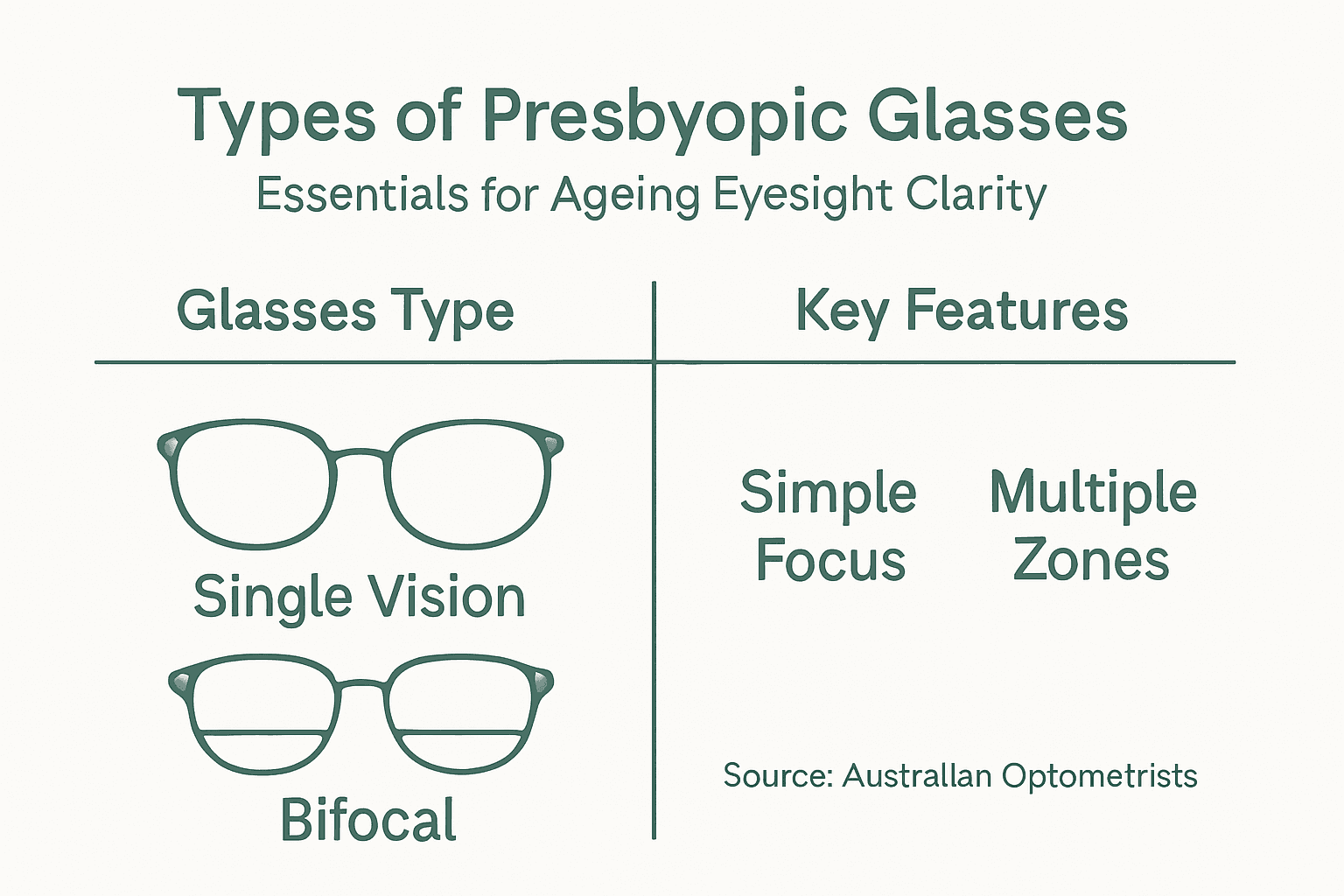
Here’s a side-by-side comparison of presbyopic glasses types and their ideal uses for Australians:
| Glasses Type | Recommended For | Visual Experience | Maintenance Needs |
|---|---|---|---|
| Single Vision | Reading, phone use | Focused near vision | Simple cleaning, low cost |
| Bifocal | Both near and distance | Noticeable lens separation | Regular checks, moderate |
| Progressive | Multi-distance activities | Smooth transitions, no lines | Precise fit, higher upkeep |
Hot tip: Consider getting a professional eye assessment to determine the most suitable presbyopic glasses for your specific vision correction needs.
How Presbyopic Glasses Correct Near Vision
As the eye ages, its natural focusing ability diminishes, creating challenges for near vision tasks. Convex lenses in presbyopic glasses are a sophisticated optical solution designed to compensate for this age-related vision change. Understanding what reading glasses are helps Australians appreciate how these specialised lenses restore clear close-up vision.

The optical mechanism behind presbyopic glasses is remarkably precise. When the eye’s natural lens becomes less flexible with age, it struggles to focus on nearby objects. Convex lenses bend light differently, moving the focal point forward onto the retina and effectively compensating for the eye’s reduced accommodation. Each lens is carefully calibrated with a specific diopter measurement tailored to an individual’s unique vision requirements.
The correction process involves adding positive lens power that the eye can no longer generate naturally. This means the glasses essentially do the focusing work that the ageing lens cannot, allowing clear vision for reading, smartphone use, and other close-range activities. The lens power is determined through comprehensive eye examinations, ensuring a personalised approach to vision correction that addresses each person’s specific near-vision challenges.
Hot tip: Schedule a professional eye assessment every two years to ensure your presbyopic glasses remain precisely matched to your evolving vision needs.
Choosing Frames and Lenses Online
Selecting the right presbyopic glasses online requires a strategic approach that balances vision correction with personal style. Tips for buying glasses online can help Australians navigate this crucial decision with confidence. The process begins with a current, accurate prescription from a licensed optometrist, ensuring your online selection precisely matches your vision needs.
When choosing frames, consider multiple factors beyond aesthetic appeal. Frame material plays a critical role in comfort and durability, with options ranging from lightweight metals to flexible acetate. Key considerations include:
- Frame width matching your facial structure
- Nose bridge fit for comfort
- Temple arm length for secure positioning
- Weight distribution for all-day wearability
Lens selection is equally important for presbyopic correction. Different lens types offer unique advantages for near vision tasks. Progressive lenses provide seamless vision transitions, while bifocals offer distinct near and distance zones. Many online platforms now offer advanced lens coatings like anti-reflective treatments and blue light protection, which can significantly enhance visual comfort for middle-aged Australians spending considerable time on digital devices.
Hot tip: Measure your pupillary distance at home using online tools and keep your most recent prescription handy to ensure accurate online glasses selection.
Alternatives to Presbyopic Glasses Compared
Australians experiencing presbyopia now have multiple innovative options beyond traditional reading glasses. Flexible reading glasses guide highlights emerging technologies that offer promising alternatives for managing age-related near vision challenges. These solutions cater to different preferences, lifestyle needs, and comfort levels.
Contact lens technologies have significantly expanded presbyopia management options. Multifocal contact lenses provide seamless vision correction by incorporating multiple prescription strengths within a single lens. Another approach, monovision contacts, involves fitting one eye for distance vision and the other for near vision, allowing the brain to adapt and create a comprehensive visual experience. This technique works particularly well for active Australians seeking versatile vision correction.
Recent medical research has introduced exciting non-surgical alternatives. Innovative eye drops containing compounds like pilocarpine are showing remarkable potential in improving near vision. These drops work by subtly constricting pupils, creating a pinhole effect that enhances focusing ability. Clinical studies in Argentina demonstrate that twice-daily applications can significantly improve close-up vision, offering a convenient alternative for those reluctant to wear glasses or undergo surgical interventions.
The table below summarises leading alternatives to presbyopic glasses for Australians:
| Alternative Option | How It Works | Ideal For | Key Consideration |
|---|---|---|---|
| Multifocal Contacts | Multiple powers in one lens | Active lifestyle | Requires adaptation |
| Monovision Contacts | One eye for distance, one near | Tasks switching between viewpoints | May affect depth perception |
| Innovative Eye Drops | Pupil constriction pinhole | Non-glasses preference | Ongoing application needed |
Hot tip: Consult an optometrist to understand which presbyopia alternative best matches your specific vision requirements and lifestyle preferences.
Discover Perfect Presbyopic Glasses for Clearer Near Vision
If you are finding it harder to focus on close-up tasks like reading or using your mobile phone due to presbyopia, it is time to explore stylish and effective eyewear solutions that suit your needs. At Ministry of Sight, we specialise in offering a diverse range of glasses including Retro Reading Glasses, Round Reading Glasses, and Rectangular Reading Glasses that combine comfort with functionality to help you see clearly and confidently.
Don’t let ageing eyesight slow you down. Take advantage of free shipping Australia wide, buy-one-get-one deals, and the satisfaction guarantee at Ministry of Sight. Find your ideal pair of presbyopic glasses today to enjoy clearer vision and renewed comfort for all your near vision tasks. Visit us now and experience effortless shopping from home.
Frequently Asked Questions
What is presbyopia and how does it affect vision?
Presbyopia is a natural age-related vision change where the eye’s lens becomes less flexible, making it difficult to see close-up objects clearly. Most commonly, this affects reading small print or using mobile devices.
What types of glasses are available for presbyopia?
There are three main types of presbyopic glasses: single vision reading glasses for focused near tasks, bifocal glasses with two power zones for near and far vision, and progressive lenses that provide a smooth transition between different viewing distances without visible lines.
How do convex lenses in presbyopic glasses correct near vision?
Convex lenses bend light to move the focal point forward onto the retina, compensating for the reduced flexibility of the ageing lens. This allows for clear vision for close-up tasks like reading or using smartphones.
Are there alternatives to traditional presbyopic glasses?
Yes, alternatives include multifocal contact lenses that provide multiple prescription strengths, monovision contacts that use one eye for distance and one for near vision, and innovative eye drops that improve near vision by constricting the pupils.
Recommended
- Understanding What are Reading Glasses and Their Importance – ministry of sight
- Understanding Your Reading Glasses Checklist for Better Vision – ministry of sight
- Complete Guide to How Reading Glasses Work – ministry of sight
- Understanding the Role of Reading Glasses for Adults – ministry of sight
- 7 Best retro sunglasses for vintage fashion enthusiasts in 2025
- Why Use Anti-Glare Screen Protectors at Home – StudioShake
- Best Sunglasses Trends of the Year - STOMART.CO.UK


