

TL;DR:
- Re-lensing existing frames is a cost-effective and environmentally friendly alternative to buying new glasses.
- Not all frames are suitable for lens replacement; condition, material, and age affect feasibility.
- Choosing the right lens type involves considering your vision needs, lifestyle, and frame compatibility.
You love your frames. They fit perfectly, suit your face, and you’ve probably had them adjusted to sit just right. But your vision has shifted, or the lenses are scratched beyond saving, and now you’re stuck wondering whether you have to start all over again. You don’t. Getting new lenses fitted into your existing frames is a well-established, cost-effective option that thousands of Australians take advantage of every year, and this guide walks you through everything: from checking your frames are suitable, to choosing the right lenses, to what the whole process actually costs and takes.
Table of Contents
- What to know before updating your lenses
- How to get new lenses fitted: step-by-step guide
- Comparing lens options: which is best for your needs?
- Troubleshooting and FAQs: what to look out for
- Why re-lensing your frames is smarter than you think
- Find your perfect lens solution with Ministry of Sight
- Frequently asked questions
Key Takeaways
| Point | Details |
|---|---|
| Keep your favourite frames | You can update lenses for most well-kept frames without buying new glasses. |
| Check frame condition first | Only solid, undamaged frames are suitable for safe and lasting lens fitting. |
| Multiple lens choices | You can customise your glasses with single-vision, bifocal, progressive, and specialty lenses. |
| Stepwise process saves money | A simple process lets you refresh your eyewear affordably and with minimal fuss. |
| Ask about coatings and extras | Lens upgrades like blue light filtering and anti-scratch coatings boost value when replacing lenses. |
What to know before updating your lenses
Not every frame can take new lenses, and it’s worth doing a quick assessment before you invest time and money into the process. Start by examining your frames closely. Run your fingers along the rim and check for fine cracks, warping, or any sign that the acetate or metal has become brittle. Frames older than five to seven years are at higher risk of breakage during the lens-fitting process, especially if they’ve been exposed to heat or heavy wear over that time.
Key things to check before booking in your frames:
- Frame condition: no visible cracks, chips, or warping along the rims
- Hinge integrity: screws should be secure and hinges should open and close smoothly
- Rim shape: fully rimmed frames hold new lenses most securely; semi-rimless and rimless styles may add complexity
- Frame size: very small or very unusual frame shapes can limit the range of lenses that will fit
- Material: high-quality acetate and metal frames generally fare better during refitting than budget plastics
You’ll also need a valid, up-to-date prescription from a registered optometrist. Prescriptions in Australia are typically valid for two years for adults and one year for children, so if yours is older than that, book an eye test before proceeding. Optometrists can also advise whether your chosen frames are structurally suited to your prescription strength. High prescriptions often require thinner lens indexes, which behave differently in different frame shapes.
As a starting point for choosing lens types, consider the range available: single-vision (for one focal point), bifocal (two zones), progressive (graduated multifocal), and specialty options like blue-light blocking, photochromic, and understanding reading lenses for close work. Your frame shape and size will influence which options work for you, so it’s also worth reviewing a guide to frame styles before committing.
| Lens type | Best for | Key consideration |
|---|---|---|
| Single-vision | Distance or near correction only | Most affordable; suits most frames |
| Bifocal | Two focal zones | Visible line on lens; not suited to wrap styles |
| Progressive | Smooth multifocal | Needs larger lens area; frame size matters |
| Reading | Close work only | Simple; wide frame choice |
| Blue-light blocking | Screen users | Can be added to most prescriptions |
| Photochromic | Indoor and outdoor use | Darkens in UV; compatible with most frames |
Pro Tip: Book your optometry appointment at least two weeks before you plan to reorder lenses, so your prescription is ready and fresh when you visit the retailer.
How to get new lenses fitted: step-by-step guide
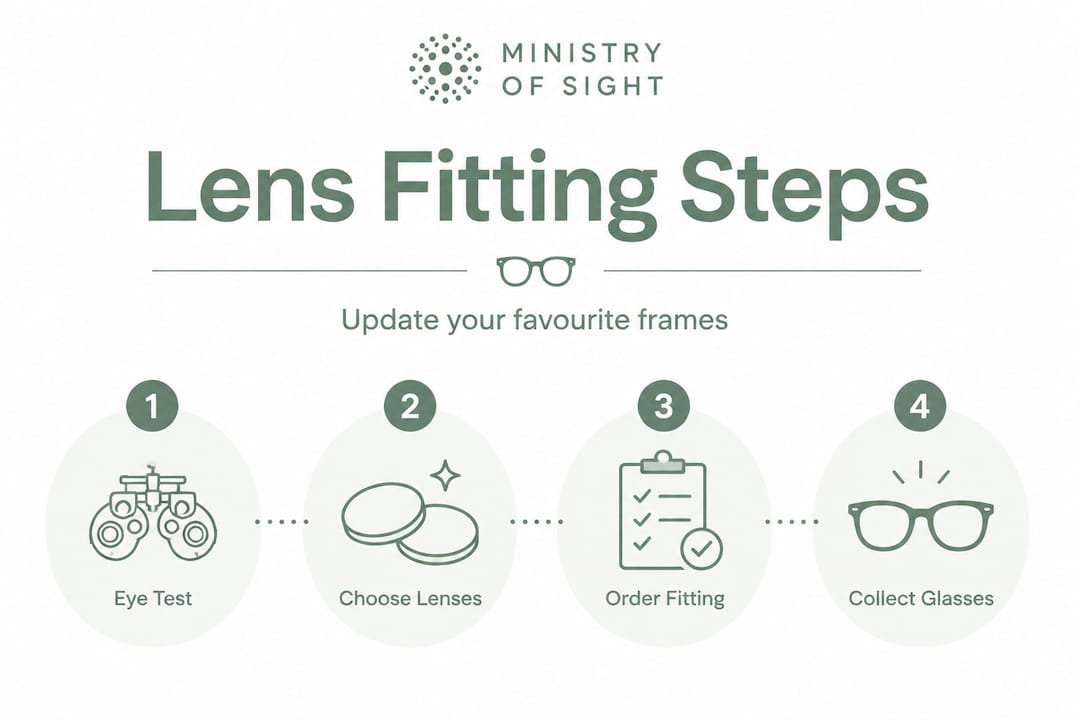
With your frames and requirements ready, here’s exactly how to arrange your new lenses stress-free. The process is more straightforward than most people expect, and knowing each stage in advance means no nasty surprises.
-
Confirm your prescription is current. Your optometrist should provide a written prescription that includes sphere (SPH), cylinder (CYL), axis, addition power (for multifocals), and pupillary distance (PD). PD is the measurement in millimetres between your pupils and it’s critical for centering your lenses correctly. Don’t skip it.
-
Choose your lens type and coatings. Decide between single-vision, bifocal, progressive, or specialty lenses. Then consider coatings: anti-reflection, UV protection, scratch resistance, and hydrophobic (water-repellent) coatings are all worth discussing. These additions improve longevity and visual comfort significantly.
-
Find a compatible retailer or optometrist. Not all optical stores accept frames from other brands or third-party purchases. Call ahead and ask explicitly whether they fit lenses into customer-supplied frames. Online retailers may also offer a mail-in service, though turnaround times vary.
-
Submit your frames. Hand over your frames physically at the store or via tracked post if using an online service. Keep a receipt or tracking number as proof.
-
Wait for fitting. Most standard single-vision lenses are cut and fitted within three to seven business days. Progressive or specialty lenses can take longer, especially if they’re ordered from an offshore lab.
-
Collect and adjust. When you collect your glasses, ask the optician to check the fit and make micro-adjustments if needed. Lenses that sit too low or too high on your nose will cause distorted vision even if the prescription is correct.
“An incorrect pupillary distance measurement, even by just two millimetres, can cause eye strain, headaches, and distorted vision. Always have your PD measured by a professional rather than estimating it yourself.”
The table below summarises each step and what to expect in terms of cost and time.
| Step | Estimated cost (AUD) | Typical timeframe |
|---|---|---|
| Eye test and prescription | $80 to $200 | Same day |
| Single-vision lenses (basic) | $80 to $200 | 3 to 5 business days |
| Progressive lenses | $250 to $600+ | 5 to 10 business days |
| Specialty coatings (per pair) | $30 to $100 | Same session |
| Frame adjustments at pickup | Usually free | 15 to 30 minutes |
When it comes to choosing lens power, the index (thickness) of your lens matters as much as the prescription power. Higher index lenses are thinner and lighter, making them ideal for stronger prescriptions or frames with smaller, more stylish rims. Your optician can walk you through the options, but knowing your options in advance helps you ask the right questions. It’s also worth exploring reading lenses types if you primarily need help with close-up tasks.

Pro Tip: Ask your optician at the time of ordering whether your chosen lenses carry a warranty against defects or delamination. Many quality lenses include a 12-month manufacturer’s warranty.
Comparing lens options: which is best for your needs?
Having covered the process, let’s compare the actual lens options available and how to pick the best for you. Choosing the wrong lens type is one of the most common reasons people feel dissatisfied after replacing their lenses, so this section is worth reading carefully.
Single-vision lenses are the simplest option. They correct vision at a single focal distance, whether that’s far away for driving, or up close for reading. They’re the most affordable option and fit almost all frame shapes. If you only need one type of correction, this is your most cost-effective path.
Bifocal lenses divide the lens into two distinct zones: one for distance and one for near vision. A visible horizontal line separates the two segments. They’re reliable and less expensive than progressives, but that visible line is a drawback for some wearers, both aesthetically and in terms of the “image jump” sensation when shifting between zones.
Progressive lenses (also called multifocal or varifocal) offer a smooth transition across multiple focal distances without any visible line. They take adjustment time, usually one to two weeks of regular wear, but most people find them far more comfortable and natural for everyday use. They require a larger vertical lens area, so very small frames can limit the usable progression zone.
Blue-light blocking lenses are worth considering if you spend more than four hours a day in front of screens. Research on their efficacy for preventing eye strain is still evolving, but many wearers report reduced headaches and improved sleep quality when using them consistently. They can be added to almost any prescription lens type.
Photochromic lenses (sometimes known by the brand name Transitions) darken automatically in sunlight and clear indoors. They offer the convenience of not needing a separate pair of sunglasses, which is a genuine advantage for Australians who spend time outdoors regularly.
| Lens type | Pros | Cons | Approximate cost (AUD) |
|---|---|---|---|
| Single-vision | Affordable, widely available | One correction only | $80 to $200 |
| Bifocal | Durable, cost-effective | Visible line, image jump | $150 to $300 |
| Progressive | Natural vision, no line | Adjustment period needed | $250 to $600+ |
| Blue-light blocking | Reduces screen strain | Limited sun protection | $50 to $120 add-on |
| Photochromic | Dual use: indoor and outdoor | Slower to clear in cool weather | $200 to $450 |
| Prescription readers | Tailored near vision | Only for close work | $100 to $250 |
As outlined in reading glasses lens types, prescription readers can be a particularly smart choice for those who only need vision correction for close work. If your lifestyle also calls for stylish frames, it’s worth having a look at on-trend frame shapes before making any final decisions.
Questions to guide your lens choice:
- How many hours a day do you spend on screens?
- Do you need correction for both distance and near vision simultaneously?
- Do you frequently go from indoors to outdoors in strong Australian sunlight?
- Do you have a strong prescription that may require a higher-index lens?
- Is budget the primary factor, or are you prioritising comfort and longevity?
Troubleshooting and FAQs: what to look out for
Choosing the right lenses is important, but knowing what can go wrong ensures the best outcome. Even with the best intentions, a few common issues can derail an otherwise smooth re-lensing experience.
Signs your frames are not suitable for re-lensing:
- Hairline cracks running through the rim or bridge
- Warping visible when the frame is placed flat on a surface
- Soft, spongy, or brittle texture in the rim material
- Loose or rusted hinges that have been repeatedly repaired
- Significant scratching or fading that suggests heavy UV degradation
Signs of poorly fitted lenses after collection:
- Lenses that move or rattle when you tap the frame
- Distorted peripheral vision that wasn’t present before
- Visible gaps between the lens edge and the frame rim
- Uneven lens alignment when the frame is placed on a flat surface
- Discomfort or pressure points on your nose or temples
One of the most common mistakes people make is skipping the prescription update and using an old script. Vision changes gradually, and even a small drift in prescription can cause significant discomfort if the new lenses don’t match what your eyes actually need right now. Another frequent error is attempting to self-measure your pupillary distance using a mirror and ruler. This method introduces more error than most people realise, and even a small inaccuracy translates to eye strain.
“There is a real risk of frame breakage during the lens-cutting process. Older frames, particularly brittle acetate or thinly rimmed styles, can crack when the rim is stretched to accept the new lens. Always discuss this risk with your optician before submitting your frames.”
Understanding whether your frames are metal or plastic also matters significantly. As covered in the metal vs plastic frames comparison, each material behaves differently under the stress of lens removal and refitting. Metal frames with adjustable screws and barrel hinges are generally more forgiving during the process. Plastic frames may need to be gently warmed before the lens can be removed or inserted, which introduces risk if the material is already aged.
Why re-lensing your frames is smarter than you think
Most optical marketing encourages you to think about “new glasses” as a complete package: new frames, new lenses, new look. And while that’s great when you genuinely want a change, it overlooks something important. The frames are often the most expensive and the most personal part of the purchase. The lenses are a functional component that wears out, changes with your prescription, or simply needs updating.
Re-lensing is a genuine act of sustainability. Eyewear frames, particularly quality acetate and metal styles, take considerable resources to produce. Discarding a perfectly good pair of frames simply because the lenses are outdated creates unnecessary waste. In a country like Australia, where we’re increasingly conscious of the environmental impact of our purchasing decisions, choosing to refresh rather than replace is a meaningful choice.
There’s also the sentimental dimension. Many people have frames they’ve searched hard to find, or that were gifted, or that genuinely suit their face in a way they’ve never replicated with a new purchase. Replacing those lenses rather than replacing the frames preserves something that has real personal value. We’ve heard this from countless customers who assumed re-lensing would be complicated or expensive, only to discover it was simpler and more affordable than buying a new complete pair.
The broader market norm, that “new glasses” always means the whole package, isn’t driven by your best interests. It’s driven by retail economics. When you separate the frame from the lens as two distinct products with different lifecycles, you make smarter, more economical decisions. A quality frame can genuinely last ten years or more. Your prescription might change every two. Those timelines don’t have to be synchronised. If you’re thinking about refreshing the look while you’re at it, exploring refresh frame style options can help you spot whether a new frame really does serve you better, or whether your current ones are already the best option.
Find your perfect lens solution with Ministry of Sight
If you’re ready to take action on updating your lenses or exploring eyewear options that work harder for your lifestyle, Ministry of Sight is a great place to start.
Ministry of Sight offers a curated range of eyewear designed for real Australian life, from sun readers to accessories that protect your updated frames day to day. The Lumière Sun Readers are a standout option for those who want the convenience of reading correction built into a stylish sunglass frame, ideal for outdoor entertaining, beach days, or anything under the Australian sun. Browse reading accessories to find cases, chains, and cleaning kits that extend the life of your eyewear. And if you want to understand the full range of reading glass options available, the about our reading glasses page gives you a clear overview of what’s on offer. Whether you’re upgrading lenses or exploring a fresh pair, Ministry of Sight makes quality eyewear accessible across Australia.
Frequently asked questions
Do all optical shops in Australia replace lenses in existing frames?
Most optical shops will replace lenses in gently used frames, but policies vary widely so it’s always worth checking with your local retailer before making the trip.
How long does it take to get new lenses fitted in my frames?
Lens fitting typically takes between three and seven business days, though progressive or specialty lenses may take up to ten business days depending on frame type and lens complexity.
Will re-lensing my frames affect their durability?
If your frames are in good structural condition, re-lensing should not compromise their durability. Damage during fitting usually only occurs with frames that are already brittle or weakened, as discussed in the metal vs plastic frames guide.
Can I get special lenses, like blue light or photochromic, put into my frames?
Yes, most optical retailers offer blue-light blocking, photochromic, and other specialty lenses to fit your existing frames, provided the frame is structurally compatible. The full range of lens types for eyewear covers all the specialty options available.
Is it cheaper to replace lenses in my frames than to buy new glasses?
Replacing lenses in your existing frames is almost always more cost-effective than purchasing a complete new pair, particularly when your frames are in excellent condition and you simply need an updated prescription or lens type.
Recommended
- How to choose between lens types for perfect eyewear – MINISTRY OF SIGHT
- Find your perfect on-trend frame shapes for style – MINISTRY OF SIGHT
- How to choose the right lens power for glasses – MINISTRY OF SIGHT
- Best Lenses for Glasses: Finding the Ideal Fit – MINISTRY OF SIGHT
- Lenses – Precision Glass


