

TL;DR:
- Proper understanding of prescription numbers ensures accurate lens selection and better vision.
- Lifestyle and prescription strength influence the choice of lens types, coatings, and materials.
- Legal requirements in Australia mandate prescriptions from registered optometrists for safe eyewear purchases.
You finally got new glasses, but something still feels off. The world looks slightly blurry, or your eyes ache after an hour of reading. This is one of the most common frustrations Australians face with eyewear, and it almost always comes down to lens power. Getting the right power is not just about reading tiny numbers on a prescription slip. It is about understanding what those numbers mean for your daily life, your vision conditions, and the type of lenses that will actually work for you. This guide walks you through everything you need to know, from decoding your prescription to avoiding the mistakes that leave people squinting.
Table of Contents
- Understanding your glasses prescription
- Which lens power is right for you?
- Types of lenses and specialty options
- What to check before buying glasses in Australia
- Our take: Why there’s no perfect formula—practical wisdom from the field
- Making your next eyewear choice easy with Ministry of Sight
- Frequently asked questions
Key Takeaways
| Point | Details |
|---|---|
| Know your prescription | A current optometrist-issued prescription is the only safe way to choose lens power in Australia. |
| Match power to lifestyle | Consider reading, driving, and screen time when selecting lens strength and coatings. |
| Lens type matters | Single vision, bifocal, and progressive lenses serve different needs—choose based on your main tasks. |
| Comfort comes first | The best power is the one you can wear comfortably with clear vision day to day. |
Understanding your glasses prescription
Before you can choose the right lens power, you need to understand what your prescription is actually telling you. It can look like a jumble of numbers and abbreviations, but each element has a clear purpose. Lens power is determined by an optometrist through refraction testing, measuring sphere (SPH) for myopia or hyperopia, cylinder (CYL) and axis for astigmatism, and add power for presbyopia.
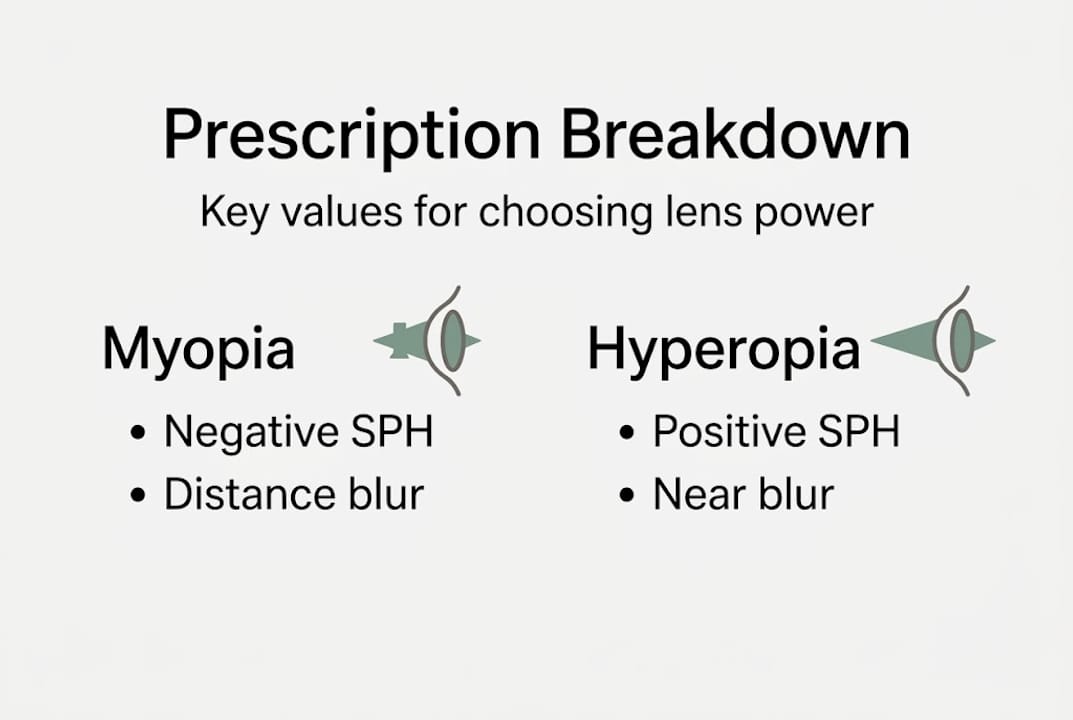
SPH (sphere) is the core correction value. A negative number means you are short-sighted (myopia), so distant objects appear blurry. A positive number means you are long-sighted (hyperopia), making close objects harder to see. CYL (cylinder) and axis work together to correct astigmatism, which is when your cornea is not perfectly round. The axis is a number between 1 and 180 degrees that tells the lens maker where to position the correction. Add power appears on prescriptions for people with presbyopia, the natural loss of near-focus ability that usually starts around age 40.
Here is a quick reference table to make sense of common prescription values:
| Prescription element | Example value | What it means |
|---|---|---|
| SPH | -2.50 | Moderate short-sightedness |
| SPH | +1.75 | Mild long-sightedness |
| CYL | -1.00 | Mild astigmatism |
| Axis | 90 | Direction of astigmatism correction |
| Add | +2.00 | Reading boost for presbyopia |
Your prescription should answer these key questions:
- Am I short-sighted, long-sighted, or both?
- Do I have astigmatism in one or both eyes?
- Do I need different corrections for distance and near vision?
- Are my two eyes significantly different from each other?
Understanding the best lens types available for your specific prescription values will help you make a much more confident choice.
Pro Tip: Ask your optometrist to explain each number on your script before you leave the clinic. A good optometrist will take five minutes to walk you through it, and that conversation can save you a lot of confusion later.
Which lens power is right for you?
With your prescription in hand, let’s find out what those numbers mean for your real-world vision and daily life. The strength of your prescription directly affects which lenses will suit you, how thick they will be, and what you can realistically expect from your vision correction.
Negative SPH values indicate myopia, ranging from mild at around -0.25 to high at -6.00 and beyond, while positive values indicate hyperopia, with higher absolute values meaning stronger correction and thicker lenses. This matters practically because a high prescription changes which lens materials are worth considering.
Here is how prescription strength maps to typical vision needs:
| Power range | Category | Common uses |
|---|---|---|
| 0 to +/-1.00 | Mild | Light reading, minor distance blur |
| +/-1.25 to +/-3.00 | Moderate | Everyday driving, screen work |
| +/-3.25 to +/-6.00 | Strong | Full-time wear, distance and near |
| Above +/-6.00 | High | Specialist lenses often needed |
Your optometrist determines your power through a structured process:
- Initial visual acuity test using a standard eye chart to identify how much correction is needed.
- Refraction test using a phoropter to fine-tune sphere, cylinder, and axis values.
- Binocular balance check to ensure both eyes work together comfortably.
- Trial frame fitting where you wear test lenses and give real-world feedback.
- Final prescription issue once your optometrist is satisfied with clarity and comfort.
Age and lifestyle also play a big role. If you spend long hours driving, your distance correction needs to be precise. If you work on screens all day, an add power or specific lens design might reduce eye strain significantly. People over 45 often benefit from progressive lenses that handle both distance and near in one pair.

Pro Tip: For prescriptions above +/-2.00, ask about high-index lenses. They are thinner and lighter than standard lenses, which makes a noticeable difference in comfort and appearance. When shopping for glasses online, check whether high-index options are available and factor this into your budget. More buying glasses tips can help you navigate the options confidently.
Types of lenses and specialty options
Knowing the right power matters, but choosing the correct lens type and coatings is just as vital. The lens type determines how your vision is corrected across different distances, while coatings can make a significant difference to comfort in the Australian environment.
Single vision lenses correct for one distance only, bifocal lenses have two distinct zones separated by a visible line, and progressive or multifocal lenses offer a seamless transition between near, intermediate, and far vision. Single vision is the most common choice for people who are simply short-sighted or long-sighted. Bifocals are a practical choice for people who want clear distance and reading vision without carrying two pairs. Progressives are the modern favourite because there is no visible line and the transition feels more natural.
For more extreme prescriptions, specialty options come into play. High prescriptions above +/-10D may require lenticular lenses, which minimise thickness by concentrating the correction in the centre of the lens. Astigmatism requires precise CYL and axis correction, which is built into most standard prescription lenses but must be accurately measured.
Coatings are where many Australians underestimate the value they can add:
- Anti-reflective coating: Reduces glare from headlights and screens, which is essential for driving at night or working in brightly lit offices.
- Blue light filter: Helps reduce eye strain from prolonged screen use, particularly relevant for remote workers and students.
- Photochromic (transitions) lenses: Darken automatically in sunlight and clear indoors, ideal for people who move between environments frequently.
- UV protection coating: Critical in Australia given our high UV index. Many lenses include this by default, but always confirm.
- Scratch-resistant coating: Extends the life of your lenses, especially if you are active outdoors.
Important note on progressives: Progressive lenses can take two to four weeks to adapt to. During this period, peripheral distortion is normal and your brain is learning to use different zones of the lens. If discomfort persists beyond a month, return to your optometrist for a recheck rather than assuming the prescription is wrong.
If you are exploring options for close-up reading, the essential reading glasses guide covers what most Australians should consider before purchasing.
What to check before buying glasses in Australia
Once you have found your ideal lens type and power, it is time to make your purchase safely and legally. Australia has specific rules around prescription eyewear that protect consumers from poorly fitted or incorrect lenses.
Australian law requires that prescriptions be provided by registered optometrists, and consumers cannot self-select power without a proper eye examination. The only exception is over-the-counter reading glasses for presbyopia, which typically range from +1.00 to +2.75 and are sold based on general age-related need rather than a specific prescription.
Here are the steps to legally and safely obtain glasses in Australia:
- Book an eye examination with a registered optometrist. Medicare covers standard eye tests for eligible Australians.
- Receive your written prescription after the examination. It is valid for two years for adults in most states.
- Choose your frames and lens type based on your lifestyle, prescription strength, and budget.
- Provide your prescription to the retailer, whether in-store or online.
- Confirm the fit and lens quality when your glasses arrive, and return within the adjustment period if something feels wrong.
Common mistakes Australians make when buying glasses:
- Using an outdated prescription that no longer reflects their current vision needs.
- Buying reading glasses from a chemist without checking whether they have astigmatism that needs correcting.
- Mismatching lens power between eyes because they assumed both eyes are the same.
- Skipping coatings to save money, then finding the lenses uncomfortable in real-world conditions.
Understanding your eyewear rights in Australia can help you push back if a retailer provides incorrect lenses or refuses to adjust a faulty pair. For those specifically looking at readers, the guide on buying reading glasses online is worth reading before you purchase. And if you want a full walkthrough of the process, the glasses online step-by-step guide covers every stage from prescription to delivery.
Our take: Why there’s no perfect formula—practical wisdom from the field
Here is something the numbers on your prescription will never tell you: comfort is the real measure of success. We have seen people chase a theoretically perfect prescription only to find they cannot wear those glasses for more than an hour. And we have seen people with modest corrections who wear their glasses all day without a second thought.
Your prescription is a starting point, not a final answer. Tuning is completely normal. If your first pair feels slightly off, that is not a failure. It is part of the process. The best outcomes come from people who stay in dialogue with their optometrist, give honest feedback about how their vision feels in real situations, and are willing to revisit their script when their lifestyle changes.
Multiple pairs often serve people better than trying to find one perfect lens. A dedicated reading pair, a distance pair for driving, and perhaps a pair with photochromic lenses for outdoor use can each be optimised for their purpose. Explore best lens choices insights to see how different lens designs serve different needs. The relationship you build with your optometrist over years is worth far more than any single prescription.
Making your next eyewear choice easy with Ministry of Sight
You now have the knowledge to approach your next eyewear purchase with real confidence. Understanding your prescription, matching it to the right lens type, and knowing the Australian rules around buying glasses puts you well ahead of most shoppers.
Ministry of Sight makes it straightforward to put that knowledge into action. Whether you are after reading glasses accessories to keep your eyewear in top condition, or you want to explore stylish sun readers that combine UV protection with your reading correction, the range is built for real Australian lifestyles. Browse the full collection and find the pair that fits both your prescription and your daily routine.
Frequently asked questions
Can I choose my own lens power without seeing an optometrist in Australia?
No, Australian law requires a current prescription from a registered optometrist for prescription glasses. The only exception is over-the-counter readers for presbyopia.
What does the ‘SPH’ value on my prescription mean?
SPH indicates whether you are short-sighted (negative value) or long-sighted (positive value), with higher absolute numbers meaning stronger correction and typically thicker lenses.
Should I choose progressive lenses or bifocal lenses?
Progressive lenses are generally preferred for their seamless appearance and flexible vision zones, though they do require an adaptation period of a few weeks.
Which lens coatings are best for the Australian lifestyle?
For most Australians, anti-reflective, blue light, and photochromic coatings cover the key needs of driving, screen use, and outdoor activity, with UV protection being non-negotiable given Australia’s sun intensity.


