

TL;DR:
- Lens choice impacts clarity, comfort, and style, making understanding types essential.
- Personal lifestyle, activities, and environment should guide lens and coating selections.
- Prioritize fit, purpose, and long-term value over unnecessary features for satisfaction.
You’ve found a gorgeous pair of frames, but then the lens conversation starts and suddenly you’re drowning in jargon: single vision, multifocal, anti-reflective, blue light blocking. It’s enough to make anyone’s head spin. The truth is, the lens you choose matters just as much as the frame, affecting how clearly you see, how comfortable your eyes feel, and yes, how polished the whole look comes together. This guide walks you through every lens type, what to consider before you buy, and how to match features to your lifestyle so you leave feeling confident, not confused.
Table of Contents
- Understanding the main lens types
- What to consider before choosing your lenses
- Comparing lens features and enhancements
- Step-by-step process for choosing your ideal lens type
- A new perspective on lens selection
- Find your perfect eyewear match with Ministry of Sight
- Frequently asked questions
Key Takeaways
| Point | Details |
|---|---|
| Know your main activities | Your typical daily tasks should shape your lens type decision. |
| Consider comfort and clarity | Choose features and coatings that suit your lifestyle for the best experience. |
| Comparison is essential | Look at all lens enhancements side by side before buying. |
| Take a step-by-step approach | Follow a clear process to make a confident and informed eyewear choice. |
Understanding the main lens types
Not all lenses are created equal, and different lens types offer specific benefits for various visual needs. Knowing the difference upfront saves you from buying the wrong pair twice.
Single vision lenses are the most common. They correct one focal point only, either distance or near vision, making them ideal for people with a straightforward prescription. They work beautifully for everyday use and come in the widest range of lens materials.
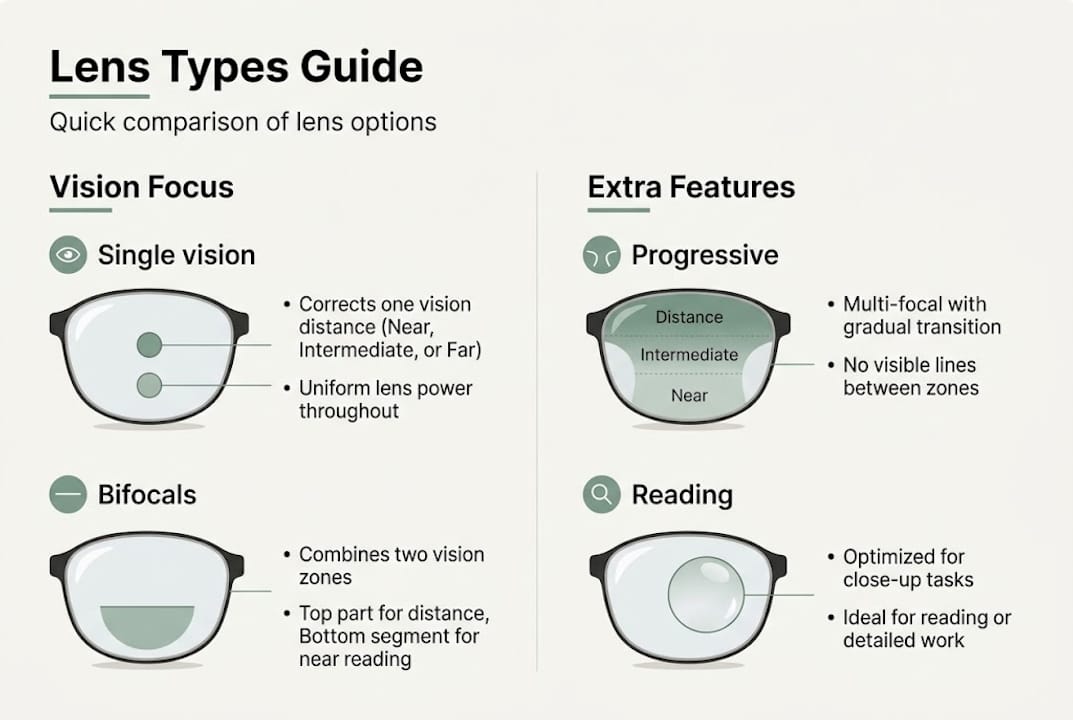
Bifocal lenses contain two distinct zones, one for distance and one for close-up work, with a visible line dividing them. They suit people who need correction at both ends of the spectrum but prefer a more traditional solution.
Multifocal or progressive lenses are the modern upgrade on bifocals. They offer a seamless transition across distance, intermediate, and near focal zones without any visible line. Many wearers find them more natural looking and more comfortable over long periods.
Reading lenses are optimised purely for close-up tasks like books, phones, or screens. There’s a wide variety of reading glasses lens types designed to match different strengths and reading distances.
Fashion-first lenses may include non-prescription or lightly tinted options where style leads the decision. These are popular in sunglasses or statement frames where the visual correction is minimal or optional.
| Lens type | Best use | Visual benefit |
|---|---|---|
| Single vision | Distance or near correction | Sharp, focused single zone |
| Bifocal | Combined distance and reading | Dual focus, traditional |
| Multifocal/progressive | All-distance correction | Seamless, natural transition |
| Reading | Close-up tasks only | Optimised near clarity |
| Fashion/non-prescription | Style or light UV tint | Aesthetic appeal |
Pros and cons at a glance:
- Single vision: Simple and affordable, but won’t help if you need both distance and near correction
- Bifocal: Effective for two zones, but the visible line can look dated and cause image jump
- Progressive: Versatile and modern, but takes an adjustment period and costs more
- Reading: Affordable and targeted, but must be removed for distance tasks
- Fashion: Stylish and fun, but limited functional correction
Pro Tip: Think about the one activity you do most often, whether that’s driving, reading, or working at a screen, and let that drive your lens choice first.
What to consider before choosing your lenses
Knowing the types is a solid start, but getting clear on your personal requirements is what turns knowledge into the right purchase. Lifestyle and prescription needs are the top two factors when choosing lenses, and skipping either one often leads to regret.
Start with these questions before you do anything else:
- What is your current prescription strength, and has it changed in the past year?
- What is your primary activity: reading, driving, computer work, or outdoor sport?
- What environments do you wear your glasses in most, indoors, outdoors, or both?
- Do you want your glasses to look a certain way, minimalist, bold, professional?
- Are you experiencing eye fatigue, glare, or headaches with your current pair?
Australians are spending more time on screens than ever, with over 75% of adults using digital devices for at least four hours daily, driving significant demand for lenses that manage screen-related eye strain. This shift means that for many buyers, blue light filtering has moved from a nice-to-have to a practical necessity.
Cost is another real factor. Premium lenses and coatings carry a higher upfront price, but they often outlast and outperform budget options significantly. Consider the full picture: comfort over months, visual clarity, and how long the lenses hold up to daily use.
Checklist before you choose:
- Current prescription from a registered optometrist (ideally within the last two years)
- Your primary visual tasks and the environments you’re in daily
- Budget range including coatings and add-ons
- Preferred frame style, since some frames suit certain lens thicknesses better
- Any sensitivity issues such as light glare, screen fatigue, or dry eyes
- Whether lens coatings like UV or anti-reflective are needed for your environment
Pro Tip: Investing a little more in quality coatings often delivers better long-term eye comfort than spending that same amount upgrading to a fancier frame.
Comparing lens features and enhancements
Once you know your requirements, weighing up features helps you customise your choice. The lens itself is just the starting point. Enhancements and coatings are what really fine-tune the experience.

Anti-reflective coating reduces glare from screens, headlights, and overhead lighting. It’s one of the most popular add-ons for good reason: it makes lenses clearer in most indoor and night-time conditions.
Blue light blocking filters a portion of the high-energy visible light emitted by screens. Many users report reduced eye fatigue and better sleep quality after switching.
Photochromic lenses (often known by the brand name Transitions) darken automatically in sunlight and return to clear indoors. They’re a practical choice for people constantly moving between environments.
Scratch-resistant coatings extend lens life considerably. Given how often glasses are handled, cleaned, and occasionally dropped, the scratch-resistant benefits are easy to underestimate until your lenses are already compromised.
UV coatings block harmful ultraviolet rays. Particularly important in Australia’s harsh sun conditions, this coating protects your eyes much like sunscreen protects your skin.
| Enhancement | Primary benefit | Ideal for | Approx. cost tier |
|---|---|---|---|
| Anti-reflective | Glare reduction | Screen users, drivers | Low to mid |
| Blue light blocking | Eye fatigue reduction | Office and digital workers | Low to mid |
| Photochromic | Indoor/outdoor adaptation | Frequent environment changers | Mid to high |
| Scratch-resistant | Lens longevity | Active or busy lifestyles | Low |
| UV coating | UV eye protection | Outdoor Australians | Low |
How to assess if you need a specific enhancement:
- Identify your biggest daily visual frustration, glare, fatigue, or exposure
- Match that frustration to the enhancement designed to address it
- Consider whether you spend more time indoors, outdoors, or both
- Factor in how long you plan to keep the glasses before your next upgrade
- Ask whether the coating is covered under warranty or a satisfaction policy
“The right lens coatings explained are not just add-ons. Coatings such as anti-reflective and scratch-resistant make a significant performance difference to the overall quality, longevity, and comfort of your eyewear experience.”
Step-by-step process for choosing your ideal lens type
Now, let’s tie everything together in an easy-to-follow selection process. A methodical approach ensures the right fit, quality, and style rather than leaving things to guesswork at the counter.
- Confirm your prescription. Start with a current prescription from your optometrist. If it’s more than two years old, book an eye test before purchasing anything. Lens strength matters enormously.
- Define your primary use case. Decide on your number one activity: reading, distance, screens, driving, or outdoor sports. This becomes the anchor for all other decisions around choosing lens strengths.
- Choose your lens type. Based on your prescription and activities, select from single vision, bifocal, progressive, or reading lenses. Use the table from the first section as your reference.
- Select your enhancements. Layer on the coatings that match your lifestyle needs. Combine UV protection with anti-reflective for outdoor office workers, or add blue light blocking for heavy screen users.
- Compare total value, not just price. Look at the full cost including coatings, warranty, and return policies. A slightly more expensive lens that lasts two years and stays scratch-free is better value than a cheaper one that degrades in six months.
- Verify fit and comfort before you commit. If a retailer offers a trial period, take advantage of it. Wear the lenses in your actual daily environment, not just in the shop.
- Follow proper care from day one. Good lens care steps from the start protect your investment and keep your vision consistently clear.
Pro Tip: Write down your top three priorities before you speak to anyone in store or online. It keeps you focused on what you actually need rather than what’s being promoted that week.
A new perspective on lens selection
Here’s something the eyewear industry doesn’t always say clearly: the best lens isn’t the newest, the most expensive, or the one with the most features. It’s the one that fits your specific vision and life.
There’s a quiet pressure in retail to always choose the premium option. The upsell on photochromic lenses sounds logical, the blue light add-on feels responsible, and before long, you’re paying for three enhancements you don’t genuinely need. What actually leads to lasting satisfaction is a decision grounded in your real daily routine, not in marketing language.
When you focus on modern lens choices that serve your specific prescription and lifestyle, something interesting happens: the glasses you end up with feel effortless. You stop noticing them. That’s the goal.
“Informed buyers consistently report higher satisfaction with their eyewear, not because they spent more, but because they chose based on need rather than novelty.”
Style matters enormously and we absolutely believe a great pair of glasses should look incredible. But the frame gets the compliment, while the right lens does the quiet, essential work of making every day easier.
Find your perfect eyewear match with Ministry of Sight
Ready to put everything you’ve just learnt into practice? At Ministry of Sight, we’ve built our range around the idea that great eyewear should never ask you to choose between looking good and seeing clearly.
Browse our full selection of frames paired with the lens options that suit your lifestyle, or explore our accessories and storage to keep your investment protected. If you want a stylish option that blends sun protection with reading convenience, our Lumière Sun Readers are a fan favourite across Australia. With free shipping Australia-wide and a satisfaction guarantee, there’s every reason to explore with confidence.
Frequently asked questions
What is the main difference between single vision and multifocal lenses?
Single vision lenses correct only one type of vision, while different lens types like multifocals address distance, reading, and intermediate focus all within one lens. The right choice depends on whether you need correction at one or multiple focal distances.
Are anti-reflective coatings really worth it?
For most wearers, yes. Anti-reflective coatings significantly reduce glare from screens and artificial lighting, making everyday wear noticeably more comfortable, especially for those working indoors or driving at night.
How can I ensure my new lenses fit my style as well as my vision?
Choose lens features that match your main activities, then pair them with frames that suit your preferred aesthetic. Matching lens type to your activity delivers both comfort and visual clarity without sacrificing personal style.
What should I do if my new lenses don’t feel right?
Use your retailer’s trial or return policy and consult your optometrist to confirm your prescription and fit are both accurate. As a methodical approach reminds us, fit and quality verification are part of the process, not an afterthought.


