

Text starts to blur, and holding your phone at arm’s length quickly turns into a daily habit. Many Australians notice these changes around age 40 as their eyes adapt to presbyopia, a natural part of getting older. Affordable reading glasses offer a practical way to restore crisp near vision without hassle. This guide breaks down how reading glasses work and shows you straightforward options for improving clarity while staying within your budget.
Table of Contents
- Reading Glasses Explained For Ageing Eyes
- How Lenses Correct Presbyopia Symptoms
- Types Of Reading Glasses Available Online
- Choosing The Right Power And Fit
- Common Mistakes And Safety Tips
Key Takeaways
| Point | Details |
|---|---|
| Presbyopia is Inevitable | Most individuals begin experiencing presbyopia around age 40 due to the hardening of the eye’s lens. Regular eye exams will help monitor changes in vision over time. |
| Reading Glasses Enhance Vision | Reading glasses correct blurred vision by bending light properly, enabling clear focus on close objects and improving quality of life. |
| Custom vs. Ready-Made Glasses | Custom-made glasses are tailored to individual prescriptions, especially beneficial for those with astigmatism or differing prescriptions between eyes. Ready-made glasses are a convenient option for those with similar vision needs. |
| Eye Health is Crucial | Regular check-ups are essential for detecting other vision issues like cataracts. Ensure glasses offer UV protection when outdoors to safeguard your eyes from harmful rays. |
Reading Glasses Explained For Ageing Eyes
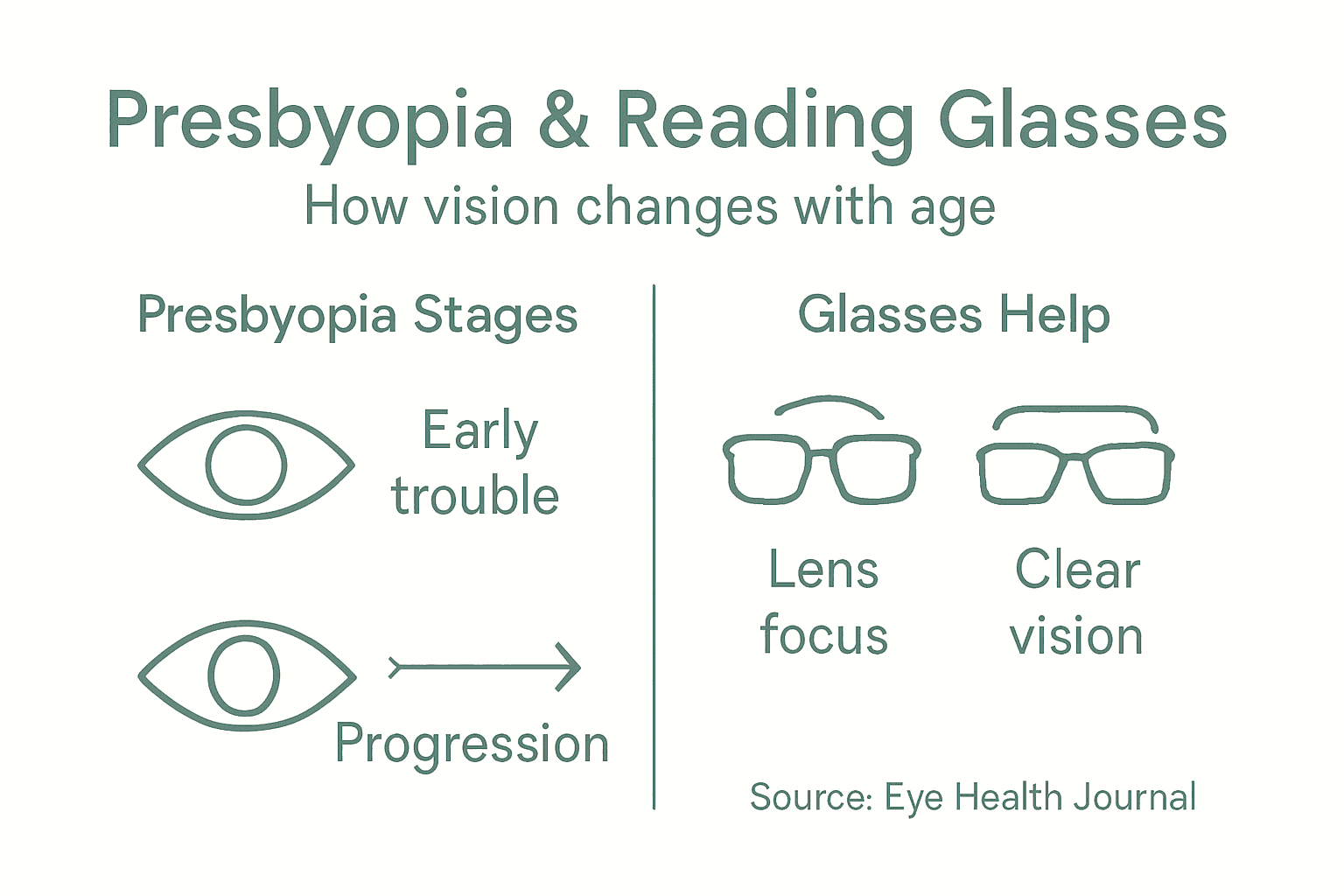
Around age 40, something shifts in your eyes. Text on menus becomes fuzzy. You hold your phone further away to read messages. You’re not imagining it. Your eye’s lens has started to harden, making it increasingly difficult to focus on close objects. This age-related condition is called presbyopia, and it affects virtually everyone eventually.
Presbryopia happens because the lens in your eye loses flexibility over time. When you’re young, tiny muscles around the lens contract and relax to shift focus between distant and close objects. As you age, the lens becomes denser and less pliable, so those muscles can’t reshape it effectively anymore. This is a completely natural part of ageing, not a sign that anything is wrong with your vision. The condition typically becomes noticeable somewhere between your late 30s and early 50s.
Reading glasses work by placing a lens in front of your eye that does the focusing work your natural lens can no longer manage. When you look through the magnified lens, light bends at precisely the right angle to land directly on your retina, bringing close objects into sharp focus. You’re essentially giving your eye a helping hand. Different prescriptions exist for different near vision distances, so some people might need stronger glasses for reading than for computer work.
Understanding how reading glasses work helps you appreciate why they’re not a weakness but rather a practical solution. Your eyes aren’t failing; they’re simply adapting to a stage of life where additional support improves your quality of life. Many Australians in your age group find reading glasses transform everyday activities, from enjoying a novel to checking recipes whilst cooking.
Presbryopia progresses gradually over about 10 to 15 years. You might notice your reading glasses prescription changing every one or two years during this time. Regular eye exams catch these changes early, ensuring your glasses always provide optimal clarity. An optometrist can also rule out other vision problems that might be developing alongside presbyopia.
Pro tip: Keep multiple pairs of reading glasses in different locations—bedside table, kitchen drawer, handbag—so you’re never without clarity when you need it.
How Lenses Correct Presbyopia Symptoms
Reading glasses work through a straightforward optical principle: they bend light rays before they enter your eye, compensating for what your hardened lens can no longer do. When light hits the curved surface of a reading glass lens, it refracts at a precise angle that allows it to focus correctly on your retina. This simple redirection transforms blurry text into sharp, readable words. It’s the same physics that’s been used for centuries, just refined for your specific vision needs.

The strength of your reading glasses depends on how much help your eyes need. Someone with mild presbyopia might manage with a lower power, such as +1.00 or +1.50, whilst someone with more advanced presbyopia may require +2.50 or higher. Glasses lens strength directly corresponds to how much the lens bends light, measured in dioptres. Your optometrist determines the exact power needed by testing what brings words into sharp focus during your eye examination.
Different lens designs serve different purposes. Standard reading glasses work best for close work at a fixed distance, typically 30 to 40 centimetres from your eyes. Progressive lenses, by contrast, offer multiple zones of focus in a single pair of glasses, allowing you to see clearly at varying distances without switching between pairs. Bifocals sit somewhere in between, with a visible line separating the reading portion from the distance portion. Your lifestyle and daily activities should guide which option suits you best.
The beauty of reading glasses is that they’re remarkably effective at eliminating presbyopia symptoms. Fuzzy menus become legible again. You stop squinting at your phone. You can read to your grandchildren without holding the book at arm’s length. For most people aged 40 and beyond in Australia, a decent pair of reading glasses transforms how you experience daily life.
One advantage over some alternative solutions is simplicity. Unlike surgical procedures, reading glasses involve no recovery time and no permanent changes to your eyes. You simply put them on when you need them and remove them when you don’t. If your prescription changes in a year or two, you simply get new glasses. That flexibility matters when your vision is still adjusting to presbyopia.
Pro tip: Get both a stronger pair for detailed work like reading or sewing and a weaker pair for computer distance, so you’re never struggling through blurry vision regardless of what you’re doing.
Types Of Reading Glasses Available Online
When you start shopping for reading glasses online, you’ll quickly discover the options fall into two main categories: ready-made and custom-made. Ready-made reading glasses are those grab-and-go pairs you can order immediately without a prescription. They’re typically identical in both lenses and come in standard strengths ranging from +1.00 to +3.00 dioptres. These work well if both your eyes have similar vision needs, which is true for many people. The convenience factor appeals to Australians wanting quick solutions without scheduling an eye appointment.
Custom-made reading glasses, by contrast, are tailored to your specific prescription. Your optometrist tests each eye separately, accounting for any differences between left and right. This personalisation matters if you have unequal vision or astigmatism. Custom glasses also allow you to choose lens types for reading glasses that suit your exact lifestyle needs. You’ll pay more upfront, but the precision often justifies the cost for regular wearers.
Single Vision Versus Multifocal Options
Single vision lenses are the simplest choice. They focus at one distance, typically optimised for reading and close work. You look straight through them for sharp clarity when viewing nearby objects, making them ideal if you only need glasses for specific tasks.
Progressive lenses offer a completely different experience. Instead of a visible line, they blend smoothly from near vision at the bottom to distance vision at the top, with intermediate focus zones in between. You can look down to read, straight ahead to work on your computer, and up to see across a room, all without switching glasses. Some people find the adjustment period frustrating, but once you adapt, progressives feel seamless.
Bifocals and trifocals sit between these options. Bifocals have two distinct viewing areas separated by a visible line, whilst trifocals add a middle zone for intermediate distances. Both are less expensive than progressives and offer multiple focal points, though the visible lines bother some wearers.
Here’s a comparison of popular reading glasses lens types to clarify their uses and benefits:
| Lens Type | Best For | Distinctive Feature | Typical Adjustment Period |
|---|---|---|---|
| Single Vision | Reading up close | Focuses at one distance | None or minimal |
| Bifocal | Reading and distance | Two zones, visible line | Short (a few days) |
| Progressive | Multiple distances | No lines, seamless view | 1-2 weeks |
| Trifocal | Near, mid, far view | Three zones, visible lines | About one week |
Frame Materials and Special Features
Frames come in plastic, metal, and acetate materials. Plastic frames are lightweight and durable, ideal if you’re active. Metal frames look more refined and often cost slightly more. You can also find foldable frames, perfect for slipping into your bag, and frames with blue light blocking coatings to reduce screen strain during computer work.
For quick reference, here are factors influencing frame selection and wearer satisfaction:
| Frame Material | Durability Level | Weight | Typical Price Range |
|---|---|---|---|
| Plastic | Moderate | Light | Lower |
| Titanium | Very high | Very light | Highest |
| Metal | High | Moderate | Medium |
| Acetate | High | Light to moderate | Medium |
Pro tip: Buy one pair of ready-made readers in a common strength like +1.50 to test what works for you before investing in custom prescription glasses tailored to your exact needs.
Choosing The Right Power And Fit
Getting the right strength matters more than most people realise. Too weak and you’re squinting again. Too strong and you get headaches or eye strain from overcompensation. Most people need somewhere between +1.00 and +2.50 dioptres, but your specific number depends entirely on your individual vision and how far you typically hold reading materials from your eyes.
Ready-made glasses work best if both your eyes have roughly the same prescription and neither has astigmatism. You can test this yourself by covering one eye and seeing if you notice a significant difference in clarity. If your eyes are fairly balanced, a standard strength like +1.50 or +2.00 will likely serve you well. Many Australians find one pair of ready-made readers handles their everyday needs perfectly.
But if your eyes have different prescriptions, custom glasses become worthwhile. An optometrist can prescribe different powers for each eye, ensuring both work equally. Astigmatism, which causes blurred vision at all distances, also requires a custom prescription to correct properly. Higher prescriptions above +2.50 benefit from custom lenses too, since stronger powers need larger lens surfaces to avoid distortion and edge thickness.
Frame Fit and Lens Size
Proper frame fit affects both comfort and vision quality. Your glasses should sit level on your nose without sliding, rest comfortably on your ears, and not pinch your temples. Frames that are too loose shift during wear, throwing off your optical alignment. Frames that are too tight cause headaches after a few hours.
Lens size matters significantly with stronger prescriptions. Larger lenses provide better coverage, reducing the chance of distortion at the lens edges. With multifocal lenses like progressives or bifocals, you need adequate vertical height so each zone has enough space to work properly. Smaller frames can actually limit your usable vision when prescriptions get stronger.
Material choice influences durability and weight. Titanium and quality metal frames offer excellent strength whilst staying lightweight. Acetate frames are durable and come in countless colours and styles. Plastic tends to be budget friendly but may not last as long with daily wear. Consider your lifestyle when choosing materials.
Pro tip: Order your reading glasses online with a generous return window so you can test the fit and power for several days before committing, ensuring they work for your specific vision needs.
Common Mistakes And Safety Tips
One of the biggest mistakes people make is skipping the eye examination altogether. You might think reading glasses are simple enough to buy online without professional guidance, but that shortcut can cost you. An optometrist doesn’t just measure your reading prescription. They check for underlying conditions like cataracts, glaucoma, or macular degeneration that could be developing silently. Catching these early makes all the difference in preserving your vision long term.
Wearing the wrong prescription ranks high on the mistake list too. Too strong and you develop headaches after wearing them for an hour. Too weak and you strain your eyes trying to focus, leading to fatigue and discomfort. The temptation to buy a “one size fits all” strength without testing is understandable, but it often leads to frustration. Your eyes deserve precision, not guesswork.
Another common error is assuming over-the-counter readers suit everyone equally. They genuinely don’t work if you have different prescriptions between eyes or if astigmatism affects your vision. Forcing yourself into generic glasses when you need custom ones is like trying to fit into someone else’s shoes. It might work momentarily, but eventually the discomfort catches up.
Protecting Your Eyes Properly
UV protection matters more than many people realise. If you wear reading glasses outdoors, make sure they have UV 400 protection to shield against harmful ultraviolet rays. Sun damage to your eyes accumulates over years, potentially leading to cataracts and other conditions. It’s not vanity; it’s genuine eye health.
Handle your glasses carefully to avoid accidental damage. Regular eyeglasses are not designed to withstand impacts and can shatter if dropped or struck forcefully. Scratched lenses reduce clarity and force your eyes to work harder to see through them. Store glasses in a protective case, not loose in your bag where they can get damaged.
Schedule regular check ups every one to two years once you reach your 40s. Your vision changes throughout your life, and what worked last year might not serve you well this year. Professional eye exams catch these shifts before you even notice them, keeping your glasses prescription current and your vision sharp.
Pro tip: Always order reading glasses from reputable retailers who offer proper return policies so you can verify the fit and power work for you before finalising your purchase.
Rediscover Clear Vision With Stylish Reading Glasses
If your eyes are struggling with presbyopia and daily reading has become a challenge, the simple yet powerful solution lies in the right pair of reading glasses. Whether you prefer the classic look of Round Reading Glasses or the modern appeal of Rectangular Reading Glasses, Ministry of Sight offers stylish options that help restore sharp focus and make close-up tasks effortless again. These glasses correct the light refraction your ageing lens can no longer manage, bringing back the clarity you need without discomfort.
Don’t let blurry menus or squinting at your phone slow you down. Visit Ministry of Sight to explore affordable, comfortable glasses designed for ageing eyes. With free shipping across Australia and satisfaction guaranteed, now is the perfect time to reclaim your reading comfort. Choose your next pair today and experience clear vision that feels natural and confident.
Frequently Asked Questions
What is presbyopia and how does it affect vision?
Presbyopia is an age-related condition that typically starts around age 40, causing the lens of the eye to lose flexibility. This makes it difficult to focus on close objects, leading to blurry text when reading or using a phone.
How do reading glasses help with presbyopia?
Reading glasses work by bending light rays before they enter your eye, allowing them to focus properly on the retina. This compensation helps bring close objects into clear view, reducing strain and improving overall clarity for reading and other close tasks.
What types of reading glasses are available, and how do they differ?
Reading glasses come in two main types: ready-made and custom-made. Ready-made glasses are available in standard strengths without a prescription, while custom-made glasses are tailored to your specific vision needs, considering any differences in prescription between your eyes.
How can I determine the right strength for my reading glasses?
The right strength for reading glasses typically falls between +1.00 and +2.50 dioptres, depending on how much help your eyes need. To find the correct power, consider how far you usually hold reading materials from your eyes, and consult an optometrist for an accurate assessment.
Recommended
- Understanding Your Reading Glasses Checklist for Better Vision – ministry of sight
- Understanding the Role of Reading Glasses for Adults – ministry of sight
- Understanding What are Reading Glasses and Their Importance – ministry of sight
- How Reading Glasses Improve Reading: Complete Guide – ministry of sight


