

TL;DR:
- Major eyewear chains in Australia provide wide styles, competitive prices, and strong customer service.
- Bulk purchasing and promotional strategies enable chains to offer affordable, stylish glasses compared to independents.
- Advances in digital tools and omnichannel shopping empower customers with more control and convenience.
Buying glasses in Australia used to mean choosing between paying a small fortune at a boutique optometrist or settling for whatever limited stock your local independent stocked. That equation has shifted dramatically. Major eyewear chains now offer Australians hundreds of frame styles, competitive pricing, and genuinely strong customer service, all without the premium price tag that once felt unavoidable. Whether you’re replacing a scratched pair, chasing a seasonal trend, or shopping online from regional Queensland, understanding how these chains operate can save you money and sharpen your style at the same time.
Table of Contents
- What are eyewear chains and why do Aussies choose them?
- How eyewear chains drive style, function, and accessibility
- Are eyewear chains truly budget-friendly? Price strategies explained
- Customer service and aftercare: What really sets chains apart
- Eyewear chains’ role in modern Aussie shopping: Online, in-store, or both?
- The hidden truth about eyewear chains: More control for shoppers, not less
- Make the most of eyewear chains: Accessories and convenience for every need
- Frequently asked questions
Key Takeaways
| Point | Details |
|---|---|
| Market leaders matter | Major eyewear chains like Specsavers and OPSM set industry standards for style, service, and price. |
| Affordable quality | Chains make it easy for Australians to get stylish, functional eyewear on a budget. |
| Flexible shopping options | Online and in-store experiences are designed for both urban and regional customers. |
| Customer service leads | Eyewear chains invest in personalisation, aftercare, and transparency to build trust. |
| Accessories enhance value | Glasses chains offer helpful extras that boost both style and practicality. |
What are eyewear chains and why do Aussies choose them?
Eyewear chains are large-scale retail networks that sell prescription glasses, sunglasses, contact lenses, and related accessories across multiple store locations, often supported by online platforms. In Australia, the category grew significantly from the 1980s onward as bulk purchasing power allowed retailers to undercut independent optometrists on price while matching or exceeding them on range.
The biggest players in Australia include Specsavers, OPSM (owned by EssilorLuxottica), and Oscar Wylee, with Specsavers holding the largest market share nationally. Each brand targets a slightly different customer: Specsavers leans into value and accessibility, OPSM positions itself as premium, and Oscar Wylee pitches a fashion-forward, direct-to-consumer model.
So why do everyday Australians keep choosing chains over independents? A few reasons stand out clearly.
- Convenience: Most major chains operate in shopping centres, meaning you can get your eyes tested and pick up frames in the same trip as your groceries.
- Price transparency: Chains publish their pricing clearly, making it easier to budget before you even walk in.
- Range: Hundreds of frames across multiple style categories, from minimalist acetate to bold statement pieces.
- Online access: Many chains now offer virtual try-on tools and home delivery, which is a genuine game-changer for shoppers outside capital cities.
What separates chains from independents most clearly is scale. A single-location optometrist simply cannot negotiate the same supplier terms as a network with hundreds of stores. That gap in purchasing power flows directly to the customer in the form of lower prices and broader stock.
How eyewear chains drive style, function, and accessibility
Understanding the key players, let’s see how they innovate to blend fashion, function, and inclusivity.
Scale does more than reduce costs. It gives chains the ability to refresh their frame collections seasonally, partner with international fashion brands, and invest in technology that smaller retailers simply cannot afford. Virtual try-on tools, for instance, let you upload a photo and test dozens of frames from your couch. That kind of digital experience was once the domain of luxury brands. Now it’s standard at most major Australian chains.
For budget-conscious shoppers, eyewear chain promotions like 50% off a second pair, buy-one-get-one lens deals, and seasonal sales make stylish, functional eyewear genuinely accessible, both online and in-store. Global e-tailers may offer even wider variety, but chains strike a practical balance between choice and reliability.
Trend-driven frames are no longer reserved for boutique buyers. Chains stock oversized tortoiseshell, slim wire frames, retro round lenses, and bold coloured acetate across all price tiers. Knowing how to buy eyewear online helps you navigate these options without the overwhelm of walking into a store unprepared.
For readers who wear glasses primarily for reading, the style options have expanded enormously. Chains now carry stylish reading glasses that double as genuine fashion accessories, not just magnifying tools you hide in a drawer.
“Australian eyewear retailers are leading the charge on customer service excellence, combining omnichannel access with personalised in-store experiences that smaller retailers struggle to match.”
Pro Tip: Match your chain choice to your lifestyle. If you need glasses for sport and everyday wear, look for chains that offer lens customisation packages. If fashion is your priority, chains with seasonal designer collaborations will give you more to work with.
Regional Australians benefit particularly from chains’ online infrastructure. Free shipping, detailed size guides, and easy returns mean that living three hours from the nearest optical store no longer limits your options.

Are eyewear chains truly budget-friendly? Price strategies explained
Having covered style and access, let’s dig into the dollars. Are chains really as affordable as they seem?
The short answer is yes, but with some important nuance. Chains keep prices low through a combination of bulk purchasing, standardised manufacturing partnerships, and promotional calendars that reward shoppers who time their purchases well. Bundled deals and promotions targeting value-conscious consumers are a direct response to Australia’s ongoing cost-of-living pressures, and they genuinely deliver savings.
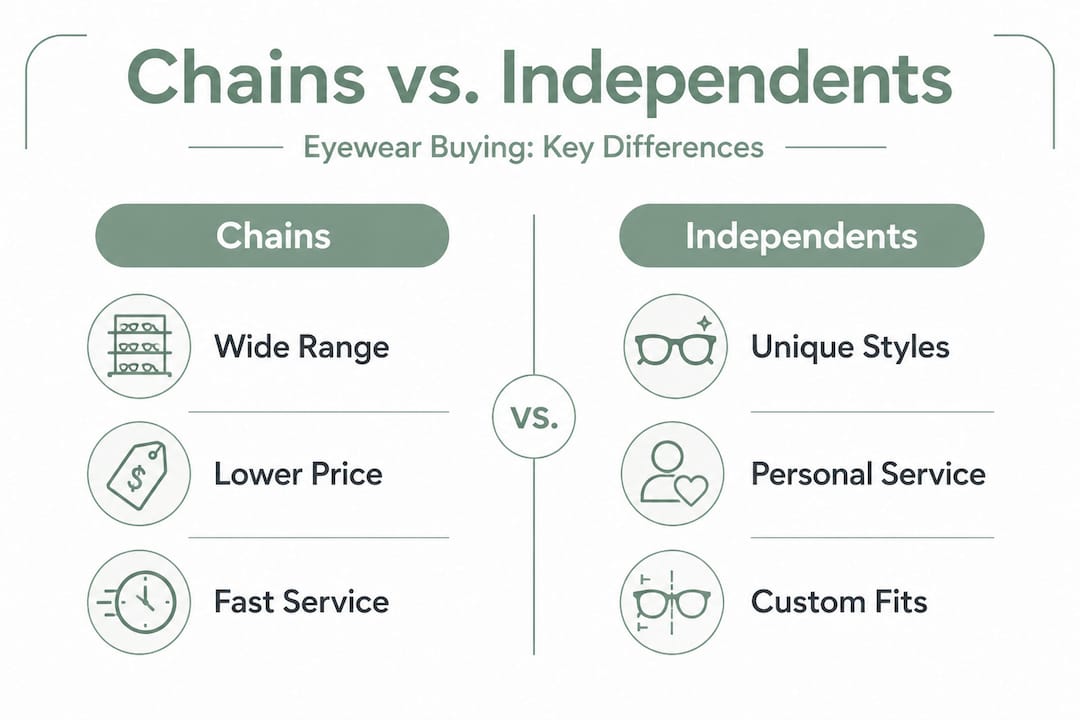
Here’s a realistic breakdown of what you might pay at a major chain versus an independent:
| Item | Major chain (approx.) | Independent (approx.) |
|---|---|---|
| Single vision frames + lenses | $99 to $199 | $250 to $450 |
| Progressive lenses | $299 to $499 | $500 to $900 |
| Designer frame + lenses | $299 to $599 | $600 to $1,200 |
| Eye test (bulk billed) | $0 with Medicare | $0 to $80 |
The savings are real, especially on progressive lenses where independents often charge significantly more for similar optical quality.
How do chains achieve these numbers? Here’s the mechanism:
- Bulk purchasing: Ordering frames and lenses in massive volumes drives per-unit costs down sharply.
- Standardised lens packages: Rather than custom-quoting every job, chains offer tiered packages that streamline production and reduce labour costs.
- Promotional calendars: Major sales events like end-of-financial-year, Boxing Day, and back-to-school periods offer additional discounts on top of already competitive base prices.
- In-house brands: Many chains manufacture their own frame lines, cutting out the wholesale markup entirely.
What might you give up? Independents often spend more time on complex fittings, offer more obscure frame brands, and may provide more personalised aftercare for unusual prescriptions. For straightforward prescriptions, though, the chain experience is hard to beat on value.
Pro Tip: The best time to buy from a chain is during end-of-financial-year sales in June or the post-Christmas period in January. Stack a promotional deal with a buy-two-get-one offer and your savings can be substantial. Check out our guide to saving on frames for more specific strategies.
If you’re ready to explore your options, buying glasses online through a reputable retailer is one of the most cost-effective moves you can make in 2026.
Customer service and aftercare: What really sets chains apart
Cost is important, but so is how you’re treated. Let’s look at why service quality can define your eyewear experience.
One of the most surprising findings in recent Australian retail research is that large eyewear chains actually outperform many independents on customer service metrics. Specsavers ranked first and OPSM ranked third in a national customer experience (CX) index based on more than 5,000 evaluations. That’s not a fluke. It reflects deliberate investment in staff training, service consistency, and aftercare programmes.
What does strong CX actually look like in practice for an eyewear shopper?
- Speed: Chains often have on-site labs or fast turnaround partnerships, meaning your glasses can be ready in as little as one hour for standard prescriptions.
- Personalisation: Modern chains train staff to assess face shape, skin tone, and lifestyle needs before recommending frames, moving well beyond the old “here are three options” approach.
- Technical support: Adjustments, repairs, and lens replacements are typically free or low-cost within a set period after purchase.
- Aftercare programmes: Many chains offer satisfaction guarantees, allowing exchanges or remakes if your prescription feels off after a few weeks of wear.
“The best chains treat aftercare as a relationship, not a transaction. That shift in mindset is what drives repeat customers and positive word-of-mouth.”
For online buyers, aftercare looks slightly different but is no less important. Understanding your consumer rights as an eyewear buyer in Australia means knowing what you’re entitled to if your glasses arrive incorrect or damaged. Most reputable chains have clear return policies and dedicated support teams.
If you’re looking for inspiration before you buy, browsing examples of stylish eyewear can help you arrive at any store or website with a clearer sense of what you want, which makes the service interaction faster and more satisfying for everyone.
For shoppers with complex prescriptions, particularly high myopia or significant astigmatism, chains are improving but may still benefit from a conversation with an independent optometrist for the fitting process. The lens itself can often still be sourced affordably through a chain once you have a confirmed prescription.
Eyewear chains’ role in modern Aussie shopping: Online, in-store, or both?
Great service seals the deal, but how you shop can change everything. Let’s map out your options.
The modern eyewear purchase doesn’t have to be purely online or purely in-store. Most major Australian chains now operate as omnichannel retailers, meaning they support a seamless experience across both. You might browse online, shortlist frames, then visit a store to try them on before completing the purchase digitally. Or you might use a virtual try-on tool, order online, and rely on a free returns policy if the fit isn’t right.
Here’s a practical comparison:
- Online only: Best for repeat buyers who know their measurements, people with straightforward prescriptions, and budget-focused shoppers chasing promotional pricing.
- In-store only: Best for first-time buyers, complex prescriptions, and anyone who wants to assess frame weight and fit before committing.
- Omnichannel (both): Best for most people. Use digital tools to research, visit a store to confirm fit, then buy wherever the price is best.
Regional shoppers benefit most from chains’ reliable shipping and aftercare infrastructure. If the nearest store is a long drive away, knowing that your online order comes with a clear returns process and responsive customer support makes a significant difference. That said, if your prescription is particularly complex, an independent optometrist in your region may still be worth the trip for the initial fitting.
Chains also lead on digital tools for managing screen time and eye health, with many now offering blue light filtering lenses as a standard add-on at checkout.
Pro Tip: Always take advantage of trial periods and return windows. Most chains offer at least 30 days to return or exchange glasses if they don’t feel right. Use that window actively, especially if you’re buying progressive lenses for the first time.
For a more fashion-forward approach to your purchase, exploring ways to style reading glasses chains can help you see glasses as a genuine style accessory rather than a medical necessity. And when it comes to the optics themselves, understanding best lens choices before you shop means you won’t be upsold on features you don’t need.
The hidden truth about eyewear chains: More control for shoppers, not less
You’ve seen the practical side. Here’s an unexpected truth you might not hear from boutique eyewear advocates.
The common narrative around eyewear chains is that they represent a trade-off: lower prices in exchange for less choice, more impersonal service, and a cookie-cutter experience. That narrative is largely outdated. The reality in 2026 is that major chains, particularly those at the top of the national CX rankings, actually give shoppers more control than ever before.
Transparent pricing means you can walk into any Specsavers location in Australia and know exactly what you’ll pay before you sit down. That kind of pricing clarity is rare in healthcare-adjacent retail, where independent optometrists sometimes quote widely different prices for identical lens specifications. Chains’ bulk buying model and standardised service structures create consistency that benefits the consumer directly.
Technology amplifies this control further. Virtual try-ons, online prescription uploads, digital measurements, and detailed product reviews mean that today’s chain customer is far more informed and empowered than the equivalent shopper from ten years ago. The volume that chains operate at also funds continuous investment in these tools, which smaller retailers simply cannot replicate.
This doesn’t mean chains are perfect for every situation. If you’re after a truly rare frame, a highly personalised fitting experience, or support for a very unusual prescription, an independent may still serve you better. But the idea that choosing a chain means accepting less? That’s worth questioning. Making ethical eyewear choices is also increasingly possible through chains, many of which now publish sustainability commitments and source frames from certified manufacturers.
The empowered eyewear shopper in Australia today uses chains as a starting point, not a compromise.
Make the most of eyewear chains: Accessories and convenience for every need
Having shifted your perspective, here’s how to turn knowledge into action and get even more value from eyewear chains.
The glasses themselves are just the beginning. The right accessories can extend the life of your frames, protect your lenses, and add a genuinely stylish touch to how you wear and carry your eyewear. Exploring the full range of accessories for your glasses at Ministry of Sight is a smart next step after you’ve settled on your frames, whether you bought them from a chain or anywhere else.
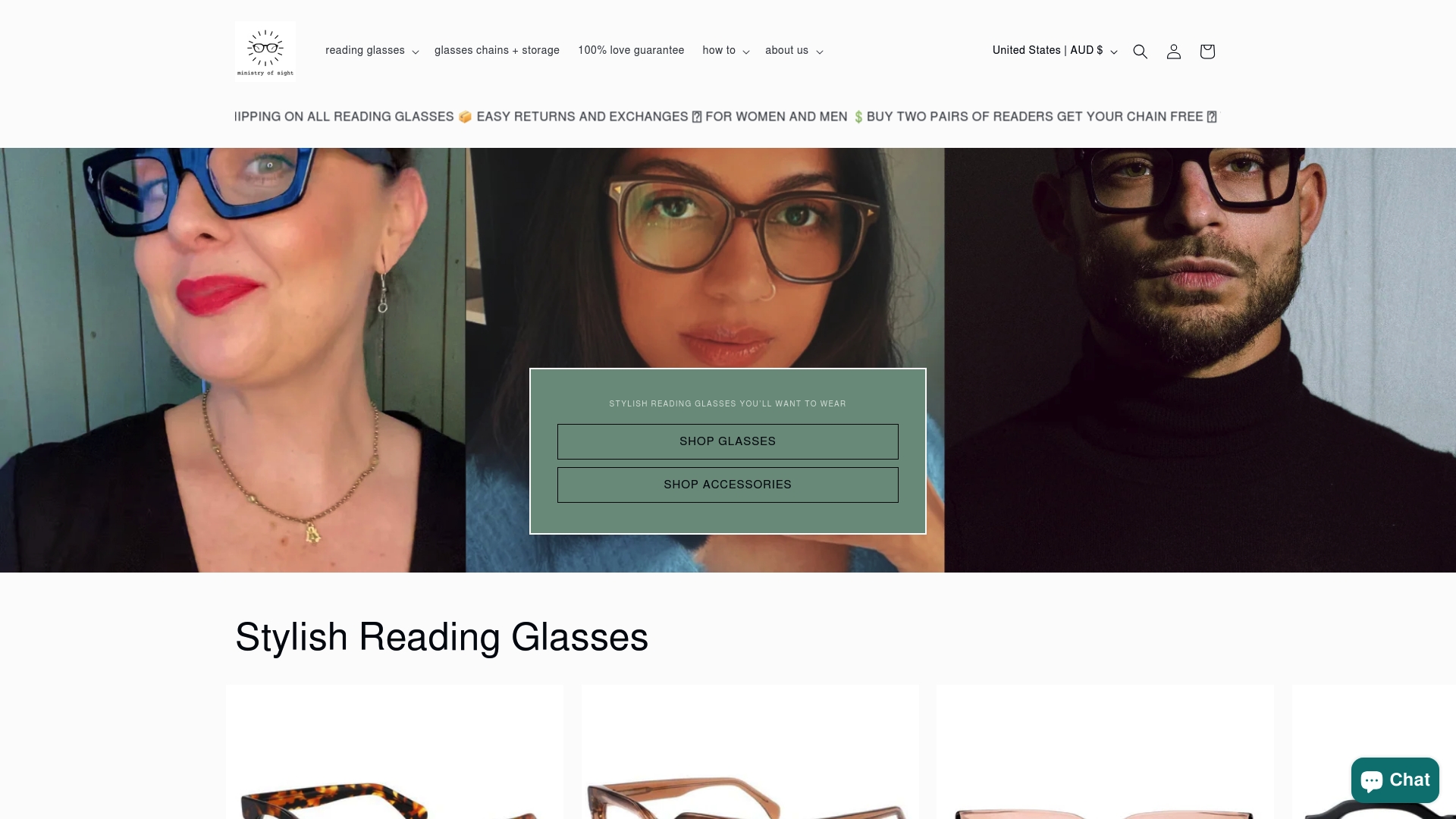
One of the most underrated accessories for glasses wearers is a quality chain or leash. Far from being a nanna cliché, reading glasses chains have had a genuine fashion revival and are now a staple of street style in Australia and globally. They keep your glasses accessible, protect them from being sat on or lost, and add a deliberate, curated touch to any outfit. Ministry of Sight stocks a curated selection that pairs beautifully with both chain-bought frames and boutique finds, making it easy to complete your look with confidence.
Frequently asked questions
Are glasses from eyewear chains lower quality than boutique stores?
Major chains offer a wide variety of quality frames and lenses, often sourced from the same suppliers as small retailers, but at more affordable prices due to bulk buying power.
How do eyewear chains keep prices low for customers?
Chains use bulk purchasing and standardised pricing models, combined with regular promotions and bundled deals, to drive prices down significantly for everyday consumers.
Can I get good customer service at large eyewear chains?
Yes. Specsavers ranked first and OPSM ranked third in a national CX index of over 5,000 evaluations, reflecting consistently strong personalisation, speed, and aftercare.
Are there benefits for regional shoppers buying from chains?
Absolutely. Regional shoppers benefit from chains’ reliable shipping, clear return policies, and online aftercare, making stylish and functional glasses far more accessible outside major cities.
Do eyewear chains offer enough style variety?
Most chains carry hundreds of frame styles and partner with global fashion brands, and their omnichannel promotions make it easy to explore options both online and in-store for all preferences and face shapes.


