

TL;DR:
- Picking the weakest effective reading glasses ensures more comfort and reduces eye strain.
- Starting with +0.50 dioptre is advisable for most new users and screen tasks.
- Low-strength glasses are affordable and widely available across Australia, improving accessibility.
Most people assume stronger reading glasses mean better vision. It’s a reasonable guess, but it’s wrong more often than you’d think. Picking the weakest pair that still lets you read comfortably is not a compromise — it’s actually the smarter, safer approach. Over-correcting with glasses that are too powerful leads to headaches, eye strain, and fatigue that can make reading feel like a chore. This guide walks you through what the lowest strengths look like, how to find the right one for your eyes, and where to buy affordable options across Australia.
Table of Contents
- Understanding reading glasses strength: what does ‘weakest’ mean?
- Choosing the lowest effective strength: practical steps
- Where to buy the weakest reading glasses in Australia
- Screen use vs. reading print: which strength suits?
- Why the weakest reading glasses are underappreciated in Australia
- Shop the best weak-strength readers and accessories
- Frequently asked questions
Key Takeaways
| Point | Details |
|---|---|
| Weakest strength defined | +0.50 dioptre is the lowest widely available reading glasses strength in Australia. |
| Start weak for comfort | Always begin with the weakest option to avoid unnecessary eye strain or headaches. |
| Screens need less power | Screen use usually requires lower magnification than reading printed text. |
| Affordable options available | Budget-friendly weak-strength glasses can be found online and in-store, often under $15. |
Understanding reading glasses strength: what does ‘weakest’ mean?
Reading glasses strength is measured in units called dioptres (sometimes spelled “diopters” in other countries, but we use the Australian spelling here). The dioptre number tells you how much magnification the lens provides. A higher number means stronger magnification. A lower number means gentler, more subtle correction.
The weakest reading glasses widely available in Australia start at +0.50 dioptre. This is the entry-level option, designed for people who are just beginning to notice mild difficulty focusing on close-up text. It provides a very gentle boost, barely noticeable to someone who doesn’t need it at all, but genuinely helpful for someone whose eyes are starting to lose their natural close-focus ability (a condition called presbyopia, which typically begins in your early to mid-40s).
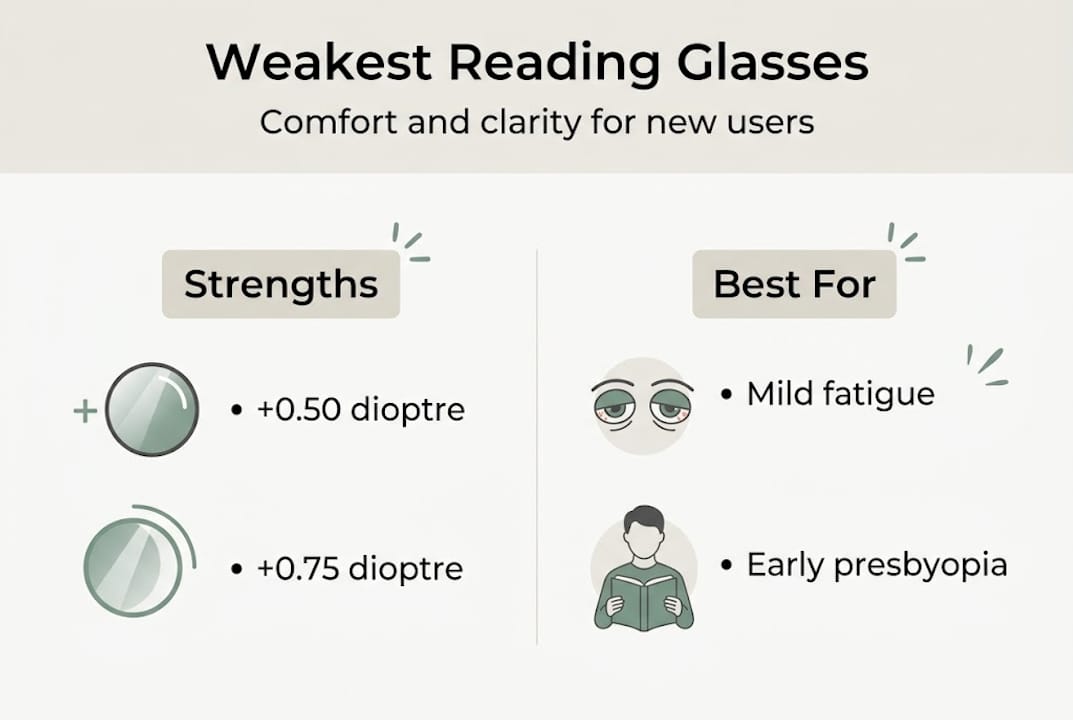
Here’s a quick breakdown of the common low-strength range:
| Strength | Who it suits |
|---|---|
| +0.50 | Very early presbyopia; mild screen fatigue |
| +0.75 | Slight difficulty with small print at arm’s length |
| +1.00 | Moderate early-stage reading difficulty |
| +1.25 | Noticeable trouble with small text or fine detail |
| +1.50 | More established presbyopia; standard starting point for many |
For screen use specifically, lower strengths are often the better fit. Your monitor or phone sits further away from your eyes than a book does. That extra distance means your eyes don’t need as much magnification to bring the image into focus. Starting at +0.50 or +0.75 for screen work is a sensible approach for many people.
Budget retailers list reading glasses starting from +0.5 dioptre priced at around $13.95, which shows how accessible these entry-level options really are in Australia.
Key things to know about low-strength readers:
- +0.50 is the weakest strength stocked at most Australian pharmacies and online retailers
- Weaker lenses cause less visual distortion at the edges of the frame
- Low-strength glasses are less likely to cause headaches if worn for extended periods
- They’re ideal for people transitioning from no glasses to occasional readers
Pro Tip: If you’ve never worn reading glasses before, always start at +0.50 or +0.75. You can always move up a strength later, but starting too high creates discomfort that can put you off glasses altogether.
Stronger isn’t always better. Over-correcting forces your eye muscles to work against the lens rather than with it. That tension is what causes the familiar headache behind the eyes that many people blame on “bad glasses” when the real issue is simply too much magnification.
Choosing the lowest effective strength: practical steps
Having defined what counts as weak, let’s look at how to select the right strength for your needs. The process is simpler than most people expect, and you don’t need a prescription to get started with low-strength readers.
Here’s a step-by-step approach that works well for most people:
- Find a reading glasses display at a pharmacy or use an online strength guide. Most retailers provide a simple chart.
- Hold a book or magazine at your normal reading distance (usually around 35 to 40 centimetres from your face).
- Try the +0.50 pair first. Read a few lines of small text. Is it clearer? Comfortable? If yes, that’s your strength.
- Move to a screen distance (roughly 50 to 70 centimetres). Does the same pair still work? If so, you’ve found a great all-rounder.
- If +0.50 isn’t quite enough, try +0.75. Keep stepping up only until the text is comfortably clear, not sharply magnified.
- If you’re torn between two strengths, always choose the weaker one. Readers that are too strong can lead to more discomfort, and experts note that screen viewing often needs lower power because screens are viewed from farther away than books.
“When in doubt, go weaker. Your eyes will thank you after an hour of reading.”
This principle matters more than most people realise. The job of reading glasses is to reduce the effort your eyes need to focus, not to do all the focusing for them. A pair that’s slightly weaker than the maximum comfortable option will feel more natural and cause less fatigue over long reading sessions.
Learning how to buy reading glasses online is a useful skill, especially if you want to compare strengths and styles without the pressure of a shop assistant hovering nearby. Online retailers often provide detailed sizing and strength guides, making it easier to take your time and choose wisely.
Pro Tip: Test your glasses in the lighting conditions you normally read in. A pair that works well under bright shop lights might feel different in the warm, dimmer light of your bedroom or home office.
One more practical note: if you wear reading glasses for extended periods (more than an hour at a stretch), comfort becomes even more critical. A pair that’s even slightly too strong will cause cumulative eye strain that builds up over time. Starting weak and moving up only when necessary protects your comfort in the long run.
Where to buy the weakest reading glasses in Australia
Once you know what to look for, it’s time to find out where to get them at the best price and quality in Australia. The good news is that low-strength readers are genuinely affordable, and there are more options than ever for Aussie shoppers.
Where to look:
- Major pharmacies (Chemist Warehouse, Priceline, Terry White): Stock +0.50 through to +3.50, usually priced between $10 and $30 for basic frames
- Online retailers: Often the best value, especially for multi-packs or bundles
- Supermarkets: Coles and Woolworths sometimes stock basic readers, though the range is limited
- Specialist eyewear online stores: Better quality frames, wider style range, and often better value per pair
Budget retailers list reading glasses with dioptre strengths from +0.5 to +2.50 priced at around $13.95, which is a fair benchmark for what you should expect to pay for a single pair at the lower end of the market.
Here’s a comparison of common buying options:
| Retailer type | Price range (AUD) | Strength range | Multi-pack option |
|---|---|---|---|
| Pharmacy (in-store) | $10 to $30 | +0.50 to +3.50 | Rarely |
| Supermarket | $8 to $15 | +1.00 to +2.50 | No |
| Online (budget) | $10 to $20 | +0.50 to +3.50 | Sometimes |
| Online (specialist) | $15 to $50+ | +0.50 to +4.00 | Yes |
If you misplace glasses frequently (a very common experience), multi-packs are excellent value. Buying three or four pairs at once means you can keep one in your bag, one on your desk, one by the bed, and one in the kitchen. You’ll never be caught squinting at a recipe again.
When shopping for glasses online, pay attention to the returns policy. A good online retailer should offer a satisfaction guarantee or easy exchanges, especially if you’re trying a new strength for the first time. Also check the lens material (polycarbonate lenses are lighter and more impact-resistant than standard plastic), and look at frame quality — a pair that sits comfortably on your nose and ears matters more than you’d think after an hour of reading.
Exploring top reading glasses brands in Australia can also help you identify which manufacturers consistently deliver quality at the lower price points, so you’re not gambling on an unknown product.
Screen use vs. reading print: which strength suits?
Even with the weakest options in hand, not every situation calls for the exact same strength. This is one of the most practical distinctions to understand, and it’s one that many people overlook entirely.
For screen use:
- Start with the lowest strength that makes text comfortable to read
- Aim for just enough clarity, not full magnification
- Most people find +0.50 to +1.00 works well for standard monitor distances
- Laptop screens (closer) may need slightly more than a desktop monitor (further away)
- Phone screens held at arm’s length often benefit from the same strength as a monitor
For close-up print:
- Books and magazines held at 35 to 40 centimetres need a little more magnification than screens
- Fine print (medicine labels, instruction manuals, small maps) may justify moving up one strength
- Craft work, sewing, or detailed tasks at very close range may need +1.25 or higher even for people who only need +0.50 for screens
Screen viewing often needs lower power because screens are viewed from a greater distance than a book or page, and readers that are too strong can lead to more discomfort. This is expert-backed guidance that’s worth taking seriously.
Understanding glasses for computer use specifically can help you make a more targeted choice rather than using a one-size-fits-all approach. Many people who work at screens all day find that a dedicated pair of low-strength computer glasses makes a significant difference to their end-of-day comfort levels.
It’s also worth reading up on screen time and eye health more broadly. Digital eye strain (sometimes called computer vision syndrome) is increasingly common among Australian adults, and choosing the right glasses strength is one of the simplest and most affordable ways to manage it.
Pro Tip: If you switch between a laptop and a large desktop monitor during the day, you might find that two pairs of slightly different strengths makes your workday noticeably more comfortable. Keep the weaker pair for the monitor and the slightly stronger one for the laptop.
A practical strategy many people find useful is to own two pairs: one at the lowest strength that works for screens, and one that’s one step higher for close reading. This way you’re never over-correcting for either task.
Why the weakest reading glasses are underappreciated in Australia
All these practical tips point to a key philosophy that’s often overlooked: starting weak is not settling for less. It’s actually the more considered, informed choice.
Here’s what we’ve observed: most people who come to reading glasses for the first time assume stronger means better. They pick up a +2.00 pair because the text looks very sharp, and they walk away feeling confident. Then, after 45 minutes of reading, they’ve got a headache and sore eyes. They blame the glasses. They stop wearing them. Their reading comfort doesn’t improve.
The reality is that their eyes were probably only ready for a +0.75 or +1.00. The +2.00 was doing too much work, forcing their eye muscles to fight against the over-correction rather than relax into it.
Australian shoppers deserve better information at the point of purchase. The focus tends to be on style and price, which are both important, but strength selection is the factor that most directly affects whether your glasses actually help you. A beautiful frame with the wrong dioptre is useless.
As screen time continues to rise across Australia, with more people working from home, reading on tablets, and spending long hours on phones, the demand for low-strength readers is only going to grow. The sweet spot for most screen users sits in that +0.50 to +1.25 range, and it’s genuinely encouraging that affordable reading glasses in Australia are becoming more widely available at these lower strengths.
There’s also a broader point about accessibility. When quality low-strength readers are available for under $20, it means more Australians can manage mild eye fatigue without needing an optometrist visit for every small change in their vision. That’s a practical, real-world benefit that shouldn’t be underestimated.
Shop the best weak-strength readers and accessories
If you’re ready to put these insights into practice, explore quality options below. Ministry of Sight offers a curated range of reading glasses designed with comfort and style in mind, including low-strength options that are ideal for screen use and everyday reading.
Browse the Lens Lounge collection for a well-edited selection of frames suited to different face shapes and reading habits. Whether you’re after a lightweight pair for the office or something more stylish for weekend reading, you’ll find options that don’t compromise on quality. You can also learn more about our reading glasses to understand what makes each pair worth choosing. And don’t forget practical extras — from cases to chains, the right accessories and storage keep your glasses safe and always within reach. Free shipping across Australia and buy-one-get-one deals make it easy to stock up on the spares you’ll actually use.
Frequently asked questions
What is the lowest strength reading glasses available in Australia?
The lowest strength commonly stocked is +0.50 dioptre, available at major pharmacies and online for under $15, with some retailers listing multi-strength ranges starting at +0.5 for around $13.95.
Are weaker reading glasses better for screen use?
Yes — screens are viewed from farther away than books, so experts recommend starting with the lowest magnification that provides comfortable clarity, rather than reaching for a stronger pair.
How do I know if I’ve picked reading glasses that are too strong?
If you experience headaches, sore eyes, or visual strain after short use, your glasses may be too strong. Readers that are too strong cause discomfort, so choosing a lower dioptre next time is the right move.
Can I use the same reading glasses for both books and computers?
You may find you need different strengths for different tasks. Screen viewing often needs lower power than close-up print work, so keeping two pairs at slightly different strengths is a practical solution for daily use.


