

TL;DR:
- Many Australians struggle to find glasses that are both stylish and protective, often compromising functionality for fashion. Modern eyewear increasingly combines trendy designs with certified features like UV400 protection, anti-glare coatings, and proper fit, ensuring health and style are not mutually exclusive. Prioritizing lens quality, proper fit, and Australian standards is essential for selecting glasses that serve both your aesthetic and eye health needs effectively.
Many Australians spend serious time hunting for glasses that actually look good and do the job properly. It feels like a false choice: pick something that turns heads on the street, or settle for frames your optometrist recommends but you quietly dread wearing. The truth is that this divide is mostly a marketing myth, one that costs people real money and, sometimes, real eye health consequences. This article cuts through the confusion, outlining exactly what separates fashionable from functional eyewear and showing you practical ways to get both.
Table of Contents
- What makes glasses fashionable or functional?
- Strengths and drawbacks: Fashion glasses vs functional eyewear
- Can you have both? Merging style with protection
- How to choose glasses that fit your life and style
- Our perspective: Why the fashion vs function debate misses the point
- Need help finding the perfect blend? Explore our solutions
- Frequently asked questions
Key Takeaways
| Point | Details |
|---|---|
| Know the difference | Fashion and functional glasses focus on different priorities but can sometimes overlap. |
| Style doesn’t mean unsafe | Modern eyewear can deliver both confidence and protection if you check lens standards and fit. |
| Always check specifications | Many fashion glasses lack essential features, so review UV protection and fit before buying. |
| You can have both | With the right guidance, it’s easy to find glasses that look great and perform well. |
What makes glasses fashionable or functional?
Before diving into practical choices, let’s clarify exactly what people mean when they talk about “fashion” versus “functional” glasses, because the terms get thrown around loosely in product descriptions and social media posts alike.
Fashionable glasses are primarily driven by aesthetics. Think frame shapes trending on runways in Milan or Paris, bold colour choices inspired by celebrity looks, and silhouettes designed to make a statement rather than solve a vision problem. These frames cycle in and out of popularity quickly, much like clothing trends. Cat-eye frames were everywhere a few seasons ago, then chunky tortoiseshell took over, and now retro geometric shapes are having their moment across Australian Instagram feeds.
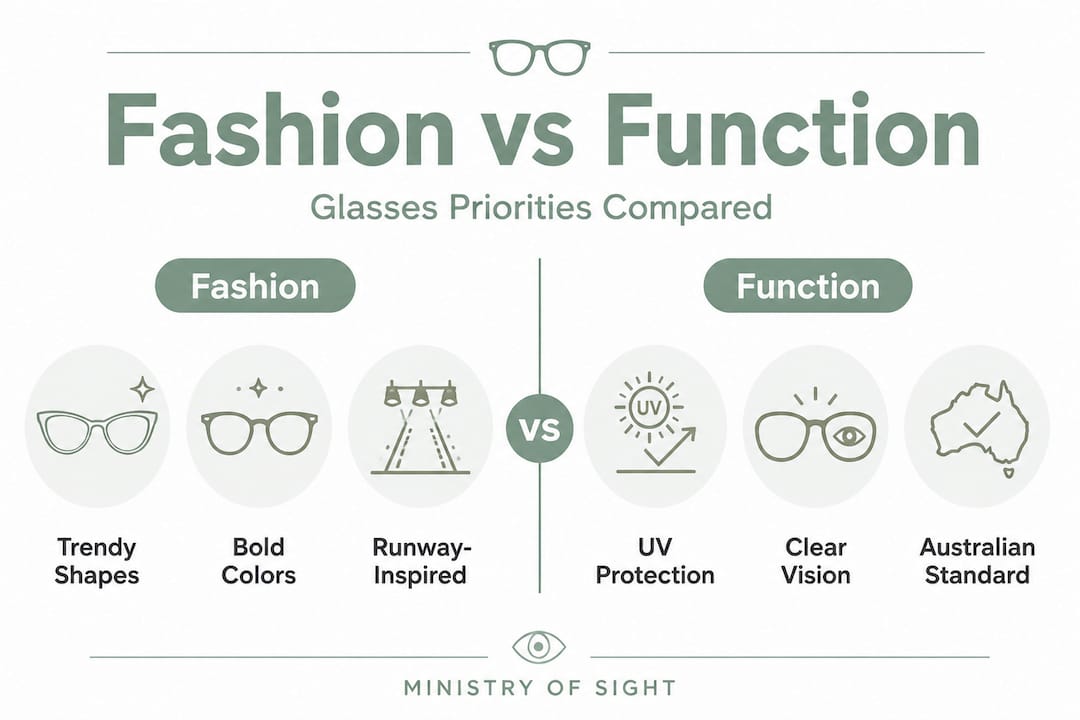
Functional glasses, on the other hand, prioritise lens quality and fit above everything else. We’re talking about UV protection ratings, blue light filtering coatings, anti-glare treatments, prescription accuracy, and frames engineered to sit securely on different face shapes without slipping or creating pressure points. These are the specs that actually protect and improve your vision every single day.
Here’s where things get genuinely interesting. The line between these two categories has blurred considerably:
- Oversized frames can provide additional peripheral coverage from UV, but only if the lens meets proper optical standards
- Tinted lenses that look fashionable may offer zero UV filtering unless certified
- A trendy thin metal frame might be entirely unsuitable for someone who needs a robust build for active daily wear
- Statement silhouettes sometimes sit too far from the face to offer effective coverage, regardless of how they look in photos
As noted by Bupa health experts, runway-driven shapes can offer more peripheral UV blocking, but functional performance relies on more than just frame style. The role of fashion in eyewear has grown enormously over the past decade, but it has not replaced the fundamental importance of eyewear fit and comfort in real world performance.
Statistic to note: Research consistently shows that Australians receive some of the highest UV exposure in the world, making lens quality a non-negotiable health issue, not just a nice-to-have feature.
The single biggest mistake shoppers make is trusting appearance as a proxy for performance. A dark lens does not mean UV-protected. An oversized frame does not mean better eye coverage. And a stylish brand name does not guarantee optical standards compliance.
Strengths and drawbacks: Fashion glasses vs functional eyewear
With the basics defined, let’s see how each type of eyewear really stacks up in everyday Australian life.
| Feature | Fashion glasses | Functional eyewear |
|---|---|---|
| Style appeal | High | Variable (improving rapidly) |
| UV protection | Often absent or unverified | Typically certified and labelled |
| Lens quality | May lack coatings | Anti-glare, UV, blue light filters |
| Durability | Often lightweight or fragile | Generally more robust |
| Prescription options | Sometimes limited | Fully supported |
| Price range | Wide (budget to luxury) | Wide (budget to premium) |
| Comfort over full day | Can be inconsistent | Prioritised in design |
Fashion glasses bring some genuinely strong advantages. Wearing frames you actually love makes you more likely to keep them on, which matters enormously for vision correction and sun protection. Confidence in your appearance affects how you carry yourself, how you feel in social situations, and even how often you reach for your glasses instead of leaving them on the bedside table.
The drawbacks are real, though. Many purely fashion-oriented frames:
- Carry no UV certification whatsoever
- Use lower quality plastic that flexes out of shape quickly
- Sit awkwardly on faces they weren’t designed to fit
- Offer minimal support for prescription lenses due to thin or unusually shaped frames
Functional eyewear has historically had an image problem. Medical or performance-first frames can feel utilitarian, clinical, or simply boring. But that reputation is increasingly outdated. As choosing fashionable reading glasses becomes easier with modern optical retailers, there are far more attractive functional options available to Australians today than there were even five years ago.

It bears repeating: functionality is not guaranteed by style alone. Glasses need to meet UV and optical standards and fit properly to actually do what they claim. A pair of oversized sunglasses that gaps at the sides lets UV radiation straight in, regardless of how good they look on the shelf.
Pro Tip: Before purchasing any sunglasses, check the swing tag or product description for “UV400” or “AS/NZS 1067” certification. These labels confirm the lenses genuinely block 99 to 100 per cent of UV radiation. If you can’t find this information, ask. If the retailer doesn’t know, walk away.
For practical day-to-day wear, a useful exercise is to read through tips for stylish glasses and cross-reference them with what the product specs actually say. Style tips and functional specs working together give you a much clearer picture than either alone.
Can you have both? Merging style with protection
Now that the pros and cons are clear, here’s how stylish and protective features are increasingly merging in today’s best eyewear options across Australia.
The good news is that the gap between fashionable and functional glasses is genuinely closing. Many brands now design frames that start with a strong aesthetic brief and then engineer the technical features in around it rather than treating them as an afterthought. This shift has produced a wave of eyewear that looks genuinely sharp while delivering the protection your eyes need under Australian conditions.
Here are the key functional features worth looking for in any pair, regardless of how stylish it is:
- 100% UV400 protection: The gold standard for UV blocking, essential in Australia’s high UV environment
- Anti-reflective coatings: Reduce glare from screens and artificial lighting, significantly reducing eye fatigue
- Blue light filtering lenses: Increasingly relevant for people who spend extended hours in front of screens
- Scratch-resistant coatings: Practical for anyone who removes glasses frequently or stores them in a bag
- Hydrophobic coatings: Repel water and oils, keeping lenses cleaner for longer
- Correct prescription accuracy: Non-negotiable for anyone with a vision correction need
The table below shows how modern frame styles can align with functional requirements when you know what to check:
| Frame style | UV coverage potential | Best functional pairing |
|---|---|---|
| Wraparound | Excellent peripheral coverage | Sports or outdoor use |
| Oversized square | Good if close to face | UV400 lenses, anti-glare |
| Round/retro | Moderate | Blue light filter coating |
| Thin metal | Lower (gaps at sides) | Anti-reflective, scratch resistant |
| Cat-eye | Moderate | UV400 minimum requirement |
As Bupa’s health content highlights, statement shapes offer peripheral coverage only if the lens meets optical standards and frames sit properly on your face. A cat-eye frame that rests three millimetres too low means your upper field of vision is completely unprotected, no matter how on-trend it looks.
Understanding eyewear as a style statement doesn’t mean abandoning health priorities. Using a reading glasses fit checklist before you commit to a purchase takes less than two minutes and can make the difference between glasses you’ll wear happily for two years and a pair gathering dust in a drawer.
Pro Tip: Try frames on (in person or via a virtual try-on tool) and check that they sit flat across the bridge of your nose, don’t gap at the temples, and don’t slide when you tilt your head forward. These three checks alone eliminate most fit problems before they become a real issue.
How to choose glasses that fit your life and style
With the possibilities clear, here’s how to pick the perfect pair without compromise, starting from your actual daily life rather than abstract style categories.
1. Define your primary use case Are these glasses for driving, screen work, outdoor activities, reading, or all-purpose everyday wear? Each scenario has different functional priorities. Driving demands excellent anti-glare and polarised lenses. Screen work benefits most from blue light filtering. Outdoor wear in Australia absolutely requires UV400 certification, full stop.
2. Identify your face shape and use it as a guide Oval faces suit almost any frame shape. Square faces benefit from rounder or softer edges to balance strong jaw lines. Round faces look great with angular or rectangular frames. Heart-shaped faces work well with frames that are wider at the bottom. Knowing this before you shop saves enormous time.
3. Check Australian standards certification Australian lenses for sunglasses should comply with AS/NZS 1067. Optical lenses for prescription glasses should meet relevant Australian optical standards. Don’t assume a well-known brand name equals compliance. Check the label, the swing tag, or ask directly.
4. Assess coverage, not just size Remember that coverage isn’t guaranteed by “oversized” frames or fashion-first designs. How the frame sits on your unique face determines actual coverage. A medium-sized frame with a close, secure fit often outperforms a large frame that gaps at the sides.
5. Consider the full cost of ownership Cheap fashion frames that break after three months, or lenses that scratch after six weeks without a protective coating, end up costing more than a well-made pair with durable materials and coatings. Think about value over 12 to 24 months, not just the sticker price.
“The right glasses aren’t just the ones that look best in the mirror. They’re the ones you reach for every morning without thinking about it.”
For people using glasses in a professional context, a guide to choosing glasses for work is worth bookmarking. And if you’re looking for frames that flatter and function for mature faces, a dedicated resource on glasses styles for mature women offers specific, practical advice that generic frame guides often skip.
Pro Tip: Before committing to a purchase online, cross-check the frame measurements against a pair you already own and find comfortable. Pupillary distance (PD), bridge width, and arm length all affect how glasses actually feel after hours of wear.
Our perspective: Why the fashion vs function debate misses the point
You’ve read the facts. Here’s our take after helping thousands of Australians find a pair they genuinely love.
The entire fashion-versus-function framing is built on an assumption that was always a little shaky: that looking good and protecting your eyes are somehow competing priorities. That idea served certain market segments well for a long time, because it allowed cheap fashion accessories to pretend they were eyewear and it allowed clinical eyewear brands to excuse themselves from caring about design. Neither is a particularly honest position.
What we’ve seen working with real people is that the glasses you actually wear are always the most functional glasses you own. A technically perfect pair that sits unworn because you find them ugly offers zero protection. Meanwhile, a stylish frame with certified lenses and a good fit that you reach for every morning is doing more for your eye health than any clinically superior pair you avoid.
We’ve also noticed something that surprises many first-time buyers. Some so-called fashion frames, particularly larger and more structured designs, perform remarkably well on functional metrics when you check the specs. In several cases, a fashionable oversized frame with UV400 lenses outperforms a basic “medical” style with cheap, unstamped lenses. The category label tells you almost nothing. The product specs tell you everything.
The other thing worth saying plainly: advancing lens technology means there is no longer a meaningful trade-off between clarity, protection, and thinness. Modern lenses can be thin, light, scratch-resistant, UV-blocking, and blue-light-filtering all at once. The limitation was never the technology. It was always the assumption that customers wouldn’t look beyond the frame.
Exploring fashionable reading glasses essentials is a great way to see how far this category has come. The options available to Australians right now are genuinely exciting, and they reward shoppers who take five extra minutes to read the product specs.
Need help finding the perfect blend? Explore our solutions
Ready to upgrade your eyewear? Ministry of Sight makes it genuinely easy to find frames that deliver on both the style and the substance front, without the usual trade-offs.
Browse an extensive range of stylish frames designed with both aesthetics and optical performance in mind, so you’re not choosing between looking great and seeing clearly. Need to complete your look? Explore the full range of eyewear accessories including chains, cases, and storage solutions that match your personal style. And before you commit, take a look at the current eyewear offers for seasonal deals and exclusive designs. Free shipping across Australia and a satisfaction guarantee mean you can shop with confidence from wherever you are.
Frequently asked questions
Do all fashionable glasses have UV protection?
No, not all fashionable glasses provide UV protection. Always check for a labelled UV400 or AS/NZS 1067 certification before buying, because functionality depends on lens standards, not frame style.
Can I get prescription lenses in fashionable frames?
Yes, many optical retailers and online brands allow you to fit prescription lenses to fashionable frames, though very unusual frame shapes may limit your prescription range options.
Are oversized sunglasses always more protective?
No, protection depends on proper fit and quality lenses rather than frame size alone. As research confirms, oversized shapes only provide meaningful extra coverage when the fit is correct and the lenses meet optical standards.
How do I know if glasses are both stylish and functional?
Look for modern designs that carry Australian standards certification, feature protective lens coatings such as UV400 or anti-reflective treatments, and sit comfortably and securely on your face without gaps.
Are fashion glasses more expensive than functional ones?
Not always. Prices across both categories vary enormously depending on brand, materials, and lens technology, and many functional frames are now priced competitively with mid-range fashion options.
Recommended
- Enhance your style with the role of eyewear in fashion – MINISTRY OF SIGHT
- Understanding Fashionable Reading Glasses Guide for Style – MINISTRY OF SIGHT
- Personalise your glasses style: step-by-step guide – MINISTRY OF SIGHT
- Role of Fashion in Eyewear: Complete Guide – MINISTRY OF SIGHT
- Why Choose Sustainable Accessories for Ethical Style – The Cork Store


