

TL;DR:
- Australian Consumer Law mandates that eyewear meet strict quality, safety, and fit standards regardless of store policies.
- Consumers can request refunds or replacements for major faults like incorrect prescriptions or defective frames under ACL.
- Recording purchase details and documenting defects helps enforce your rights when dealing with retailers, especially online.
Many Australians assume that getting a refund or replacement on a faulty pair of glasses is purely up to the retailer’s goodwill. That assumption can cost you. Under Australian Consumer Law, eyewear must meet strict quality and fitness standards regardless of what any store policy says. Whether you bought your frames at a boutique optometrist or ordered lenses online at midnight, the same legal protections apply. This guide walks you through exactly what those rights are, what counts as a defect, and what steps to take when something goes wrong with your eyewear purchase.
Table of Contents
- Australian Consumer Law and eyewear: The essentials
- Quality, fit, and prescription accuracy: What to expect
- Returns, refunds, and replacements: When are you entitled?
- Online eyewear shopping: Rights, proof, and pitfalls
- Why knowing your eyewear rights matters more than ever
- Equip yourself with stylish eyewear—know your rights
- Frequently asked questions
Key Takeaways
| Point | Details |
|---|---|
| Eyewear is protected | Australian Consumer Law guarantees safe, high-quality, and accurate eyewear—regardless of store policy. |
| Major vs minor faults | Major failures let you choose a refund or replacement; minor issues allow the retailer to repair or replace. |
| Online purchases included | Buying online from Australian sellers gives you the same consumer rights as in-store shopping. |
| No change-of-mind refunds | Retailers don’t need to offer refunds for change of mind unless it’s their policy, but must honour faults. |
| Be proactive | Keep receipts, document any problems, and know who to contact when issues aren’t resolved. |
Australian Consumer Law and eyewear: The essentials
Now that you know your purchase is protected, let’s break down what the law specifically requires of eyewear products.
Eyewear sits in the same legal category as any other consumer good sold in Australia. That means the full suite of protections under Australian Consumer Law (ACL) applies to your glasses, sunglasses, and prescription lenses, just as it would to a toaster or a pair of shoes. Retailers cannot simply write “no refunds” on a sign and call it done. Store policies do not override the law, and any attempt to enforce them over your ACL rights is itself a breach.
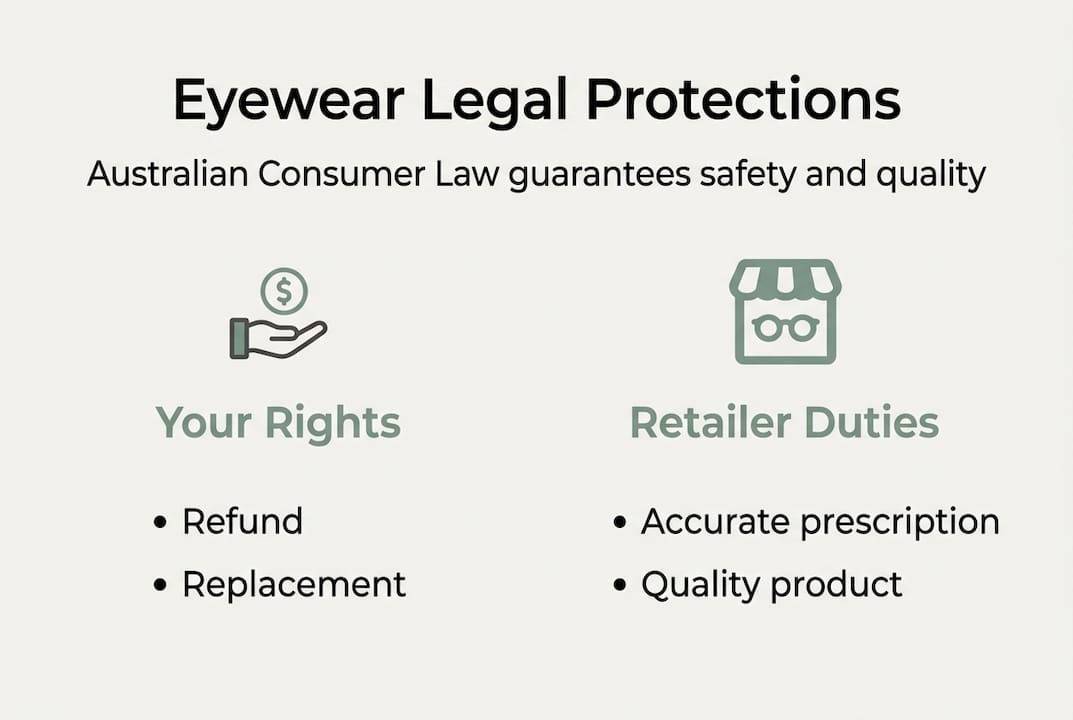
The ACL sets out that consumer guarantees require eyewear to be of acceptable quality: safe, durable, free from defects, and of acceptable appearance and finish. This is not a vague standard. It means frames should not snap under normal use, coatings should not peel within weeks, and hinges should not fail before the lenses even need changing.
Here is what the law specifically requires of eyewear:
- Acceptable quality: Safe to wear, durable under normal conditions, free from defects, and presentable in finish
- Match description: The product must match what was advertised, shown in a catalogue, or described by staff
- Fit for purpose: Glasses must do what glasses are meant to do, including correcting vision if prescribed
- Correct prescription: Lenses must match the prescription provided, with no errors in power or axis
- Retailer accountability: The seller is responsible for ACL guarantees, not just the manufacturer
Your ACL rights exist automatically. You do not need to register for them, ask for them, or pay extra for them. They apply the moment you make a purchase.
Understanding eyewear return policies at different retailers is still worthwhile, because some offer more generous terms on top of ACL. But the law is always your floor. Keeping your receipt, saving any written descriptions or advertisements, and noting the date of purchase are simple habits that make enforcing your rights far easier if something goes wrong. Do not rely on memory alone.
Quality, fit, and prescription accuracy: What to expect
Understanding your general rights is one thing, but what actually counts as a defect or failure with glasses or lenses?
Acceptable quality is the central standard under ACL, and it covers more ground than most people realise. For eyewear, it means the product must be safe to wear on your face, hold up under everyday use, and look the way it was presented at the point of sale. A frame that warps after a month of normal wear, or an anti-reflective coating that clouds over within weeks, falls short of this standard.
Fitness for purpose takes things further. Eyewear must match the description, sample, or demonstration provided, and must be fit for any disclosed purpose, including correct prescription for vision correction. If you told the retailer you needed glasses for driving at night and the lenses they sold you create dangerous glare, that is a fitness failure. If the frames were described as lightweight titanium and they are actually heavy plastic, that is a description failure.
Prescription accuracy deserves particular attention. An incorrect prescription is not a minor inconvenience. It can cause headaches, eye strain, and even safety risks. Under ACL, this constitutes a major failure, which carries the strongest remedies available to you as a consumer.

Here is a quick comparison of what counts as acceptable versus unacceptable:
| Issue | Acceptable | Unacceptable under ACL |
|---|---|---|
| Minor lens scratch from use | Yes | No, if defect at purchase |
| Frame warping within weeks | No | Yes, major quality failure |
| Wrong prescription power | No | Yes, major failure |
| Coating peeling early | No | Yes, quality failure |
| Colour differs slightly from photo | Depends on degree | Yes, if materially different |
Pro Tip: Always check your best lenses guide before ordering, so you know what coating and lens type you are actually getting. Knowing the product specification in advance makes it much easier to identify a mismatch if the glasses arrive.
It is also worth noting that manufacturer warranties are an addition to your ACL rights, not a replacement. A retailer cannot point you to a manufacturer warranty and wash their hands of the matter. The seller remains your primary point of contact under the law. Choosing retailers who follow ethical eyewear standards often means fewer disputes from the outset.
Returns, refunds, and replacements: When are you entitled?
Once you know what constitutes faulty eyewear, the next step is knowing what you can actually do about it.
ACL draws a clear line between major and minor failures, and the distinction matters a great deal for what remedy you can claim. For minor and major failures, the rules work like this: for a minor fault, the business chooses whether to repair, replace, or refund. For a major failure, you as the consumer get to choose your remedy.
Here is how the process typically works:
- Identify the fault and decide whether it is major (wrong prescription, unsafe frame) or minor (loose screw, small cosmetic blemish)
- Contact the retailer in writing, describing the issue clearly and attaching photos if possible
- State your preferred remedy if it is a major failure, you have the right to choose a refund or replacement
- Allow reasonable time for the retailer to respond and action the remedy
- Escalate if needed to your state fair trading office or the ACCC if the retailer refuses
| Failure type | Who chooses remedy | Options available |
|---|---|---|
| Major failure | You, the consumer | Refund or replacement |
| Minor failure | The retailer | Repair, replace, or refund |
| Change of mind | Retailer policy only | Depends on store policy |
Change of mind is a separate matter entirely. There is no automatic right to a refund for change of mind in Australia. If you simply decide you do not like the colour of the frames after buying them, the retailer can decline your return unless their own policy allows it. This is one area where shopping with retailers who have generous voluntary policies, like those outlined in eyewear refund policies, genuinely pays off.
Online purchases are covered by the same ACL rules as in-store buys. However, enforcing your rights when returning eyewear bought online can be more complex, particularly if the retailer is slow to respond or disputes your claim. Keep every piece of documentation.
Online eyewear shopping: Rights, proof, and pitfalls
As more Australians buy glasses online, it’s vital to know how these rights play out on the web.
The convenience of buying eyewear online is undeniable. Better prices, wider selection, and the ability to shop at any hour are all genuine advantages. But online shopping introduces risks that do not exist in a physical store, and knowing how to protect yourself makes the experience far more reliable.
Your rights are the same. Any Australian-based online retailer must comply with ACL, full stop. Incorrect prescriptions are treated as a major failure for online purchases just as they are in-store, though enforcement can be harder without face-to-face interaction. The responsibility for providing an accurate prescription rests with you as the buyer, so double-check every detail before submitting your order.
Here is what to do before and after buying eyewear online:
- Get a current written prescription from your optometrist and verify every figure before entering it
- Screenshot product descriptions and save any emails confirming specifications at the time of purchase
- Photograph the packaging and product immediately upon arrival, noting any visible defects
- Keep all email correspondence with the retailer in a dedicated folder
- Check the retailer’s returns policy before buying, so you know their voluntary terms on top of ACL
Pro Tip: When shopping for eyewear online, use a ruler to measure your pupillary distance (PD) accurately before ordering. An incorrect PD is one of the most common reasons prescription glasses feel wrong, and it can complicate a return claim if the retailer argues the error was yours.
If a retailer refuses to honour your rights, do not give up. Your first escalation point is the retailer’s formal complaints process. If that fails, contact your state or territory fair trading office, or lodge a complaint with the ACCC. Reviewing tips for buying online eyewear before you shop can also help you choose reputable sellers who are less likely to create problems in the first place.
Why knowing your eyewear rights matters more than ever
After learning the practicalities, it’s worth stepping back to see why these rights really make a difference.
Too many Australians still treat a retailer’s goodwill as their only safety net. They accept a repair when they are entitled to a replacement, or walk away from a dispute because they do not realise the law is firmly on their side. This is not a small issue. Eyewear is a health product. Getting it wrong affects how you see the world, literally.
The ACL provides robust baseline protections that retailer warranties can enhance but never replace. The consumers who fare best are not the loudest complainers. They are the ones who kept their receipt, took a photo of the defect on day one, and knew the difference between a minor and major failure before they even walked back into the store.
As the eyewear market grows more competitive, with online sellers, international brands, and direct-to-consumer models all competing for your attention, the gap between retailers who respect your rights and those who hope you do not know them is widening. Reading up on eyewear myths explained is one small step that can save you real money and frustration. Your rights are not a technicality. They are the foundation of a fair transaction.
Equip yourself with stylish eyewear—know your rights
With a clear picture of your legal protections, you’re in the best position to confidently shop for eyewear.
Choosing a reputable Australian eyewear brand means your purchase is automatically backed by ACL, and you have a clear path to resolution if anything goes wrong. At Ministry of Sight, we believe informed customers make the best customers. That is why we back our products with transparent policies and a team ready to help.
Whether you are after quality frames, practical eyewear accessories, or just want to ask a question about your purchase rights, we make it easy to get answers. Browse our range online or reach out directly through our eyewear support team. We are here to make sure your experience is as clear as the lenses we sell.
Frequently asked questions
Are glasses and lenses covered by the same consumer guarantees as other goods in Australia?
Yes, eyewear is treated as standard goods and enjoys full ACL protections for quality and fitness for purpose, with no specific exemptions for glasses or lenses.
Can I get a refund for glasses if I change my mind after buying them?
Not automatically. Change of mind refunds depend on the retailer’s own policy, but ACL guarantees you a remedy whenever the product is genuinely faulty.
What should I do if my new glasses have the wrong prescription?
A wrong prescription is a major failure under ACL, which means you can choose between a full refund or a replacement rather than accepting a repair.
Do online eyewear shops have to follow the same consumer laws as retail stores?
Yes, any Australian-based online eyewear retailer must comply with ACL, though online enforcement typically requires thorough documentation such as photos, emails, and written prescription records.


