

TL;DR:
- Genuine smart reading glasses include augmented reality displays or dynamic autofocus technology, unlike basic lenses.
- They offer enhanced reading experience but require adaptation and careful selection based on specs.
- Australians should demand transparent specs and independent testing when considering smart eyewear purchases.
Most people assume smart reading glasses are just regular readers with a fancy name slapped on the box. That assumption is costing Aussie consumers real money. The truth is, genuine smart glasses split into two distinct categories, augmented reality display glasses and dynamic autofocus models, and neither has much in common with a standard pair of progressives from the chemist. Australia’s tech-savvy eyewear market is growing fast, and the gap between marketing hype and actual innovation has never been wider. This article cuts through the noise, explains the real technology behind smart reading glasses, and gives you a practical framework for choosing the right pair.
Table of Contents
- Understanding smart reading glasses: What makes them ‘smart’
- How smart reading glasses work: Technology and mechanics
- Real-world benefits and challenges: What Aussie users report
- How to choose smart reading glasses: Practical advice for Australians
- Smart reading glasses: Where most reviews miss the mark
- Explore innovative reading solutions with Ministry of Sight
- Frequently asked questions
Key Takeaways
| Point | Details |
|---|---|
| Smart glasses categories | AR/XR display and dynamic autofocus models offer genuinely smart features beyond standard progressives. |
| Tech explained simply | The latest glasses use micro-OLED displays, liquid crystal lenses, and sensor-driven focus for eye health and digital convenience. |
| Buyer tips | Check specs, avoid gimmicks, and prioritise prescription compatibility for your reading needs. |
| Australian models available | Prescription-compatible AR models like RayNeo and Viture are now accessible in Australia. |
Understanding smart reading glasses: What makes them ‘smart’
With curiosity sparked about what smart reading glasses truly offer, let’s clarify their categories and break down the technology that sets them apart.
The term ‘smart glasses’ gets thrown around loosely, and that’s a problem. Walk into any optometrist or browse online and you’ll find progressive lenses, basic bifocals, and blue-light-blocking frames all labelled as ‘smart.’ They aren’t. Smart reading glasses encompass AR/XR display glasses and dynamic autofocus/zoom glasses, two genuinely technology-driven categories that do things no ordinary lens can.
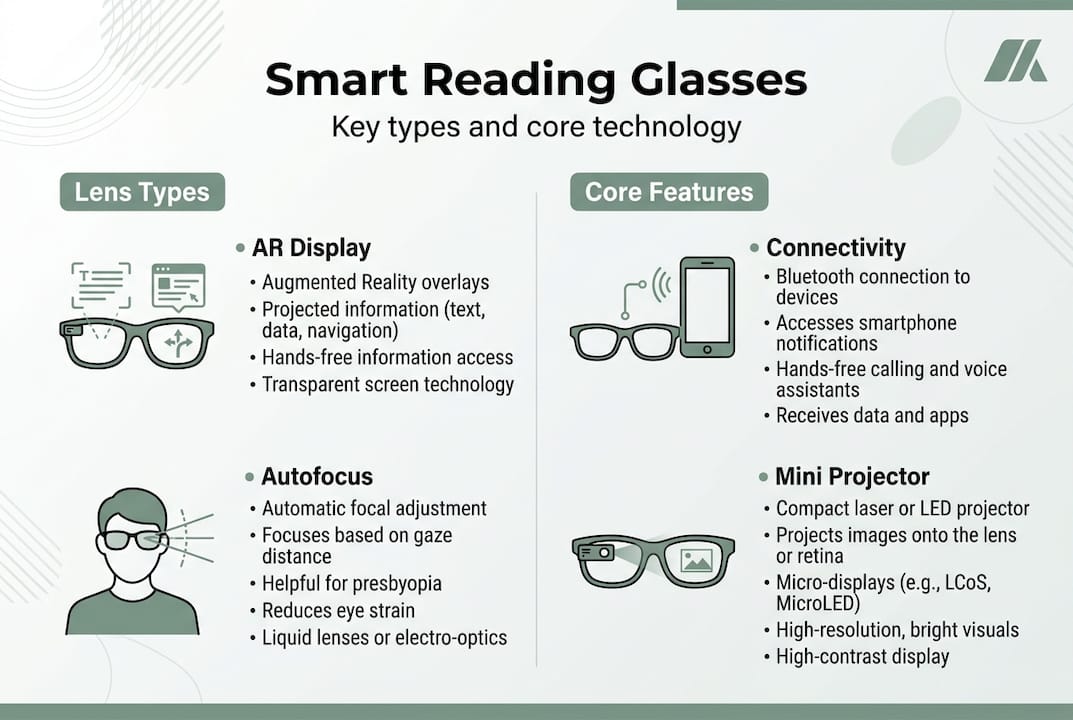
AR and XR display glasses project virtual screens directly in front of your eyes using micro-OLED or prism-based optics. Think of them as a wearable monitor you can read documents, stream content, or overlay digital information on your physical world. Dynamic autofocus glasses, on the other hand, use electronically controlled lenses that shift their focal power in real time, adapting to whether you’re reading a book, a phone, or a whiteboard.
The confusion largely comes from marketing overstating ‘smart’ for progressive lenses, which are purely optical devices with no electronics inside. Progressives are excellent lenses, but calling them smart is like calling a well-designed chair a robot. If there’s no active technology responding to your vision or environment, it’s not genuinely smart.
Here’s a quick breakdown of the three categories you’ll encounter:
| Type | Technology used | Key benefit | Electronics inside |
|---|---|---|---|
| AR/XR display glasses | Micro-OLED, prism displays | Virtual screen overlay | Yes |
| Dynamic autofocus glasses | Liquid crystal or fluid lenses | Real-time focus adjustment | Yes |
| Progressive lenses | Optical lens grinding | Multi-distance vision | No |
Key features that separate true smart glasses from the rest:
- Active sensors that detect reading distance or eye movement
- Electronically controlled lens elements or display projectors
- Connectivity via Bluetooth or USB-C for content and power
- Software integration for personalised vision profiles
Pro Tip: Before purchasing, check whether the product listing mentions any electronic components or connectivity. If it doesn’t, it’s almost certainly a traditional lens dressed up in marketing language. You can also explore common reading glasses myths to sharpen your eye for misleading claims.
How smart reading glasses work: Technology and mechanics
Now that you’re clear on what counts as genuinely ‘smart’, let’s peek under the hood at how these glasses deliver advanced reading experiences.
AR glasses use micro-OLED or prism displays projecting virtual screens, while smart zoom models rely on voltage-controlled liquid crystal or fluid lenses. These are two fundamentally different engineering approaches, but both result in a reading experience that adapts to you rather than forcing you to adapt to it.
In AR display glasses, a tiny projector sits in the frame and beams an image through a prism or waveguide directly onto your retina. The image appears to float in space, usually at a comfortable reading distance. The quality of this experience depends heavily on brightness (measured in nits), refresh rate (Hz), resolution, and field of view (FOV). In autofocus glasses, a sensor detects how far away your target object is and sends a voltage signal to the lens, which physically changes shape within milliseconds to bring that object into sharp focus.
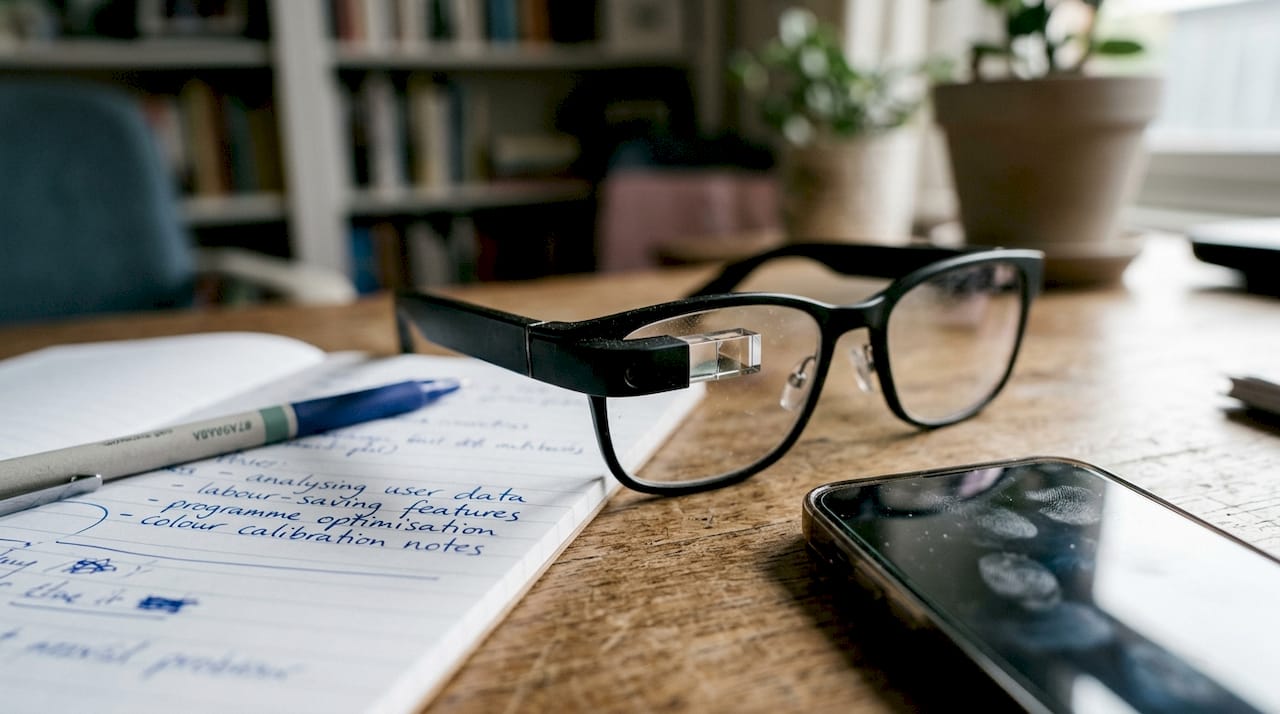
Here’s how some of the leading models stack up on technical specs:
| Model | Brightness | Refresh rate | Resolution | FOV | Weight |
|---|---|---|---|---|---|
| RayNeo Air 2s | 600 nits, 120Hz | 120Hz | 1080p | 46° | 76g |
| Laclarée autofocus | Variable | N/A | Optical | N/A | Compact |
| Viture Luma Pro | High nits | 120Hz | Micro-OLED | Wide | ~80g |
The Laclarée model is worth noting for its 0 to +2.75D addition range with under one second response time and an impressive 20-hour battery life, making it one of the most practical autofocus options available.
“The immersive reading experience from AR glasses, combined with spatial audio integration, fundamentally changes how you consume long-form content. It’s less like reading and more like being inside the page.”
For Australians exploring modern lens choices, understanding these specs is essential. Brightness matters most in outdoor use, while refresh rate affects how smooth video and scrolling text appear. If you want a deeper look at how models compare locally, the top-rated reading glasses guide is a solid starting point.
Real-world benefits and challenges: What Aussie users report
With the mechanics laid out, let’s unpack what real Australians report when switching to smart glasses and the practical ups and downs involved.
The most consistently reported benefit is reduced eye strain, particularly for people who spend long hours reading on screens. Unlike holding a phone close or hunching over a laptop, AR glasses position the virtual display at an optimal focal distance, reducing the muscular effort your eyes exert. RayNeo scored 4.0 out of 5 on PCMag, with Hilipert’s multi-focal model earning 4.7 out of 5 for comfort, and battery life ranging from 8 to 24 hours depending on the model.
However, it’s not all smooth sailing. Here are the most common challenges Aussie users report:
- Adaptation period: Most users need 3 to 7 days before AR or autofocus glasses feel natural.
- Edge blurriness: AR glasses show edge blurriness and limited head tracking, which can be disorienting at first.
- Battery dependence: Autofocus models need regular charging, which is a genuine lifestyle adjustment.
- Prescription limitations: Severe prescriptions beyond certain dioptre ranges may not be compatible with current smart lens technology.
- Motion sensitivity: Some users experience mild nausea when first using AR display glasses, similar to early VR headset experiences.
Pro Tip: If you’re prone to motion sensitivity, start with short 15-minute sessions and gradually increase usage over a week. Choosing a model with a wider FOV also reduces the tunnel-vision effect that triggers discomfort for many first-time users.
For Australians over 40 who are already navigating presbyopia, the glasses for over 40s guide offers helpful context on what to prioritise. And if you’re still sorting fact from fiction, revisiting myths about smart lenses can save you from a costly mistake.
How to choose smart reading glasses: Practical advice for Australians
Now you’re ready to move beyond features and ratings, so here’s your practical guide to choosing the right smart reading glasses for your needs.
Start by identifying your primary use case. Are you mainly reading long documents and ebooks? An AR display model will serve you better. Do you need glasses that shift focus naturally throughout the day for varied tasks? A dynamic autofocus model is the smarter pick. RayNeo Air series and Viture Luma offer accessible AR reading solutions for Australians, while Envision Glasses are available locally for low-vision users who need enhanced contrast and zoom.
Here’s a step-by-step approach to narrowing your choice:
- Define your primary need: digital reading, eye strain relief, or prescription support.
- Check prescription compatibility with the manufacturer before purchasing.
- Compare brightness specs if you plan to use glasses outdoors (aim for 500+ nits).
- Assess battery life against your daily usage pattern.
- Read verified reviews from tech publications rather than relying on retailer descriptions.
When interpreting specs, brightness above 500 nits means usable in daylight. A refresh rate of 90Hz or higher means smooth scrolling. Response time under one second in autofocus models means the lens shift won’t interrupt your reading flow.
Key pitfalls to avoid:
- Avoid products that market autofocus as a gimmick without independent testing or optical certification.
- Don’t assume all AR glasses support prescription inserts. Many require separate clip-in lenses.
- Skip any listing that doesn’t clearly state dioptre range, battery life, or display specs.
For more guidance, the tips for buying glasses resource covers the online buying process well, and buying readers online walks through what to check before you commit. If lifestyle fit matters to you, functional glasses for lifestyle is worth a read too.
Smart reading glasses: Where most reviews miss the mark
Having explored the practical aspects, let’s take a candid look at what Australia’s tech community should really expect from so-called smart reading glasses.
Most reviews either over-label basic progressives as smart or get so caught up in spec comparisons that they forget to ask the most important question: does this actually improve how you read every day? PCMag consistently favours AR display glasses over basic readers for anyone who genuinely wants a display experience, and that’s the right call. But the broader review landscape is muddier.
The uncomfortable truth is that true innovation in this space, the AR/XR and dynamic focus technology, costs more and demands more from the user. There’s an adaptation curve. There are battery habits to build. These aren’t plug-and-play products. But for the right user, they are genuinely transformative in a way no passive lens ever could be.
Australian buyers deserve transparency. Demand real specs, independent test results, and honest adaptation timelines before spending several hundred dollars. Checking out how [Australian glasses brands](https://ministryofsight.com.au/blogs/news/top reading glasses brands australia comparison) are positioning themselves in this space can also reveal which retailers are being straight with you and which are riding the hype.
Explore innovative reading solutions with Ministry of Sight
With a clear picture of smart reading glasses in mind, here’s how Ministry of Sight can help you complement your advanced eyewear.
Whether you’re pairing smart glasses with everyday accessories or looking for stylish readers to round out your collection, Ministry of Sight has you covered across Australia.
Browse a curated range of reading glasses accessories designed to keep your eyewear secure and stylish. For active lifestyles, a quality glasses leash keeps your readers close without the fumbling. And if you’re after sun protection with reading convenience built in, the Lumière Sun Readers are a brilliant option for outdoor use. Ministry of Sight offers free shipping across Australia and a satisfaction guarantee, so exploring your options is genuinely risk-free.
Frequently asked questions
What makes reading glasses ‘smart’ compared to regular readers?
Smart reading glasses use AR displays or dynamic lenses for real-time focus adjustment and digital enhancement, unlike basic progressive lenses which are purely optical with no active electronics.
Are smart reading glasses available for prescriptions in Australia?
RayNeo Air series and Viture Luma support prescription-compatible AR reading solutions, and many local providers can assist with custom inserts or integration.
Do smart reading glasses work for low vision or presbyopia?
Low-vision AR glasses enhance contrast and zoom, while autofocus models are specifically designed to address the variable focus needs of presbyopia.
Are there side effects to using smart reading glasses?
Most users adapt within a few days, though some experience mild motion sickness or edge blurriness in AR models, particularly during the initial adjustment period.