

Approximately 30% of presbyopic individuals require different corrective strengths in each eye. This surprising statistic reveals a common reality: many adults need customised lens solutions to see clearly. Selecting the correct reading glasses strength reduces eye strain, improves comfort, and transforms your reading experience. This guide walks you through understanding diopters, identifying your unique vision needs, and adapting confidently to different strength lenses for everyday activities.
Table of Contents
- Introduction To Reading Glasses And Lens Strengths
- Why Different Strength Lenses Are Needed
- How To Determine The Right Reading Glasses Strength For You
- Common Misconceptions About Reading Glasses Strength
- Alternatives And Comparisons: Multifocal And Progressive Lenses
- Practical Tips For Wearing Different Strength Lenses
- Buying Reading Glasses With Different Strength Lenses In Australia
- Explore Reading Glasses And Accessories From Ministry Of Sight
- Frequently Asked Questions
Key takeaways
| Point | Details |
|---|---|
| Reading glasses strength measures magnification | Strength is measured in diopters, indicating the magnification level needed for clear near vision. |
| Different eyes often need different strengths | Anisometropia means each eye may require unique corrective power for optimal clarity and comfort. |
| Professional eye exams ensure accuracy | Optometrists determine precise prescriptions, preventing discomfort and strain from incorrect lens strength. |
| Progressive lenses offer versatile alternatives | These lenses provide smooth transitions between focal lengths, eliminating the need for multiple pairs. |
| Adaptation takes patience and time | Adjusting to new reading glasses typically requires one to two weeks of consistent wear. |
Introduction to reading glasses and lens strengths
Reading glasses correct presbyopia, the age-related loss of ability to focus on close objects. As you reach your 40s, the eye’s lens becomes less flexible, making tasks like reading menus or checking your phone increasingly difficult. Reading glasses compensate for this natural change by magnifying text and objects at near distances.
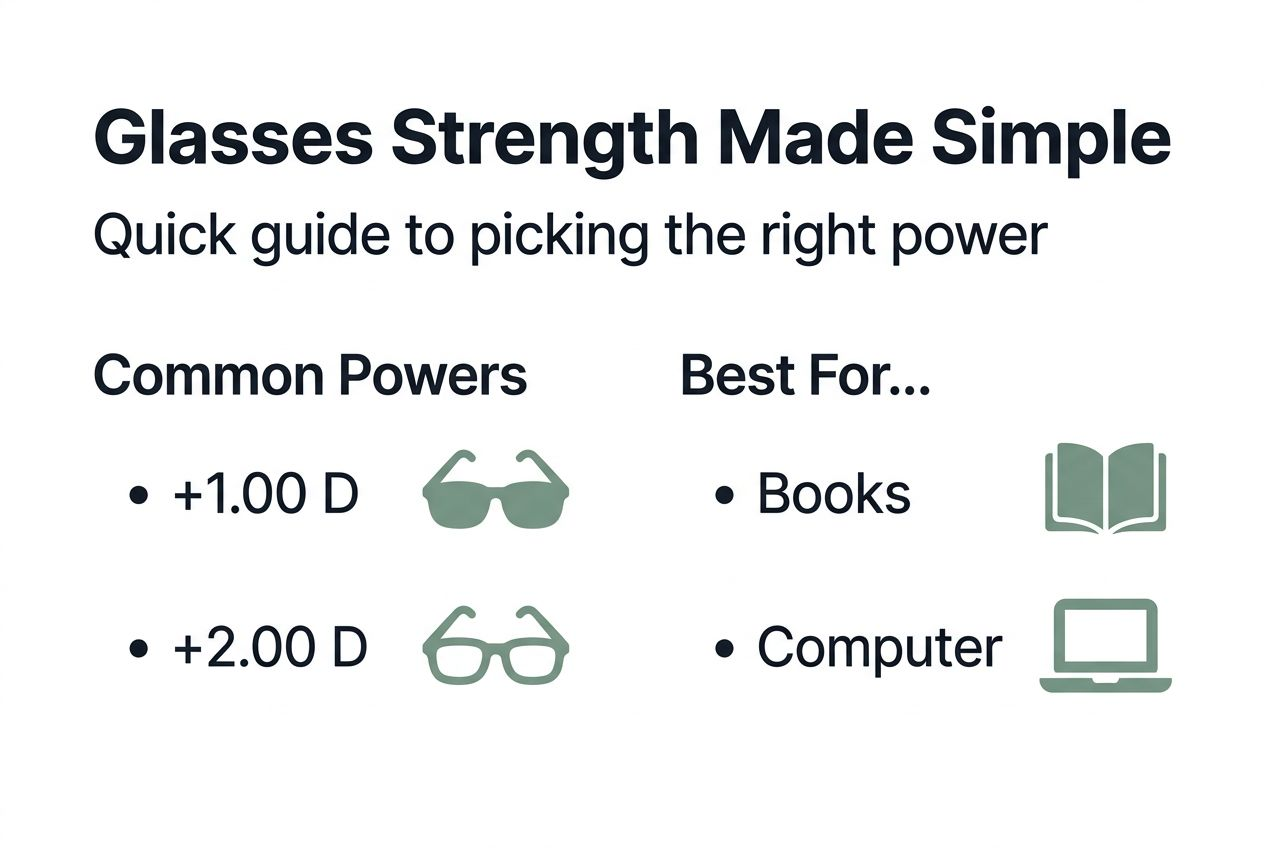
The strength of reading glasses is measured in diopters, indicating the degree of magnification needed to focus on close objects. Diopter values typically range from +1.00 to +4.00 for reading glasses, with higher numbers providing stronger magnification. You’ll see these values on prescriptions or pre-made glasses labelled with strength indicators.
Presbyopia progresses with age requiring different corrective strengths for near and intermediate distances. What worked at 45 may not suffice at 55. Your lens needs change as presbyopia advances, often requiring stronger magnification every few years. Understanding this progression helps you anticipate when to update your glasses lens strength meaning and prescription.
Typical reading glasses strengths include:
- +1.00 to +1.25 for early presbyopia or occasional reading
- +1.50 to +2.00 for regular close work and reading
- +2.25 to +3.00 for advanced presbyopia and extended reading sessions
- +3.25 to +4.00 for severe presbyopia requiring maximum magnification
Near distances (30 to 40 centimetres) demand different lens powers than intermediate distances (50 to 80 centimetres). Computer screens, sheet music, or craft projects often sit further away than books, requiring adjusted magnification. This explains why many people keep multiple pairs for different activities. Our choosing lens strengths guide explores these distinctions further. Professional guidance from presbyopia management specialists ensures you match strength to task effectively.
Why different strength lenses are needed
Prebyopia doesn’t affect both eyes identically or progress at the same rate. One eye may experience more severe lens hardening, creating unequal vision between your left and right eyes. This condition, called anisometropia, means optimal vision requires different lens strengths for each eye.
Using reading glasses with different strengths in each eye is common when each eye has different levels of near vision impairment. Your dominant eye might need +1.50 whilst your non-dominant eye requires +2.00 for balanced, comfortable vision. Ignoring this difference forces one eye to work harder, causing fatigue and headaches.
Presbyopia usually starts around age 40 and progresses over 20 years. The condition stabilises around age 60 to 65 for most people. During this progression, strength requirements increase gradually, with many individuals needing updated prescriptions every two to three years.
Strength requirements vary significantly by reading distance and task:
- Reading books at 35 centimetres demands higher magnification
- Viewing computer screens at 60 centimetres needs moderate strength
- Checking phone notifications at 25 centimetres requires even stronger lenses
- Examining detailed craft work or small print calls for maximum magnification
Many people juggle multiple pairs of single-strength glasses or opt for progressive lenses that incorporate varying strengths in one lens. The choosing lens strengths guide helps you understand which approach suits your lifestyle. More information on presbyopia correction options clarifies these choices.
| Vision need | Typical distance | Recommended strength range |
|---|---|---|
| Reading books | 30-40 cm | +1.50 to +3.00 |
| Computer work | 50-70 cm | +1.00 to +2.00 |
| Smartphone use | 25-35 cm | +2.00 to +3.50 |
| Detailed hobbies | 20-30 cm | +2.50 to +4.00 |
How to determine the right reading glasses strength for you
Finding your correct reading glasses strength involves both self-assessment and professional evaluation. Start with a preliminary home vision test to gauge approximate needs, then confirm with an optometrist for precision.
- Download and print a standard reading chart at actual size (not scaled)
- Hold the chart at your typical reading distance (usually 35 to 40 centimetres)
- Cover one eye and read the smallest line you can see clearly
- Repeat with the other eye to check for differences
- Try inexpensive reading glasses at common strengths (+1.00, +1.50, +2.00) to test comfort
- Note which strength provides clear vision without strain for each eye
Home vision tests that measure reading vision strength provide a useful preliminary guide but must be confirmed by an eye care professional. These tests offer helpful starting points, particularly when you’re between prescriptions or experiencing new vision changes.
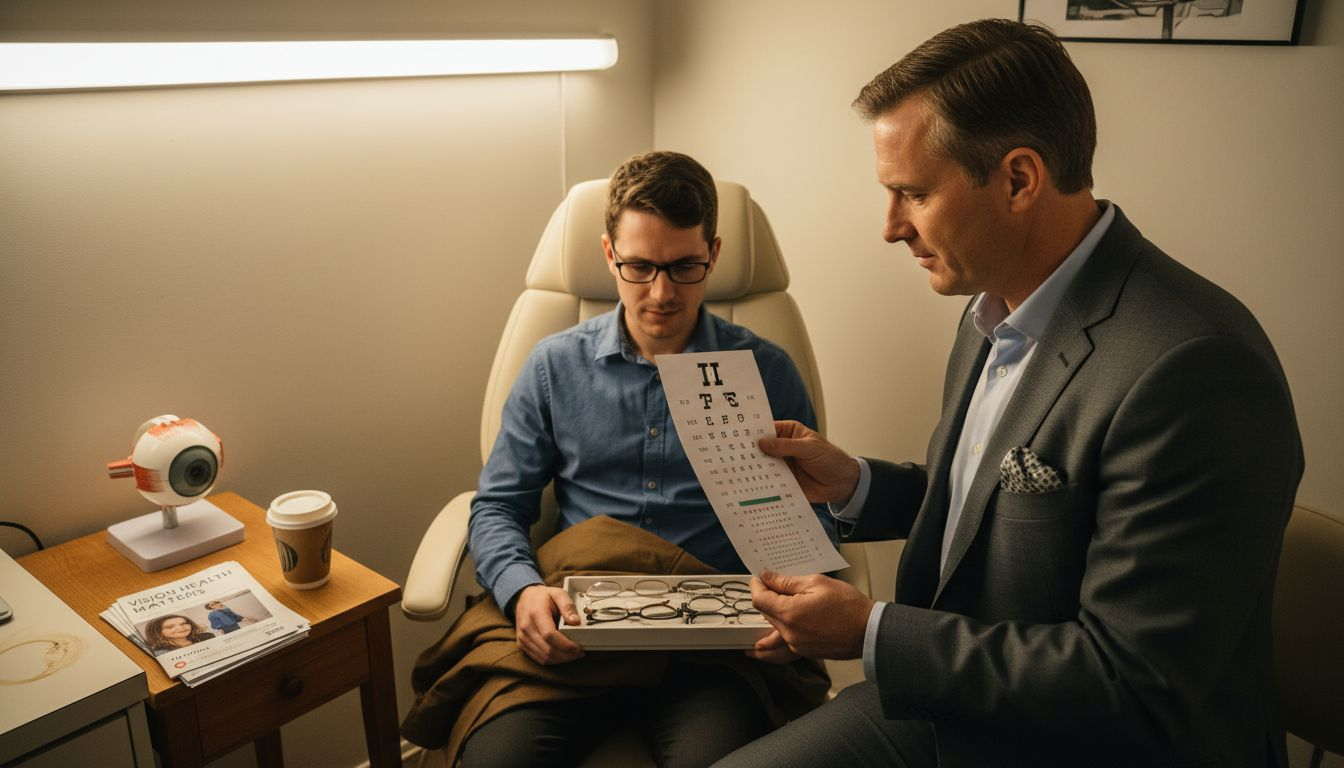
Professional eye examinations remain essential for accurate prescriptions. Optometrists assess not just magnification needs but also check for underlying conditions like cataracts, glaucoma, or macular degeneration. They measure each eye individually, test at multiple distances, and evaluate how your eyes work together.
During professional assessment, your optometrist evaluates anisometropia by comparing the refractive power needed for each eye. They’ll determine if the difference between eyes is significant enough to warrant different lens strengths. Small variations (0.25 to 0.50 diopters) often go unnoticed, whilst larger differences (0.75 diopters or more) benefit from customised prescriptions.
Our choosing lens strengths guide and resources on reading glasses health benefits complement professional advice. Additional research on home vision test accuracy explains limitations of self-testing.
Pro Tip: Wear your new glasses consistently for the first week, even if they feel slightly uncomfortable. Your brain needs time to adapt to the new visual input, and inconsistent use prolongs this adjustment period.
Adapting to glasses with different strengths requires patience. Expect mild discomfort, slight dizziness, or depth perception changes initially. These symptoms typically resolve within one to two weeks as your visual system adjusts. If discomfort persists beyond two weeks, contact your optometrist to verify prescription accuracy.
Common misconceptions about reading glasses strength
Several widespread myths about reading glasses strength lead people to make poor choices that compromise vision quality and comfort.
Myth: Stronger reading glasses improve vision instantly. Many assume that higher magnification automatically delivers better results. Stronger lenses are not always better and can cause eye strain. Over-magnification forces your eyes to work harder, creating headaches, blurred vision, and fatigue. The optimal strength provides clear vision without forcing your visual system.
Myth: Both eyes always need same strength lenses. This misconception ignores the reality of anisometropia, where eyes require different corrections. Using same strength for both eyes is not always correct due to anisometropia. Each eye has unique characteristics, and forcing identical correction compromises visual clarity and comfort.
Myth: Reading glasses prevent vision from worsening naturally. Some people avoid wearing prescribed glasses, fearing dependency or believing glasses accelerate vision decline. Reading glasses simply compensate for presbyopia, they don’t cause or prevent its natural progression. Avoiding proper correction strains your eyes unnecessarily and reduces quality of life.
Ignoring proper lens strength prescription creates multiple problems:
- Persistent headaches from eye strain
- Difficulty concentrating on reading or close work
- Neck and shoulder tension from compensatory posture
- Reduced productivity and enjoyment of hobbies
- Potential safety issues when reading important information
Understanding these realities helps you approach strongest reading glasses explained with accurate expectations. Learn more about symptoms of wrong glasses to recognise when prescriptions need adjustment.
Pro Tip: If you experience persistent discomfort with new reading glasses after two weeks, schedule a follow-up with your optometrist. Prescriptions sometimes need fine-tuning, and early adjustments prevent long-term strain.
Alternatives and comparisons: multifocal and progressive lenses
Beyond single-strength reading glasses, several lens technologies address varied vision needs without juggling multiple pairs.
Single-strength reading glasses provide one magnification level throughout the entire lens. They’re ideal for dedicated reading sessions but require removal for distance viewing. Anisometropic glasses feature different strengths in each lens, correcting unequal vision between eyes whilst maintaining single-task focus.
Progressive lenses incorporate multiple focal zones in one lens, transitioning smoothly from distance vision at the top through intermediate in the middle to near vision at the bottom. Progressive lenses provide smooth transitions between focal lengths, preferred by over 65% of presbyopic patients. These lenses eliminate the visible lines found in traditional bifocals and trifocals.
Users report 30% more convenience and 25% reduced eye strain with customised multi-strength lenses. This data reflects improved comfort from properly matched lens strengths for individual vision needs.
| Lens type | Best for | Adaptation time | Key advantages | Main drawbacks |
|---|---|---|---|---|
| Single-strength | Dedicated reading, one distance | Immediate | Affordable, simple, wide field of view | Must remove for other distances |
| Anisometropic single-strength | Reading with unequal eye strength | 1-2 weeks | Corrects eye differences, clear vision | Still single-distance only |
| Progressive | All distances, active lifestyle | 2-4 weeks | Seamless vision, no line visibility | Higher cost, peripheral distortion initially |
| Bifocal/trifocal | Two or three specific distances | 1-2 weeks | Clear zone separation, moderate cost | Visible lines, image jump |
Progressive lenses suit people who frequently shift between distances: reading, computer work, and distance viewing. They’re particularly valuable for active individuals who dislike constantly swapping glasses. However, progressives require a learning curve. Users must move their heads rather than just their eyes to find the correct focal zone.
Multi-strength single vision glasses work well when you need correction for specific, distinct tasks. Keep one pair for reading, another for computer work, and perhaps a third for hobbies. This approach avoids progressive lens adaptation but requires organising and accessing multiple pairs.
Our best eye glass lens choices resource explores these options comprehensively. More details on progressive lenses benefits help you decide if they match your lifestyle.
Pro Tip: When adapting to progressive lenses, practise moving your head to align the correct lens zone with your viewing target. Point your nose at what you want to see clearly, rather than just moving your eyes.
Practical tips for wearing different strength lenses
Successfully adapting to reading glasses with different strengths requires strategic approaches that ease the transition and maximise comfort.
Allow a one to two week adaptation period for new glasses. Your brain needs time to integrate new visual information and recalibrate depth perception. Wear your glasses consistently during this period rather than switching back to old pairs, as inconsistent use prolongs adjustment.
Strategies to reduce eye strain include:
- Position reading materials at the prescribed distance (typically 35 to 40 centimetres)
- Ensure adequate lighting that illuminates text without creating glare
- Take regular breaks using the 20-20-20 rule: every 20 minutes, look at something 20 feet away for 20 seconds
- Adjust screen brightness and contrast for comfortable computer viewing
- Keep lenses clean, as smudges and dirt force eyes to work harder
When managing multiple pairs for different tasks, establish a system. Keep computer glasses at your desk, reading glasses on your bedside table, and hobby glasses in your craft area. Glasses chains or cords prevent misplacement and allow quick access.
Visual exercises ease adjustment to new lens strengths. Practise focusing on objects at varying distances whilst wearing your glasses. Start with near objects, shift to intermediate distances, then look at distant items. This trains your visual system to adapt smoothly.
Incorrect strength can cause eye strain, headaches, and difficulty focusing within hours of use. If these symptoms persist beyond the initial adaptation period, contact your optometrist. Prescription errors do occur, and minor adjustments can dramatically improve comfort.
Persistent discomfort signals potential issues:
- Prescription may be inaccurate or outdated
- Frames might not fit properly, affecting lens positioning
- Underlying eye conditions may require treatment
- You may need progressive lenses instead of single-strength glasses
Our choosing lens strengths guide offers additional adaptation strategies. Understanding symptoms of wrong glasses helps you recognise when professional consultation is needed.
Pro Tip: Keep a glasses log during your first week with new lenses. Note when discomfort occurs, which activities trigger strain, and how symptoms change daily. This information helps your optometrist make precise adjustments if needed.
Buying reading glasses with different strength lenses in Australia
Australia offers diverse options for purchasing reading glasses with customised lens strengths, from traditional optometrists to online retailers.
The Australian market provides comprehensive eyewear choices. Major optical chains, independent optometrists, and specialised eyewear retailers all stock reading glasses with varying strengths. Many offer on-site lens customisation, allowing different strengths for each eye within the same frame.
Finding optometrists and eyewear retailers offering different strengths is straightforward. Most optical practices can create customised prescriptions with anisometropic corrections. Ask specifically about their ability to produce different lens strengths when booking appointments. Online retailers increasingly offer this service, though in-person fittings ensure better frame selection and positioning.
Key factors when purchasing glasses in Australia include:
- Frame fit: Proper positioning ensures lenses align with your pupils for optimal vision
- Lens quality: Higher-grade materials reduce distortion and improve clarity
- Coating options: Anti-reflective, scratch-resistant, and blue light filtering coatings enhance usability
- Warranty and aftercare: Reputable retailers offer adjustment services and satisfaction guarantees
- Prescription verification: Always provide your current, professionally verified prescription
Trending accessories enhance convenience and protect your investment. Glasses chains prevent loss and keep reading glasses accessible. Storage cases protect lenses from scratches and damage. Cleaning cloths and solutions maintain clarity and extend lens life.
Our choosing lens strengths guide helps Australian readers navigate local options. Explore reading glasses every Australian should own for curated recommendations. The best eye glass lens choices resource explains Australian-specific considerations.
Verifying quality involves checking for optical certifications and Australian Standards compliance. Reputable retailers display credentials and offer professional consultations. Read reviews, ask about return policies, and don’t hesitate to request adjustments if glasses feel uncomfortable.
Whilst exploring eyewear, you might also appreciate specialised products like gray nicolls cricket sunglasses for outdoor activities, demonstrating the breadth of Australian eyewear options.
Explore reading glasses and accessories from ministry of sight
Ministry of Sight offers tailored reading glasses designed for Australian vision needs, including options for different lens strengths in each eye. Their collection addresses presbyopia with stylish frames that don’t compromise on functionality or comfort.
Accessories enhance your eyewear experience significantly. The lens lounge provides organised storage for multiple pairs, keeping your reading, computer, and hobby glasses easily accessible. Browse reading glasses accessories and storage for solutions that protect your investment and simplify daily routines. The interwoven reading glasses chain combines style with practicality, ensuring your glasses stay within reach whilst adding a fashionable touch.
Explore Ministry of Sight’s range to find reading glasses that match your prescription, lifestyle, and personal style. Their Australian-based service ensures prompt delivery, local support, and products suited to our unique needs.
Frequently asked questions
What reading glasses strength do I need for computer use?
Computer screens typically sit 50 to 70 centimetres away, requiring lower magnification than typical reading glasses. Most people benefit from intermediate lens strengths between +1.00 and +1.50 diopters for comfortable computer work. Your optometrist can prescribe specific computer glasses based on your screen distance and vision needs. Learn more about strength reading glasses computer requirements for optimal screen viewing.
Can I use the same strength glasses for both eyes?
Many people have different correction needs for each eye due to anisometropia, where eyes have unequal refractive power. Using identical strength lenses for both eyes may compromise clarity and cause strain if your eyes require different corrections. Professional eye exams determine whether single or differing strengths optimise your vision. Visit our choosing lens strengths guide for detailed information on customised prescriptions.
How long does it take to adjust to different strength reading glasses?
Adjustment typically takes one to two weeks for most users as your brain adapts to new visual input. Gradual wear helps ease the transition, start with short periods and increase duration daily. Proper frame fitting accelerates adaptation by ensuring lenses align correctly with your pupils. Persistent discomfort beyond two weeks warrants an optometrist consultation to verify prescription accuracy. Our choosing lens strengths guide offers additional adaptation strategies.
Are stronger reading glasses better for poor vision?
Stronger lenses aren’t automatically better and can cause significant eye strain if they exceed your actual prescription needs. Over-magnification forces your eyes to work harder, leading to headaches, blurred vision, and discomfort. Optimal lens strength provides clear vision without strain, matching your specific refractive error. Always use professionally prescribed strengths rather than guessing or choosing arbitrarily high magnification. Explore strongest reading glasses explained to understand appropriate strength selection.


